Lepidiolamprologus boulengeri
Formerly Neolamprologus boulengeri
Last revised 2026Edit this page
On this page11 sections
Quick factsEdit
Difficulty4 of 8 measures
- Space
- medium tank
- Water
- flexible
- Temp
- needs a steady temperature
- Diet
- unknown
- Temperament
- territorial
- Social
- unknown
- Compatibility
- unknown
Other demands
Each of these can raise the rating on its own, whatever the measures above say.
- Hardiness
- unknown
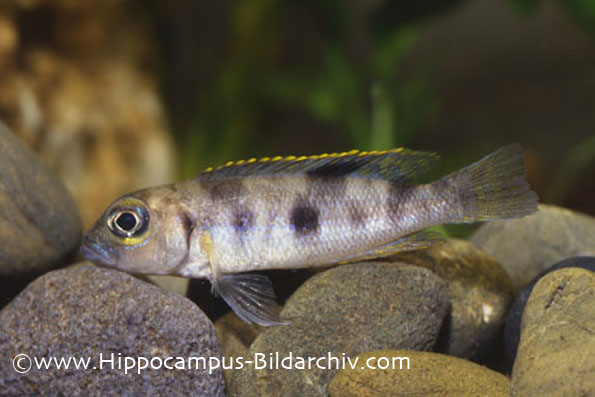
Lepidiolamprologus boulengeri is a small shell-dwelling cichlid endemic to Lake Tanganyika, found along the Tanzanian shoreline in the north of the lake. It lives among scattered rocks and open sand littered with empty snail shells. It is told apart from N. hecqui and Lamprologus kungweensis by the orange border on its dorsal and anal fins, and it will spawn in small caves if no shells are available.
Distribution
EditEndemic to lake Tanganyika. It is found along the Tanzanian shoreline in the north of the lake.
Habitat
Write a noteEditIt is found in areas with scattered rocks and areas of open sand around the shoreline, in areas where the substrate is littered with empty snail shells.
Aquarium size
Write a noteEdit18" x 12" x 12" (45cm x 30cm x 30cm) - 40 litres for a pair, a larger tank is required for a colony.
Maintenance
Write a noteEditThe aquarium should have large open areas of sandy substrate to which should be added a good number of empty snail shells (see breeding section below). More shells should be provided than there are individual fish. The substrate should be at least 2" deep as this species likes to dig. The water must be hard and alkaline.
Water conditions
EditTemperature: 24 – 27 °C75 – 81 °F
pH: 7.5-9.0
Hardness: 8-25°H
Diet
Write a noteEditLive and frozen varieties should form the bulk of the diet, although dried foods are usually accepted.
These recommendations come from this profile’s own figures. They contain affiliate links, so we may earn a commission.
Behaviour and compatibility
Write a noteEditA territorial species that will defend its shell and the small territory around it vigorously. It can be combined with other species that inhabit other areas of the aquarium. Good tankmate choices include small rockdwellers such as Neolamprologus brichardi or smaller species of Julidochromis and open water species such as Cyprichromis. If a number of fish are kept it will form a colony. If keeping it in a colony situation make sure there are enough shells and try to keep more females than there are males. Also worth bearing in mind is that a single male will hold a 12" x 12" territory in nature so adequate space must be provided if more than one male is to be kept.
Sexual dimorphism
Write a noteEditNot easy to sex by physical means, although adult males grow larger than females. The easiest way to tell the sexes apart is by differences in behaviour, as males display almost constantly to females.
Reproduction
Write a noteEditQuite easy. Shell brooder. It may breed in the community aquarium, but if you want to raise a full brood of these fish, a separate aquarium should be used. Set up the aquarium as suggested above. Provide a good number of snail shells in which the females will lay their eggs. Escargot shells are a good choice and can be obtained from most decent delicatessens. Water should be hard and alkaline, with a pH of around 8.0-8.5 and a temperature of 25 – 26.5 °C77 – 80 °F. Allow at least a square foot of territorial space for each male, if there is more than one. Provide 3-4 females for each male as this species spawns in a harem situation. Condition the fish well on a good diet of live and frozen foods.
The male(s) will dig a depression in the centre of their territory, in which several shells are placed. He will then attempt to catch the attention of females by displaying at them, and if he is successful a female will choose one of the shells and proceed to bury it until only the entrance is visible. Several females usually live in a single male's territory and he will spawn with them all. During spawning itself, the female deposits her eggs inside her shell. When she has finished she begins to back out of the shell at which point the male releases his sperm which is either 'sucked' into the shell by the action of the exiting female or fanned in by the male using his fins, thus fertilising the eggs. After fertilisation, the pair become very aggressive towards anything entering the male's territory, with the female guarding the area around the shell and the male patrolling the entire territory. The eggs (up to 60) hatch in around 3 days, becoming free swimming at around the 10 day stage.
The fry are large enough to accept brine shrimp nauplii or microworm once they become free swimming. It is probably better to remove the fry to a separate rearing tank at this stage to ensure the best survival rate. Although the parents do not usually harm them, other fish in the colony may eat them. The fry also tend to leave the protection of the parents more quickly than with most other shell dwelling species.
Notes
EditN. boulengeri can be distinguished from the similar N. hecqui and Lamprologus kungweensis primarily by the orange border on the dorsal and anal fins, although its adult patterning is somewhat different to the other species. Unlike many other shell dwellers, it will spawn in small caves if no shells are made available.
Species images · 1
These photographs are used with each photographer's permission.
Send a photographHow the name has changed
Moved from Neolamprologus boulengeri to Lepidiolamprologus boulengeri.
2015Tanganyika Cichlids in their natural habitat, 3rd edition
Distribution
Profile completeness18 of 24
75% complete
Also missing: aquarium size, a common name, etymology.
Community
Questions about Lepidiolamprologus boulengeri?
Ask on Discord