Mastacembelus erythrotaenia
Fire Eel
Last revised 2026Edit this page
On this page11 sections
Quick factsEdit
Difficulty5 of 8 measures
- Space
- large tank
- Water
- needs a steady pH
- Temp
- needs a steady temperature
- Diet
- unknown
- Temperament
- fights its own kind
- Social
- fine alone
- Compatibility
- unknown
Other demands
Each of these can raise the rating on its own, whatever the measures above say.
- Hardiness
- unknown
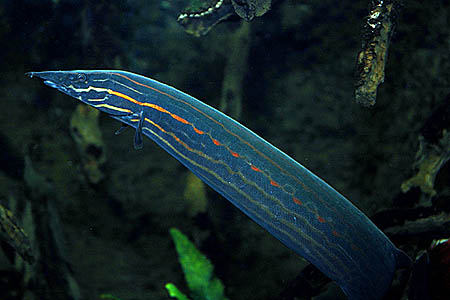
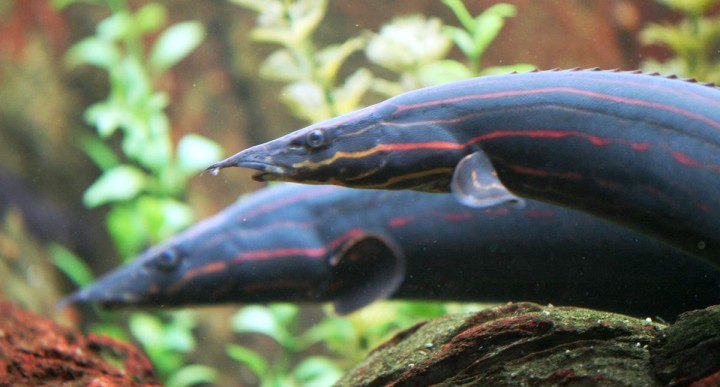
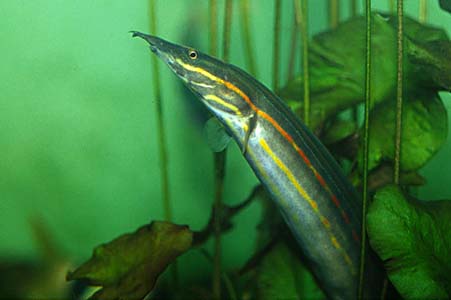
The fire eel, Mastacembelus erythrotaenia, is a spiny eel recorded from Laos, Vietnam, Cambodia, Thailand, Malaysia and Indonesia. It usually inhabits sluggish lowland waters including floodplains and slow-moving rivers, and is also a food fish in its native countries. In the aquarium it hides away during the day and often buries itself, so it needs a sand substrate, plenty of cover and a close-fitting hood.
Distribution
EditHabitat
Write a noteEditUsually inhabits sluggish lowland waters including floodplains and slow-moving rivers.
Aquarium size
Write a noteEdit120 ∗ 60 ∗ 60 cm48 ∗ 24 ∗ 24 in ~432 litres~114 US gal. (Can be kept in smaller tank when juvenile)
Maintenance
Write a noteEditTank should be well planted with floating plants also used. An abundance of hiding places should be provided as this species likes to hide away during the day. Bogwood, rock caves and PVC piping are all suitable for this purpose. Sand should be used as substrate as the spiny eels often like to bury themselves. Dimmer lighting will encourage the fish to venture from its hiding places more often. A close-fitting hood is required as the eel can find its way through the smallest of gaps. Water flow should be fairly gentle as the fish mainly inhabits areas of still water in the wild.
Water conditions
EditTemperature: 24 – 28 °C75 – 82 °F
pH: 6.0 - 7.0
Hardness: 5 - 12°H
These recommendations come from this profile’s own figures. They contain affiliate links, so we may earn a commission.
Diet
Write a noteEditWild fish are omnivorous and consume a variety of smaller fish, aquatic invertebrates, plant matter and detritus. Prefers meaty foods such as prawn, krill, and lancefish. Live and frozen foods can also be fed, however these foods alone are unlikely to be enough to sustain larger fish. Some specimens will also accept vegetable matter, although this is fairly rare.
Behaviour and compatibility
Write a noteEditGenerally peaceful community fish, although care should be taken to ensure tankmates are too large to be considered prey as this species does eat live fish in the wild. It is recommended to only keep one fire eel per tank as they may be aggressive to conspecifics. This can sometimes be avoided by keeping the fish in groups of five or more individuals.
Sexual dimorphism
Write a noteEditFemale is fuller bodied when inbreeding condition.
Reproduction
Write a noteEditHas been occasionally bred in the aquarium but this has been accidental.
Notes
EditA member of the spiny eel family, which range across tropical Asia and Africa, Mastacembelus erythrotaenia is one of the more common species available to the hobby, along with the peacock eel (Macrognathus siamensis)and the tyre-track eel (Mastacembelus favus). These species are all from Asia but there are some members of the family from Africa that are occasionally seen for sale. These majority of these species are from the Afromastacembelus genus, with the most common representative being the Tanganyikan spiny eel (Afromastacembelus tanganicae
The family is named 'spiny eels' due to the presence of spines running along the back of the fish. These are harmless to humans.
The fire eel is also a food fish in its native countries.
Species images · 3
These photographs are used with each photographer’s permission.
Send a photographDistribution
Profile completeness21 of 24
Community
Questions about Mastacembelus erythrotaenia?
Ask on Discord