Microctenopoma fasciolatum
Banded ctenopoma
On this page11 sections
Quick facts
Difficulty4 of 8 measures
More bars, more demanding. Hardiness is not averaged with the rest.
- Space
- modest tank
- Water
- mild adjustment
- Temp
- steady heat
- Diet
- unknown
- Temperament
- territorial
- Social
- unknown
- Compatibility
- unknown
Hardiness on its own can raise the rating, whatever the measures above say.
- Hardiness
- unknown
M. fasciolatum is found in clear water with lots of surface and overhanging vegetation in nature.
Distribution
Habitat
Known from the Congo basin in both the Republic of Congo and Democratic Republic of Congo, as well as a handful of rivers in Cameroon.
Aquarium size
75 ∗ 30 ∗ 30 cm30 ∗ 12 ∗ 12 in
Maintenance
Prefers a densely planted tank with lots of floating cover and stained water. The tank should be well-covered as these fish are great escape artists.
Water conditions
Temperature: 24 – 28 °C75 – 82 °F
pH: 6.5-7.5
Hardness: 4-20 dH
These recommendations come from this profile’s own figures. They contain affiliate links, so we may earn a commission.
Diet
Small live foods and frozen foods. Dried food is rarely taken.
Behaviour and compatibility
Less shy than M. ansorgei this is still quite a slow-moving fish and will easily be out-competed by more boisterous species at feeding time, so is best kept with small, peaceful species that inhabit the upper and lower parts of the tank such as hatchetfish, lampeyes, corydoras and small loricariids. Males are territorial so a larger tank should be provided if several are to be kept together.
Sexual dimorphism
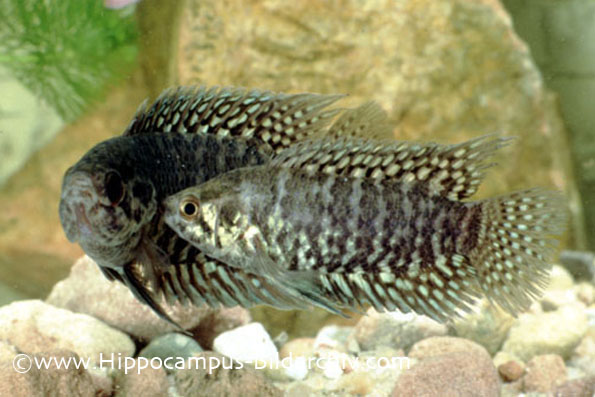
The male has filamentous extensions to the dorsal and anal fins and brighter colouration than the female.
Reproduction
Has been achieved in captivity. Bubblenester. A dimly-lit, well-planted aquarium with lots of floating plants and soft, acidic water is required to spawn these fish. Condition them with live food. The male will build a fairly complex bubblenest amongst floating vegetation or under a broad leaf. Spawning occurs under the nest in a typical anabantoid embrace. The eggs hatch in around 24 hours and become free-swimming in 2-3 days. It is best to remove the parents after hatching. The fry are tiny and should be fed infusoria for the first week, after which they will accept brine shrimp nauplii.
Notes
M. fasciolatum is found in clear water with lots of surface and overhanging vegetation in nature.
Species images · 3
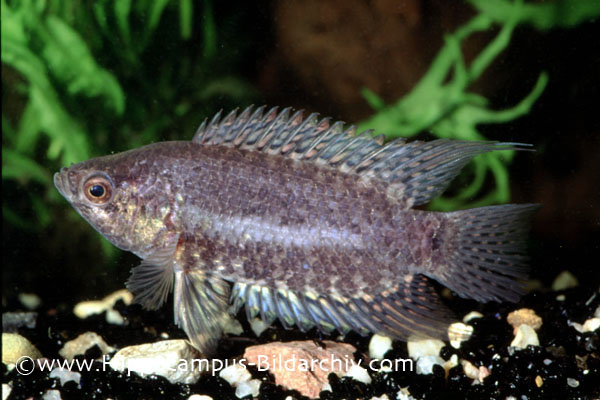
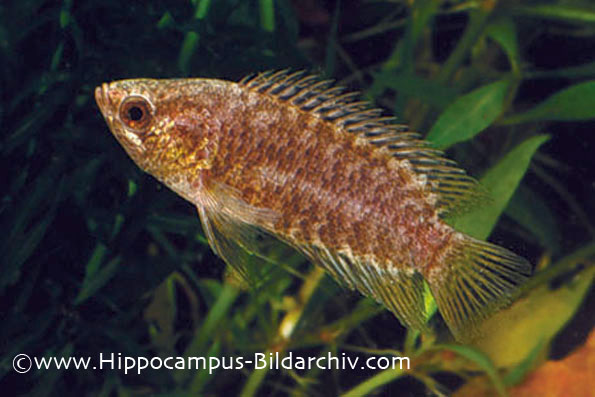
Used with the photographer’s permission. Not licensed for reuse.
Profile completeness18 of 24
75% complete
Also missing: a recorded distribution, taxonomic authority, etymology.
Community
Questions about Microctenopoma fasciolatum?
Ask on Discord