Country · Asia
Philippines
Only species with a profile on Seriously Fish are counted, whether native or introduced.
- Species
- 16
- Families
- 6
- Genera
- 12
- Found only here
- 2
- Photographed
- 16 of 16
Regions here
Shares its fishes withspecies recorded in both
Found only here2
2 of the species on this page are recorded in Philippines and in no other country. This is not the same as being endemic.

Barbodes binotatusSpotted Barb
Cyprinidae · Valenciennes, 1842
The spotted barb, Barbodes binotatus, is a cyprinid ranging from Myanmar and Thailand through the Greater Sunda Islands to the Philippines. So ubiquitous across its range that it's often called simply 'common barb', it occurs from sea level to at least 2000 m in habitats from fast-flowing hill streams to irrigation canals and floodplain ponds. The basic pattern of a dark spot at the dorsal-fin origin and another on the caudal peduncle varies with origin.

Butis amboinensisOlive Flathead Gudgeon
Butidae · Bleeker, 1853
The olive flathead gudgeon, Butis amboinensis, is a nocturnal ambush predator from the eastern Indian Ocean to the West Central Pacific. It inhabits brackish estuaries, lagoons and mangroves, entering tidal freshwater rivers to an extent, and often aligns itself with solid surfaces or swims upside-down. It is occasionally exported as bycatch and differs from congeners in lacking enlarged outer teeth and scales on the cheek. It is territorial and should probably be kept singly.

Butis butisCrazy Fish
Butidae · Hamilton, 1822
The crazy fish, Butis butis, is a flathead gudgeon of coastal and brackish waters across the Indo-Pacific, from eastern Africa to Fiji. The most commonly traded member of the genus, it has many other names, including crocodile fish, duckbill sleeper and upside-down sleeper. A nocturnal ambush predator, it often swims upside-down, and it is territorial and not sociable with conspecifics, so is best kept singly.
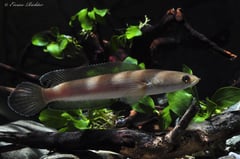
Channa melasomaBlack Snakehead
Channidae · Bleeker, 1851
The black snakehead, Channa melasoma, is a snakehead from southern Thailand, Peninsular Malaysia, Singapore, Borneo, Sumatra and the Philippines. It can be told apart from the similar C. baramensis, once considered a synonym, by lacking a black spot in the centre of many body scales and a barred caudal fin. In nature it appears to favour clear forest streams with mud and leaf litter, but it has also been recorded from acidic blackwater in peat swamp forest.

Cyclocheilichthys armatus
Cyprinidae · Valenciennes, 1842
Cyclocheilichthys armatus is a cyprinid ranging from the Mekong region through Thailand and Peninsular Malaysia to Borneo, Sumatra and Java. It forages from mid-water to the bottom of rivers in the dry season and is thought to migrate into flooded forest to breed. Rarely imported in numbers and most often arriving as bycatch, it makes a peaceful, unusual addition to larger aquaria in a group of at least six.

Gymnothorax tile'Freshwater' Moray Eel
Muraenidae · Hamilton, 1822
The 'freshwater' moray eel, Gymnothorax tile, is a moray from coastal regions of the Indo-West Pacific, from eastern India to the Philippines. Although typically sold as a freshwater fish, this is not strictly the case, and the profile treats a marine salt mix as mandatory. It has small pale spots on a darker head and body, where the congener G. polyuranodon has much larger dark spots on a paler background. Highly piscivorous, it is best kept alone in all but the very largest aquaria.
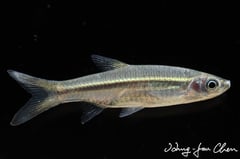
Rasbora argyrotaeniaSilver Rasbora
Cyprinidae · (Bleeker, 1849)
The silver rasbora, Rasbora argyrotaenia, is a cyprinid from Peninsular Malaysia, Singapore, Sumatra, Java, Borneo and the Palawan islands. One of the larger rasboras at up to 140 mm TL, it is a plain, silvery fish with a faint dark stripe, and fish pictured under this name with a bold black stripe are probably a regional variant of R. daniconius. A DNA barcode study found two mitochondrial lineages under the name, and the species as currently recognised is likely to be split.
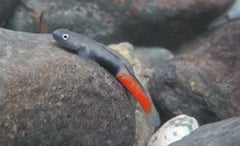
Sicyopus cebuensis
Gobiidae · Chen & Shao, 1998
Sicyopus cebuensis is a stream goby known from the Uling brook in the upper Naga River basin on Cebu, the Philippines. It appears rare in nature, and the type series consisted of a single adult pair. Males have a creamy-yellow front half with a dark midbody blotch and bright orange-red behind. Its complex amphidromous breeding strategy means fry are not raised in aquaria.
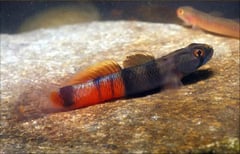
Sicyopus zosterophorus
Gobiidae · Bleeker, 1856
Sicyopus zosterophorus is a stream goby with a patchy but wide range from the Marquesas Islands westwards to Indonesia, Japan and southern China. It is occasionally available in the hobby as the 'flaming arrow goby', 'belted rockclimbing goby' or 'ornate goby', often under the invalid name Sicyopus zosterophorum. It inhabits short coastal streams on tropical islands, typically above waterfalls or cataracts.
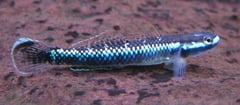
Stiphodon atropurpureusBlue Neon Goby
Gobiidae · Herre, 1927
The blue neon goby, Stiphodon atropurpureus, is a stream-dwelling goby from southern Japan, Taiwan, southern China, the Philippines and Malaysia. It is available occasionally but often under the wrong name, including S. elegans and 'Sumatran blue neon goby', though it is not found on Sumatra. In males the bright blue-green lateral stripe combined with a reddish outer edge to the first dorsal fin is unique within the genus.
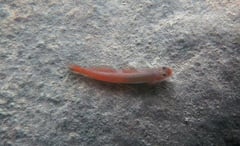
Stiphodon surrufus
Gobiidae · Watson & Kottelat, 1995
Stiphodon surrufus is a small stream-dwelling goby described from Leyte in the Philippines and also reported from Okinawa and Yakushima, Japan. Males are reddish in life and lack elongate spines in the first dorsal fin. It was possibly carried north by the Kuroshio Current, and is less abundant there than congeners such as S. percnopterygionus. Like other Stiphodon it is a specialised algal grazer with an amphidromous life cycle.

Allenbatrachus grunniensFreshwater Toadfish
Batrachoididae · Linnaeus, 1758
The freshwater toadfish, Allenbatrachus grunniens, is a euryhaline toadfish from the Ganges delta in India and Bangladesh east to the Philippines. It is relatively common in the hobby and, contrary to popular belief, not venomous, but its dorsal and opercular spines can pierce the skin, so it needs netting with extreme caution. It rarely does well when kept in freshwater for prolonged periods.

Brachygobius aggregatusSchooling Bumblebee Goby
Gobiidae · Herre, 1940
The schooling bumblebee goby, Brachygobius aggregatus, is a small goby described from the Philippines and recorded from the lower Mekong in Vietnam. The name appears on ornamental trade lists quite often but seems to be routinely misapplied to other species, particularly B. doriae-type fishes. It is very similar to B. kabiliensis, and both are best considered nominal taxa for now since several species might be involved. Small live foods are probably essential.

Ctenopharyngodon idellaGrass Carp
Cyprinidae · Valenciennes, 1844
The grass carp, Ctenopharyngodon idella, is a large cyprinid native to the Amur River system in eastern Russia and northeastern China. Adults typically reach 800 to 1200 mm, making it a wholly unsuitable aquarium subject, though an albino form is traded. Widely introduced for aquaculture and weed control, it has caused serious damage to natural waters, and unwanted fish should never be released.
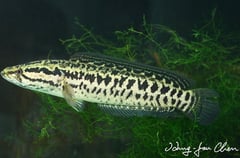
Channa maculataBlotched Snakehead
Channidae · Lacepède, 1801
The blotched snakehead, Channa maculata, is a snakehead from coastal drainages of southeastern China, including Hong Kong, and northern Vietnam. It is frequently confused with C. argus but has fewer fin rays and lateral line scales and carries 2-3 rounded blotches on the caudal peduncle. An important food fish, it has become established in Japan, Taiwan, the Philippines, Madagascar and Hawaii, and hybrids with C. argus appear to be quite common in aquaculture.
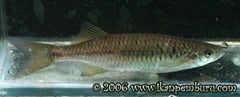
Nematabramis alestes
Cyprinidae · Seale & Bean, 1907
Nematabramis alestes is a cyprinid from the southern Philippines, with records from Basilan, Mindanao, Palawan and Busuanga. The only member of the genus with barbels shorter than the head, its body has a pronounced ventral keel.