Country · Asia
Brunei
Only species with a profile on Seriously Fish are counted, whether native or introduced.
- Species
- 22
- Families
- 10
- Genera
- 18
- Found only here
- 0
- Photographed
- 22 of 22
Regions here
Shares its fishes withspecies recorded in both

Barbodes binotatusSpotted Barb
Cyprinidae · Valenciennes, 1842
The spotted barb, Barbodes binotatus, is a cyprinid ranging from Myanmar and Thailand through the Greater Sunda Islands to the Philippines. So ubiquitous across its range that it's often called simply 'common barb', it occurs from sea level to at least 2000 m in habitats from fast-flowing hill streams to irrigation canals and floodplain ponds. The basic pattern of a dark spot at the dorsal-fin origin and another on the caudal peduncle varies with origin.

Barbonymus schwanefeldiiTinfoil barb
Cyprinidae · Bleeker, 1854
The tinfoil barb, Barbonymus schwanefeldii, is a large cyprinid found across much of Southeast Asia, from the Mekong to Borneo and Sumatra. Usually sold at 50 to 75 mm, it grows to 355 mm SL, and tinfoil barbs are among the species most often returned to shops having outgrown their aquarium. Selectively-bred 'golden' and 'blushing' strains exist, and the species has also been subjected to artificial dyeing.

Betta akarensis
Osphronemidae · Regan, 1910
Betta akarensis is a paternal mouthbrooding labyrinth fish from Borneo, collected in Brunei and the Malaysian state of Sarawak. It lends its name to the Betta akarensis group of closely related species and is considered one of the more widely distributed Bornean Betta. Most are collected from blackwater, though it also lives in clear flowing streams, roadside ditches and larger ponds.

Betta macrostomaBrunei Beauty
Osphronemidae · Regan, 1910
The Brunei beauty, Betta macrostoma, is a large paternal mouthbrooding labyrinth fish endemic to Brunei and the northern tip of Sarawak, Borneo. It grows to 100 mm SL, and males are red with a red patch on the opercle and an ocellus in the dorsal fin. It lives in still, shady pools at the top of rainforest waterfalls. Listed as Vulnerable by the IUCN, it has been banned from export by the Sultan of Brunei.

Butis butisCrazy Fish
Butidae · Hamilton, 1822
The crazy fish, Butis butis, is a flathead gudgeon of coastal and brackish waters across the Indo-Pacific, from eastern Africa to Fiji. The most commonly traded member of the genus, it has many other names, including crocodile fish, duckbill sleeper and upside-down sleeper. A nocturnal ambush predator, it often swims upside-down, and it is territorial and not sociable with conspecifics, so is best kept singly.
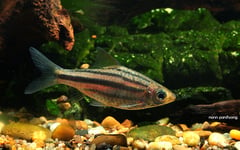
Desmopuntius johorensisStriped Barb
Cyprinidae · Duncker, 1904
The striped barb, Desmopuntius johorensis, is a cyprinid from southern Thailand, Peninsular Malaysia, Singapore, Sumatra and Borneo. Juveniles have 4 dark vertical bars and develop 5 or 6 broad lateral stripes as they grow, a pattern change shared with D. gemellus and D. trifasciatus. Before Kottelat (1992) it was referred to as Puntius eugrammus, while the name 'Puntius johorensis' was misapplied to D. hexazona. It lives mainly in peat swamps and black water streams.
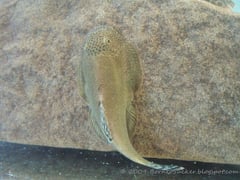
Gastromyzon aeroides
Gastromyzontidae · Tan & Sulaiman, 2006
Gastromyzon aeroides is a hillstream loach endemic to northern Borneo, recorded from western Sabah in Malaysia and the Temburong basin in Brunei. The dorsal, caudal and anal fins are blue in life, and the plain brown body separates it from the other two species in the G. punctulatus group. Like its congeners it needs swift, clean, well-oxygenated water.
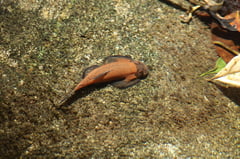
Gastromyzon lepidogaster
Gastromyzontidae · Roberts, 1982
Gastromyzon lepidogaster is a hillstream loach from northern Borneo and the most widely-distributed member of the genus. It occurs in Sabah, Brunei and East Kalimantan. Colour is variable: large adults may be bright green, orange or barred, and can apparently change from barred to plain in a few seconds. It is occasionally available in the trade, where the orange form is particularly sought after.
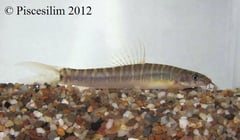
Nemacheilus selangoricus
Nemacheilidae · Duncker, 1904
Nemacheilus selangoricus is a nemacheilid loach ranging from southern Thailand through Peninsular Malaysia and Singapore to western Borneo and Sumatra. It is most common in shallow, flowing forest streams over sand, gravel and detritus. It belongs to the N. selangoricus group and is most similar to N. spiniferus, from which it differs in its 8-12 very regular dark bars on the flanks.

'Puntius' lineatusLined Barb
Cyprinidae · Duncker, 1904
The lined barb, 'Puntius' lineatus, is a laterally-striped cyprinid from Peninsular Malaysia, Sumatra and Borneo, found mostly in peat swamps. It is most often confused with 'P.' johorensis, the two being the most common of the striped species in the trade, but it has no more than one pair of barbels, lacks vertical bars as a juvenile and grows smaller. Its habitats include black water streams stained brown with humic acids, with pH as low as 3.0 or 4.0.
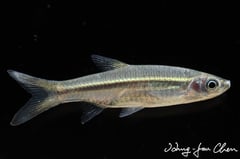
Rasbora argyrotaeniaSilver Rasbora
Cyprinidae · (Bleeker, 1849)
The silver rasbora, Rasbora argyrotaenia, is a cyprinid from Peninsular Malaysia, Singapore, Sumatra, Java, Borneo and the Palawan islands. One of the larger rasboras at up to 140 mm TL, it is a plain, silvery fish with a faint dark stripe, and fish pictured under this name with a bold black stripe are probably a regional variant of R. daniconius. A DNA barcode study found two mitochondrial lineages under the name, and the species as currently recognised is likely to be split.
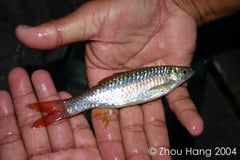
Rasbora tornieri
Cyprinidae · Ahl, 1922
Rasbora tornieri is a cyprinid from Sumatra, Borneo, Peninsular Malaysia and the Mekong drainage in Cambodia. Its identity was unclear for decades before its redescription by Ng and Kottelat (2013). It is very similar to R. dusonensis, which shares the Musi river with it, but its caudal fin is carmine red, against bright yellow in R. dusonensis. It lives in flowing streams and peat swamp blackwaters alike.

Anabas testudineusClimbing Perch
Anabantidae · Bloch, 1792
The climbing perch, Anabas testudineus, is a labyrinth fish found from Pakistan and Sri Lanka east to southern China, Indonesia and Singapore. It lives in almost every kind of lowland water from rice paddies to main river channels, and can cross several hundred metres of land provided it stays moist. Its taxonomy is confused, and additional taxa probably exist. Its size and predatory nature make it unsuitable for the general community.
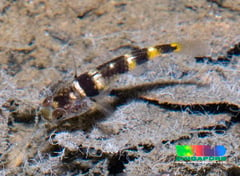
Brachygobius kabiliensisKabili bumblebee goby
Gobiidae · Inger, 1958
The Kabili bumblebee goby, Brachygobius kabiliensis, is a tiny goby described from the Kabili River in Sabah, northeastern Borneo. Its reported range is disjunct, with records from Brunei, Singapore and the lower Mekong in Vietnam and Cambodia. The name is often misapplied to B. doriae-type fishes in the trade. It lives in fresh and brackish lowland coastal habitats and prefers harder water than some congeners. It grows to just 15 to 18 mm.
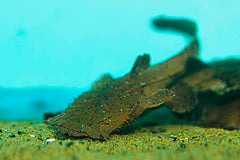
Chaca bankanensisChocolate Frogmouth Catfish
Chacidae · authority not recorded
The chocolate frogmouth catfish, Chaca bankanensis, is an ambush predator from rainforest waters in Malaysia, Indonesia and Brunei. It lies hidden among leaf litter and mulm, using its barbels as a lure to draw prey within reach of its capacious mouth. Very similar to C. chaca, it is darker and redder and lacks the hooklets on the lips and body. Chaca species appear to lower the pH in confined conditions, so water quality needs close attention.
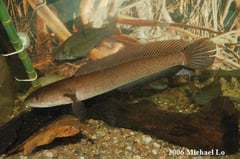
Channa baramensisBaram Snakehead
Channidae · Steindachner, 1901
The Baram snakehead, Channa baramensis, is a snakehead endemic to Borneo, known from Sarawak, western Sabah and Brunei. It was treated as a synonym of C. melasoma until its revalidation by Ng et al. (1996). A black spot in the centre of many body scales and, in fish over 120 mm SL, a barred caudal fin separate it from C. melasoma and the similar C. cyanospilos.

Ctenopharyngodon idellaGrass Carp
Cyprinidae · Valenciennes, 1844
The grass carp, Ctenopharyngodon idella, is a large cyprinid native to the Amur River system in eastern Russia and northeastern China. Adults typically reach 800 to 1200 mm, making it a wholly unsuitable aquarium subject, though an albino form is traded. Widely introduced for aquaculture and weed control, it has caused serious damage to natural waters, and unwanted fish should never be released.

Hampala macrolepidotaHampala Barb
Cyprinidae · Kuhl & van Hasselt, 1823
The hampala barb, Hampala macrolepidota, is a cyprinid ranging from Myanmar through Thailand to the Mekong, and south to Borneo, Sumatra and Java. Also known as 'jungle perch' or 'sidebar barb', it can grow to over 2 feet and 5 kg and is a powerful, pelagic predator and not an aquarium subject in all but the most extreme circumstances. Prized as a food and sport fish, it has been introduced to numerous water bodies.

Phalacronotus apogon
Siluridae · Bleeker, 1851
Phalacronotus apogon is a large silurid catfish from much of Southeast Asia, including Thailand, the Mekong basin and the Greater Sunda Islands. It reaches 700 mm and arguably should not be considered a home aquarium subject at all, but juveniles are sometimes sold as 'blue neon sheatfish' or 'metallic cheatfish' without adequate information on long-term care. It is an important food fish across much of its native range.
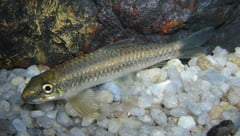
Garra borneensis
Cyprinidae · Vaillant, 1902
Garra borneensis is a cyprinid endemic to northern and western Borneo, in Kalimantan, Brunei, Sabah and Sarawak. No other member of the genus is known from the island. An obligate dweller of swiftly-flowing streams and headwaters, it lives in clear, oxygen-saturated water over gravel, rocks and bedrock carpeted with biofilm.
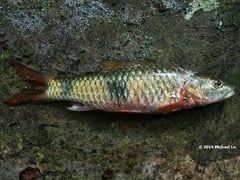
Hampala bimaculata
Cyprinidae · Popta, 1905
Hampala bimaculata is a large riverine cyprinid endemic to Borneo, recorded from Sarawak, Sabah, East Kalimantan and Brunei. Its adult size of up to 500 mm SL more-or-less precludes it as an aquarium fish, and it is poorly known in the ornamental trade. Of the Hampala species with two body blotches, it has saddle-shaped markings, with the anterior blotch beneath the posterior half of the dorsal-fin.
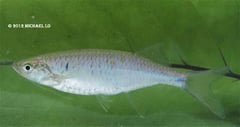
Nematabramis steindachnerii
Cyprinidae · Popta, 1905
Nematabramis steindachnerii is a cyprinid endemic to northern and central Borneo, in Sarawak, Sabah, Brunei and North and East Kalimantan. It has barbels longer than the head but not reaching beyond the pectoral-fin base, and a relatively slender body with a short head.