Platystacus cotylephorus
Banded Banjo Catfish
On this page11 sections
Quick facts
Difficulty4 of 8 measures
More bars, more demanding.
- Space
- large tank
- Water
- tap water
- Temp
- steady heat
- Diet
- unknown
- Temperament
- predatory
- Social
- unknown
- Compatibility
- unknown
Other demands
Each of these can raise the rating on its own, whatever the measures above say.
- Hardiness
- unknown
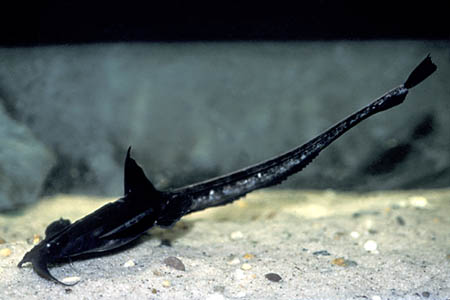
The banded banjo catfish, Platystacus cotylephorus, is an aspredinid catfish from estuarine and coastal waters of northern South America and Trinidad. Largely inactive and secretive, it is camouflaged to resemble a dead leaf and emerges only after dark, often lying buried in muddy substrates of fresh or brackish mangroves. During the spawning season females develop fleshy stalks called cotylephores on the belly, to which the eggs are attached until they hatch.
Distribution
Habitat
Aquarium size
A largely inactive species requiring relatively little space. A tank measuring 120 ∗ 30 ∗ 30 cm48 ∗ 12 ∗ 12 in - ~108 litres~29 US gal is adequate.
Maintenance
Requires plenty of hiding places and dim lighting. Use sand as substrate, as the fish will partially bury themselves during daylight hours. Provide cover in the form of bogwood, branches and smooth rocks. The addition of some non-toxic, dried leaves (beech works well) would replicate the natural environment of the fish. The addtion of salt is not essential, but it can be kept under brackish conditions if you wish.
Water conditions
Temperature: 22 – 25 °C72 – 77 °F
pH: 6.0-8.2, preferably around neutral. It won't do well in very acidic water.
Hardness: 12-30°H
These recommendations come from this profile’s own figures. They contain affiliate links, so we may earn a commission.
Diet
Unfussy but not easily fed due to its sedentary lifestyle. It relishes live and frozen foods such as bloodworm, earthworms etc., as well as sinking dried foods. Add food after lights out to ensure it receives its share.
Behaviour and compatibility
It will eat small fish, but is peaceful with anything too large to be considered food. Tankmates that enjoy similar water conditions should be selected, such as livebearers, Central American cichlids and rainbowfish. In the brackish community it can be kept with archerfish, scats, monos, gobies and chromides. It's very peaceful towards its own kind, and can be kept both singly or in groups.
Sexual dimorphism
Males are darker in colour and more highly patterned than females. When mature, males also develop enlarged pectoral fins.
Reproduction
Not yet fully achieved in aquaria, although the occasional egg-carrying female has been imported, and fry subsequently raised. Thought to spawn in brackish water, although some reports suggest it migrates into freshwater at some stage in the breeding cycle. It has a very interesting form of brood care. During the spawning season females develop a large number of fleshy stalks, known as cotylephores, on their bellies. The eggs are attached to these until they hatch, and it's thought that they may act in a similar way to the umbilical cord in mammals, providing the developing embryos with nutrients or oxygen. This would make sense given the oxygen and nutrient-deprived habitats in which the fish are often found.
Notes
Not a particularly good catfish for the general community tank, as it's a largely inactive, secretive species that will only emerge and become active under cover of darkness. It is, nonetheless, an interesting aquarium subject for the enthusiast, exhibiting an incredible degree of camouflage. It's designed to resemble a dead leaf, and usually will not even swim to escape a net. When released into the aquarium will simply drift in the current until it hits the bottom. All members of the family occasionally shed their skins, although the exact reasons for this aren't known. They also have a novel method of propulsion, taking in water through the mouth and expelling it through the gills to provide thrust.
Species images · 4
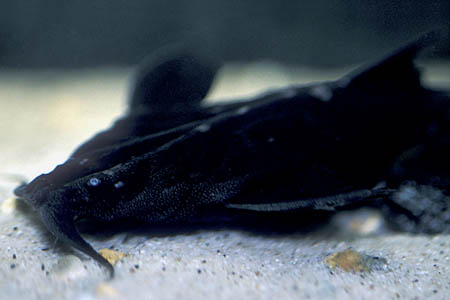
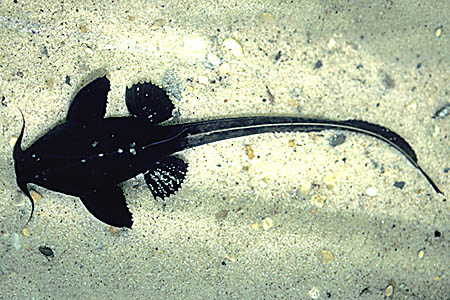
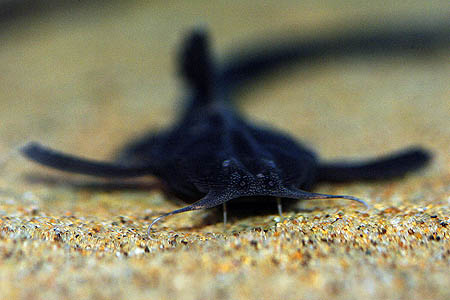
Used with the photographer’s permission. Not licensed for reuse.
Profile completeness18 of 24
75% complete
Also missing: a recorded distribution, taxonomic authority, etymology.
Community
Questions about Platystacus cotylephorus?
Ask on Discord