Protomelas sp. steveni "Taiwan reef"
Last revised 2012
On this page11 sections
Quick facts
Difficulty4 of 8 measures
- Space
- large tank
- Water
- flexible
- Temp
- needs a steady temperature
- Diet
- unknown
- Temperament
- territorial
- Social
- unknown
- Compatibility
- unknown
Other demands
Each of these can raise the rating on its own, whatever the measures above say.
- Hardiness
- unknown
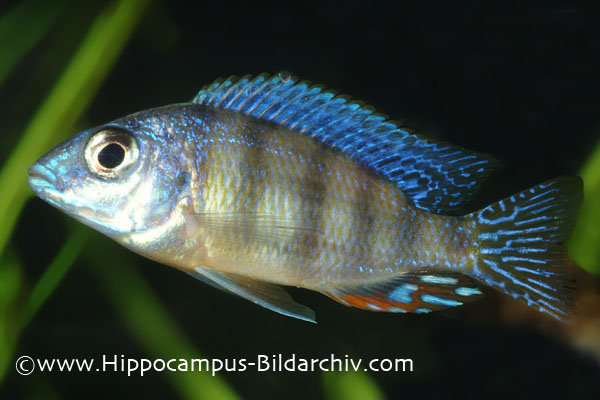
Protomelas sp. 'steveni taiwan reef' is an undescribed cichlid endemic to Lake Malawi, found at Taiwan Reef, Higga Reef and Mbamba Bay Island. Often sold as a subspecies of P. fenestratus, it is thought to be distinct, and adult males are told from P. fenestratus and P. taeniolatus by their bright red anal fin. Males hold territories on flat rock deeper than 20 metres, and in nature these can measure 5 or 6 feet across.
Distribution
Habitat
It stays around the rocky reefs and island shorelines, sometimes moving into the water column to feed on zooplankton. Males form territories on flat rock surfaces at depths greater than 20 metres.
Aquarium size
120 ∗ 45 ∗ 38 cm48 ∗ 18 ∗ 15 in - ~205 litres~54 US gal.
Maintenance
Much of the aquarium should contain piles of rocks arranged to form caves and also large flat surfaces on which males will form territories. If you wish to replicate the natural habitat then the entire tank base should be covered with rockwork. Sand is the best choice of substrate.
Water conditions
Temperature: 24 – 28 °C75 – 82 °F
pH: 7.6-8.8
Hardness: 10-25°H
These recommendations come from this profile’s own figures. They contain affiliate links, so we may earn a commission.
Diet
It will accept most foods offered but live and frozen varieties should form part of the diet. Also ensure the fish recieve some vegetable matter in the form of spirulina flake or similar.
Behaviour and compatibility
A gentle species which is not suited to the boisterous mbuna community, although it does become territorial when breeding. Suitable tankmates include Aulonocara, Copadichromis and other peaceful Malawi species. Males are very territorial and a very large tank would be required to keep more than one as in nature their territories can measure 5 or 6 feet across. It is also better to keep several females per male.
Sexual dimorphism
The male is larger and much more colourful than the female and has extended dorsal, anal and pelvic fins.
Reproduction
Possible. Maternal mouthbrooder. For the best results, it should be spawned in a species tank. Adult fish tend to be quite expensive, so a more feasible option is to start with a group of 6-8 young fish. A 48x15" aquarium is an adequate size and this should be furnished as suggested above. Be sure to provide some areas of open sand and flat rock surfaces to act as potential spawning sites. The pH should be around 8.0-8.5 and the temperature 25 – 26.5 °C77 – 80 °F. Condition the fish on a good diet of live, frozen and dried foods.
When in condition, the male will form a territory containing either a flat rock surface or simply an area of the substrate in which he excavates a pit. He will display around this, showing intense colour and will attempt to entice females to mate with him. He can be quite aggressive in his pursuits and it is in order to dissipate this aggression that this species should be spawned in a harem. If there are other species in the tank, they will not be permitted to enter the male's territory. When a female is willing, she will approach the spawning site and lay her eggs there, allowing the male to fertilise them before taking them into her mouth.
The female carries the eggs for around 3 weeks before releasing the free swimming fry. She will not eat during this period and can be easily spotted by her distended mouth. If a female is overly stressed, she may spit out the brood prematurely or eat them, so care must be taken if you decide to move the fish in order to avoid fry predation. Some breeders artificially strip the fry from the mother's mouth at the 2 week stage and raise them from that point, as this usually results in a larger number of fry. However it must be said, that this method is only for the expert.
The fry will accept newly hatched brine shrimp or microworm immediately after they become free swimming.
Notes
Protomelas sp. "steveni taiwan reef" is often sold as a subspecies of P. fenestratus, but is actually thought not to be synonymous and is currently undescribed. It can be distinguished from similar species such as P. fenestratus and P. taeniolatus by the bright red anal fin of adult males. None of these related species or morphs should be kept together in aquaria as they may hybridise.
Some captive spawns of this species have resulted in albino fry. It is one of the more popular and readily available Protomelas species in the hobby.
Species images · 1
These photographs are used with each photographer’s permission.
Profile completeness17 of 24
71% complete
Also missing: a recorded distribution, taxonomic authority, a common name, etymology.
Community
Questions about Protomelas sp. steveni "Taiwan reef"?
Ask on Discord