Synodontis robbianus
Last revised 2026Edit this page
On this page11 sections
Quick factsEdit
Difficulty4 of 8 measures
- Space
- large tank
- Water
- flexible
- Temp
- needs a steady temperature
- Diet
- unknown
- Temperament
- unknown
- Social
- unknown
- Compatibility
- unknown
Other demands
Each of these can raise the rating on its own, whatever the measures above say.
- Hardiness
- hardy
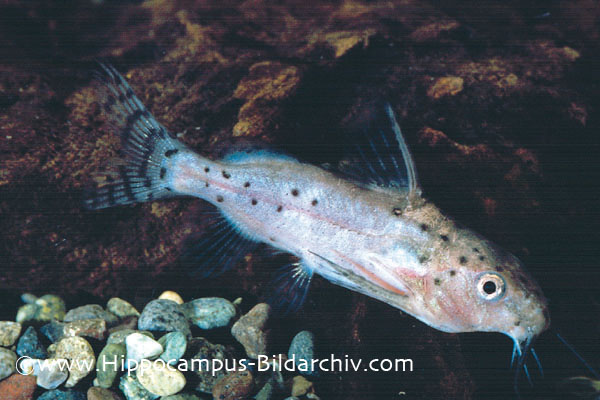
Synodontis robbianus is a Synodontis catfish found only in Nigeria, in the Lower Niger and Cross rivers. It is often confused with the similar but larger S. nigrita, from which its brownish base colour separates it, and it resembles several other Synos when juvenile. A hardy, adaptable species suited to a newcomer to Synodontis, it is not often seen for sale.
Distribution
EditThis species is found only in Nigeria.
Habitat
Write a noteEditAquarium size
Write a noteEdit90 ∗ 30 ∗ 30 cm36 ∗ 12 ∗ 12 in - ~81 litres~21 US gal.
Maintenance
Write a noteEditA dimly lit aquarium with a soft substrate and rocks, pieces of driftwood and twisted roots arranged to form hiding places suits this species. Floating vegetation is also recommended in order to diffuse the light entering the tank. Other planting is beneficial but not essential.
Water conditions
EditTemperature: 22 – 25 °C72 – 77 °F
pH: 6.0-7.5
Hardness: 5-20°H
These recommendations come from this profile’s own figures. They contain affiliate links, so we may earn a commission.
Diet
Write a noteEditSynodontis are omnivorous and are most unfussy in terms of feeding. Frozen, live and dried foods are all accepted. It also relishes vegetable matter in the form of shelled peas, cucumber etc., which it will rasp at with the teeth in its lower jaw.
Behaviour and compatibility
Write a noteEditShould not be kept with any fish so small as to be considered food. Ideal tankmates include Alestiid tetras, robust cichlids (particularly West African species), Mormyrids, Knifefish, Gouramis and larger rasboras and barbs. It tends to become slightly territorial as it matures, especially towards other Synos. However any aggression is usually far less pronounced than in some other members of the genus and it can be maintained in a small group in a suitably sized aquarium provided each fish is given a refuge to call home.
Sexual dimorphism
Write a noteEditThe female is plumper than the male when adult. It is a little too small to be effectively sexed using the genital papillae technique, though it may be possible.
Reproduction
Write a noteEditNot recorded in aquaria. In nature S. robbianus breeds like other riverine Synodontis in areas of seasonal flooding that are rich in micro-organisms. They are egg scatterers and exhibit no parental care.
Notes
EditS. robbianus is often confused with the similar but larger S. nigrita. They can be distinguished by the brownish base colour of this species as opposed to the greyer patterning exhibited by S. nigrita. It is also similar to several other Syno species, especially when juvenile.
A hardy, adaptable species ideal for the newcomer to Synodontis but not often seen for sale.
Species images · 1
These photographs are used with each photographer’s permission.
Send a photographProfile completeness16 of 24
67% complete
Also missing: a recorded distribution, taxonomic authority, a common name, etymology.
Community
Questions about Synodontis robbianus?
Ask on Discord