Hobbyist group · Characiformes
Tetras
Tetras spans 3 families.
- Species
- 106
- Families
- 3
- Genera
- 40
- Photographed
- 97 of 106
- Difficulty rated
- 106 of 106
Families
Where they come fromnative records only

Hyphessobrycon bifasciatusYellow Tetra
Characidae · Ellis, 1911
The yellow tetra, Hyphessobrycon bifasciatus, is a characid from coastal rivers of southeastern Brazil between Espírito Santo and Rio Grande do Sul. It also occurs in parts of the upper Paraná basin, in floodplain tributaries, lakes and streams, usually under forest cover. Two vertically elongate humeral spots, the front one more prominent, help separate it from similar congeners. Generally peaceful, it is best kept as a group of 8-10 or more.

Hyphessobrycon compressusMayan Tetra
Characidae · (Meek, 1904)
The Mayan tetra, Hyphessobrycon compressus, is a characid from southern Mexico, Guatemala and Belize. The type species of the genus Hyphessobrycon, it is not well known in the ornamental trade. Analysis has shown it to be more closely related to 'rosy tetra' species such as H. eques and H. pulchripinnis than to many other members of the genus. It has been collected from rivers, streams, temporal swamps and permanent lakes.

Alestopetersius caudalisYellow-Tailed Congo Tetra
Alestidae · (Boulenger, 1899)
The yellow-tailed Congo tetra, Alestopetersius caudalis, is an alestid from the lower Congo region, recorded upriver as far as the Irebu channel. Also traded as the 'yellow-finned', 'yellowtail' or 'blue Congo' tetra, it is occasionally bred commercially, though not on the scale of its better-known relative Phenacogrammus interruptus. Adult males develop extended median caudal-fin rays, and the narrow dark lateral stripe broadens markedly on the caudal fin.

Aphyocharax anisitsiBloodfin Tetra
Characidae · Eigenmann & Kennedy, 1903
The bloodfin tetra, Aphyocharax anisitsi, is a characid endemic to the Paraná River drainage in Brazil, Paraguay and Argentina. A hardy species that adapts to a wide range of conditions, it can even be kept unheated in a well-insulated house, though it is less colourful in cooler water. Captive specimens over ten years old are not unheard of. It may nip long-finned or slow-moving tankmates, and the tank needs a tight cover as it will jump.

Aphyocharax nattereriDawn Tetra
Characidae · (Steindachner, 1882)
The dawn tetra, Aphyocharax nattereri, is a small characid from southern Brazil, Bolivia and Paraguay. In the hobby it is usually called A. paraguayensis, a name considered a synonym of A. nattereri since 2003. Confusion remains, because the type locality of A. nattereri lies on the main Amazon channel, far from most confirmed localities. It is most often imported as a contaminant among shipments of other species.

Aphyocharax rathbuniGreen Fire Tetra
Characidae · Eigenmann, 1907
The green fire tetra, or Rathbun's bloodfin, Aphyocharax rathbuni, is a characid endemic to the Paraguay, Paraná and Uruguay river drainages. It is found in Brazil, Paraguay, Argentina and Uruguay, in streams and rivers shaded by floating or overhanging vegetation. Although suitable for a community aquarium, it has a reputation as a fin-nipper, and long-finned species such as many cichlids and anabantoids should be avoided as tankmates.

Arnoldichthys spilopterusAfrican Red-eyed Tetra
Alestidae · (Boulenger, 1909)
The African red-eyed tetra, Arnoldichthys spilopterus, is a characin endemic to Nigeria, where it occurs in the Ogun and lower Niger river systems. Also known as the 'large-scaled African characin' or 'Niger tetra', it has large scales compared with most relatives and is hardy once settled. In the wild it is relatively scarce, known from fewer than 10 localities in an area of extensive deforestation and pollution.

Astyanax bimaculatusTwo Spot Astyanax
Characidae · (Linnaeus, 1758)
The two spot astyanax, Astyanax bimaculatus, is a characid ranging from Panama through most of the Amazon and Orinoco basins. It lives in a wide variety of biotopes, from swiftly-flowing rivers and streams to ponds, ditches and reservoirs. The name is currently applied to what is considered a species complex of at least four taxa, and aquarium fish most often arrive as contaminants among shipments of other species.

Astyanax kennedyiKennedy's Tetra
Characidae · Géry, 1964
Kennedy's tetra, Astyanax kennedyi, is a small characid endemic to the upper Amazon basin in Peru, around the city of Iquitos. Like most Astyanax it is rarely offered for sale, and the occasional specimen turns up mixed among shipments of wild fishes from Peru.

Astyanax mexicanusBlind Cave Tetra
Characidae · (De Filippi, 1853)
The blind cave tetra, Astyanax mexicanus, is a characid found from Texas and New Mexico in the southern United States through Mexico into Guatemala. The eyeless, troglomorphic form lives only in underground caves in Mexico and is produced in huge numbers on Far Eastern farms, while the surface form is rarely seen in the hobby. The two may have diverged within the last 10,000 years, and the blind form finds its way with its lateral line.
Bario oligolepisGlass Tetra
Characidae · authority not recorded
The glass tetra, Bario oligolepis, is a characin from northern South America, with populations in Venezuela, the Guianas, Peru and Brazil. One of a handful of species that closely resemble the red-eye tetra, it is seen much less often in the hobby and is also known as the glassy tetra. It inhabits slow-moving rivers, tributaries and floodplain lakes. Very peaceful, it does not compete well with boisterous or much larger tankmates.

Brachychalcinus orbicularisDiscus Tetra
Characidae · (Valenciennes, 1850)
The discus tetra, Brachychalcinus orbicularis, is a deep-bodied characid generally considered endemic to coastal watersheds of Guyana and Suriname. Recent records suggest it, or a similar congener, may also occur in the Orinoco and Negro drainages. The genus is often referred to collectively as 'silver dollar tetras', and although B. orbicularis is normally said to be the species in the trade, identification is challenging.

Chalceus macrolepidotusPink-tailed Chalceus
Characidae · authority not recorded
The pink-tailed chalceus, Chalceus macrolepidotus, is a large characin found throughout northern South America, from Colombia to French Guiana. It inhabits the surface layers of highly oxygenated rivers. Its very large scales tend to fall off during transport, so new imports can be delicate, though once acclimatised it usually proves fairly hardy. It does best singly or in a group of more than six, since smaller groups tend to scrap.

Gymnocorymbus bondiSilver Tetra
Characidae · authority not recorded
The silver tetra, Gymnocorymbus bondi, is a characid from the Rio Orinoco basin in Colombia and Venezuela. It inhabits small tributaries, streams and creeks. Juveniles have reddish unpaired fins that fade as they mature, and the fairly bland adults are not often seen in the hobby. Peaceful and hardy, it is sometimes labelled G. socolofi, a name now considered a junior synonym of G. bondi.

Hasemania nanaSilvertip Tetra
Characidae · authority not recorded
The silvertip tetra, Hasemania nana, is a characid from the Rio São Francisco basin in Brazil. It inhabits creeks and tributaries away from the main river channels. Hasemania is one of the few characid genera whose members lack an adipose fin. All the fish in the trade are captive bred and unfussy about water chemistry and diet, and it is sometimes sold as the 'copper tetra'.
Hemigrammus barrigonaeBarrigona Tetra
Characidae · authority not recorded
The barrigona tetra, Hemigrammus barrigonae, is a small characin from the Rio Meta and Orinoco basins in Colombia and Venezuela. It inhabits slow-moving rivers and tributaries. Not a common species in the hobby, it occasionally shows up as a contaminant among imports of more popular species. Like all Hemigrammus, its taxonomic status is Incertae Sedis, and most experts agree the genus needs a full revision.
Hemigrammus boesemaniBoesman's Tetra
Characidae · authority not recorded
Boesman's tetra, Hemigrammus boesemani, is a small characin officially recorded from Suriname, French Guiana and Peru. It favours sluggish and still waters. Very rare in the hobby, it was once considered a subspecies of H. micropterus. The recorded range suggests it has been misidentified in at least one of these countries or occurs in others as well.
Hemigrammus levis
Characidae · authority not recorded
Hemigrammus levis is a small characin native to the Brazilian Amazon, found in slow-moving rivers, tributaries and floodplain lakes. A rather rare fish in the UK hobby, it occasionally shows up as a contaminant among imports of more popular species. Like all Hemigrammus, its taxonomic status is Incertae Sedis, and most experts agree the genus needs a full revision.

Hemigrammus rodwayiGolden Tetra
Characidae · authority not recorded
The golden tetra, Hemigrammus rodwayi, is a small characin native to Guyana, Suriname, French Guiana, Peru and Brazil. Its normal colour is a rather dull silvery grey. In some areas wild fish react to a trematode parasite with metallic gold deposits of guanin in the skin, and these were once described as a separate species, H. armstrongi. Captive-bred fish are not exposed to the parasite, so most 'golden tetras' on sale lack the gold colour.

Hemigrammus stictusRed-base Tetra
Characidae · authority not recorded
The red-base tetra, Hemigrammus stictus, is a small characin from Venezuela, Guyana and Brazil. It inhabits slow-moving rivers, tributaries and floodplain lakes. Not often seen for sale, it occasionally shows up as a contaminant among imports of more popular species. Like all Hemigrammus, its taxonomic status is Incertae Sedis, and most experts agree the genus needs a full revision.

Hemigrammus unilineatusFeatherfin Tetra
Characidae · authority not recorded
The featherfin tetra, Hemigrammus unilineatus, is a small characin widespread across northern South America, from Venezuela to Peru and Brazil. Despite its abundance in nature it is not commonly seen in the hobby, and usually turns up only as a contaminant among imports of other species. A very peaceful shoaling fish, it inhabits slow-moving rivers, tributaries, oxbow lakes and ditches, some clear and others murky with sediment.
Hemigrammus vorderwinkleri
Characidae · authority not recorded
Hemigrammus vorderwinkleri is a small tetra known only from the Rio Negro in Brazil, where it inhabits blackwater rivers and tributaries. It is most likely to be seen as a contaminant among imports of other species. A very peaceful shoaling fish growing to around 40 mm SL, it suits a blackwater biotope or a heavily planted tank, since fish on sale will almost certainly be wild caught.

Holopristis ocelliferaHead-and-tail light Tetra
Characidae · authority not recorded
The head-and-tail light tetra, Holopristis ocellifera, is a small characin from Guyana, Suriname, French Guiana, Peru and Brazil. Also known as the beacon tetra, it is hardy, inexpensive and one of the best choices for a newcomer to fishkeeping. Wild fish are rarely offered, since it is commercially bred in huge numbers for the trade, and a selectively bred albino form is also available.

Hyphessobrycon agulha
Characidae · Fowler, 1913
Hyphessobrycon agulha is a small tetra known with certainty only from the rio Madeira system in the Amazon basin of Brazil, Peru and Bolivia. Relatively rare in the hobby, it is occasionally traded as the 'red-tailed flag tetra'. It lends its name to a group of closely-related species with a dark lower half of the body, especially above the anal fin, and it is very peaceful.

Hyphessobrycon amandaeEmber Tetra
Characidae · Géry & Uj, 1987
The ember tetra, Hyphessobrycon amandae, is a tiny characid from the rio das Mortes, a tributary of the Araguaia in Mato Grosso, Brazil. Also traded as the 'Amanda's', 'dwarf red', 'red' and 'fire' tetra, it grows to around 20 mm SL. Very peaceful and gregarious, it makes a good dither fish for Apistogramma and other dwarf cichlids and spawns often in a mature aquarium.

Hyphessobrycon amapaensisAmapá Tetra
Characidae · Zarske & Géry, 1998
The Amapá tetra, Hyphessobrycon amapaensis, is a small characid from the rio Preto and rio Maraca drainages in Amapá state, northeastern Brazil. Also known as the 'red line' or 'scarlet' tetra, it is very similar to the flag tetra, H. heterorhabdus, but has a broader red stripe and a white or creamy central stripe. It comes from clear, light brown savanna streams over sand and gravel.

Hyphessobrycon anisitsiBuenos Aires Tetra
Characidae · (Eigenmann, 1907)
The Buenos Aires tetra, Hyphessobrycon anisitsi, is a characid from the Paraná and Uruguay river systems in Brazil, Paraguay, Argentina and Uruguay. A popular and hardy aquarium fish, it is also available as a line-bred albino strain, sometimes traded as 'golden'. It has a reputation for fin-nipping, though mostly when too few are kept or space is limited, and a group of at least 8-10 is the minimum.

Hyphessobrycon columbianusColombian Tetra
Characidae · Zarske & Géry, 2002
The Colombian tetra, Hyphessobrycon columbianus, is a characid that appears to be known only from the Río Acandí in Chocó, northern Colombia. It is also traded as 'blue flame', 'blue-red' and 'Colombian red fin' tetra, and was misidentified as H. ecuadorensis for several years before it was described. Both sexes are silver with iridescent blue in the upper body and bright blood red caudal and anal fins.

Hyphessobrycon herbertaxelrodiBlack Neon Tetra
Characidae · Géry, 1961
The black neon tetra, Hyphessobrycon herbertaxelrodi, is a characid from the upper rio Paraguai in Mato Grosso and Mato Grosso do Sul, Brazil. A ubiquitous aquarium fish since its discovery, it is produced commercially in several countries, so wild fish are no longer collected. It is widespread north and south of the Pantanal, favouring minor tributaries, headwater rivers, oxbows and seasonal floodplains.

Hyphessobrycon heterorhabdusFlag Tetra
Characidae · (Ulrey, 1894)
The flag tetra, Hyphessobrycon heterorhabdus, is a characid from Pará and Maranhão states in eastern Brazil, also known as 'Belgian flag tetra'. Its name has been misapplied to similar fishes across much of the Amazon, the Orinoco and the Guianas, and the true species may reach no further upstream than the rio Tapajós. It lives almost exclusively in small, shaded forest streams called igarapés.

Hyphessobrycon loretoensisLoreto Tetra
Characidae · Ladiges, 1938
The Loreto tetra, Hyphessobrycon loretoensis, is a small characid from the upper Amazon basin in Colombia, Peru and Ecuador. It is relatively popular in the hobby, but most traded fish are wild-caught, so availability can be sporadic. Most records are from forest streams and minor tributaries with tea-coloured water, overhanging vegetation and leaf litter.

Hyphessobrycon melanostichosBlack Stripe Tetra
Characidae · Carvalho & Bertaco, 2006
The black stripe tetra, Hyphessobrycon melanostichos, is a characid endemic to the Rio Doze de Outubro in the upper Rio Tapajos basin, Brazil. It shares a number of similarities with Hyphessobrycon sp. 'Blue Ribbon' but has a lighter, more streamlined body, a smaller humeral spot and red colouring. It can become territorial in small tanks, but a group of 10 or more should prevent problems.

Hyphessobrycon metaePurple Tetra
Characidae · Eigenmann & Henn, 1914
The purple tetra, Hyphessobrycon metae, is a characid endemic to the middle Río Orinoco watershed in Colombia and Venezuela. Also known as 'Río Meta tetra', it is often misidentified, and H. peruvianus has repeatedly appeared under its name. The dark band on the caudal peduncle, without a broad dark band along the lower body, separates it from H. peruvianus and H. loretoensis.

Hyphessobrycon pulchripinnisLemon Tetra
Characidae · Ahl, 1937
The lemon tetra, Hyphessobrycon pulchripinnis, is a characid from central Brazil, mostly recorded from the rio Tapajós basin. It is bred commercially in several countries, but the origin of the aquarium strain is questionable. Fish identical to it have been photographed in the lower Xingu, while a related 'orange red' form from the Tapajós may not be the same species.

Hyphessobrycon roseusYellow Phantom Tetra
Characidae · (Géry, 1960)
The yellow phantom tetra, Hyphessobrycon roseus, is a small characid from Suriname, French Guiana and the Brazilian bank of the Oyapock/Oiapoque. Although popular in the hobby, its identity is somewhat confused, and two colour forms have been traded. It inhabits forest tributaries and igarapés with acidic, brownish water, sandy substrates and leaf litter.

Hyphessobrycon simulatusFalse X-ray Tetra
Characidae · (Géry, 1960)
The false x-ray tetra, Hyphessobrycon simulatus, is a characid endemic to French Guiana, from the Maroni to the Oyapock/Oiapoque river basins. Uncommon in the trade, it was originally described in the genus Pseudopristella. It is told from Pristella maxillaris by a larger humeral spot and black in the anal fin limited to the first ray.

Hyphessobrycon stegemanniSavanna Tetra
Characidae · Géry, 1961
The savanna tetra, Hyphessobrycon stegemanni, is a characid from the middle rio Tocantins and rio Araguaia basins in central Brazil. In the hobby its name has often been misapplied to Hemigrammus ataktos, since both occur in the Tocantins and have a dark lateral stripe. Its range lies almost entirely in the cerrado, the tropical wooded grassland of central Brazil.

Hyphessobrycon vilmae
Characidae · Géry, 1966
Hyphessobrycon vilmae is a small characid that appears to be endemic to the upper rio Tapajós basin in Amazonas and Mato Grosso states, Brazil. It is occasionally traded as 'chocolate neon tetra', and has a continuous, solid dark lateral stripe with no obvious humeral blotch. Generally peaceful, it is best kept in a mixed-sex group of at least 8-10.

Inpaichthys kerriPurple Emperor Tetra
Characidae · authority not recorded
The purple emperor tetra, Inpaichthys kerri, is a small characin from the Rio Aripuanã and upper Rio Madeira basins in Brazil. Also sold as the 'blue emperor', 'regal' or 'royal' tetra, it is sometimes confused with the emperor tetra, Nematobrycon palmeri, but can be told apart by its adipose fin (absent in Nematobrycon). It lives in sluggish, tannin-stained forest tributaries and has been spawned regularly in the hobby.

Makunaima pittieriDiamond Tetra
Characidae · authority not recorded
The diamond tetra, Makunaima pittieri, is a characid endemic to Lake Valencia and surrounding waters in Venezuela. It is usually sold as a fairly bland, silvery juvenile, and given time and a good diet develops into an adult that sparkles like a diamond. It is found in shallow, vegetated parts of the lake and slow-moving tributaries, but most fish in the trade are mass-bred on commercial farms in Eastern Europe or the Far East.

Megalamphodus equesSerpae Tetra
Characidae · (Steindachner, 1882)
The serpae tetra, Megalamphodus eques, is a characid with an enormous range through much of the Amazon drainage and the Río Paraguay. Very common in the trade, it is also sold as the 'jewel', 'red minor', 'blood' or 'callistus' tetra, and ornamental strains include 'long-finned' and 'balloon' forms. It has a reputation for nipping the fins of tankmates, although this is most pronounced when too few are kept or space is limited.

Megalamphodus haraldschultziCrystal Red Tetra
Characidae · (Travassos, 1960)
The crystal red tetra, Megalamphodus haraldschultzi, is a small characid endemic to the rio Araguaia system in Brazil. It is occasionally available, usually as bycatch among shipments of other fishes, and is sometimes traded as 'Araguaia red' or 'Schultz's tetra'. It is most easily separated from the similar Megalamphodus eques by the dorsal-fin marking, which is less extensive and bordered above by a white blotch and below by a yellowish band.

Megalamphodus megalopterusBlack Phantom Tetra
Characidae · Eigenmann, 1915
The black phantom tetra, Megalamphodus megalopterus, is a characid from the upper rio Madeira and upper rio Paraguai in Bolivia and Brazil. Most records are from the rio Guaporé (Río Iténez in Bolivia). Popular in the hobby and bred commercially in several countries, it is also available as a 'long-finned' strain. Adult males have black fins with the pelvic, dorsal and anal enlarged, while females are deeper-bodied with reddish pelvic, anal and adipose fins.

Megalamphodus rosaceusRosy Tetra
Characidae · (Durbin, 1909)
The rosy tetra, Megalamphodus rosaceus, is a small characid from Guyana, Suriname and Brazil, in river systems including the Essequibo and Corantijn. It is so similar to Megalamphodus bentosi that it was once considered a subspecies of it, and is most easily told apart by lacking the dark marking just behind the operculum. The vast majority of fish in the trade are mass bred on commercial farms.

Megalamphodus sweglesiRed Phantom Tetra
Characidae · Géry, 1961
The red phantom tetra, Megalamphodus sweglesi, is a small characid endemic to the upper and middle Río Orinoco watershed in Colombia and Venezuela. It apparently favours minor tributaries, oxbows and flooded forests, and in Venezuela is often found in morichals. Bred commercially in several countries, it has been traded in more than one colour form, and Zarske (2014) concluded that the particularly red form sold as 'red' or 'var. rubra' is conspecific.

Nematobrycon lacorteiRainbow Tetra
Characidae · Weitzman & Fink, 1971
The rainbow tetra, Nematobrycon lacortei, is a small characid from western Colombia, considered endemic to the Río San Juan system. All records appear to come from the Río Calima, where it is apparently restricted to small, isolated forest pools. It is very close to N. palmeri in morphology but has a highly distinctive colour pattern, and adult males are territorial to an extent.

Paracheirodon axelrodiCardinal Tetra
Characidae · (Schultz, 1956)
The cardinal tetra, Paracheirodon axelrodi, is a small characid from the rio Negro and Orinoco drainages of Brazil, Colombia and Venezuela. Immensely popular in the hobby, it is now commercially bred on a large scale, but a significant proportion of trade fish are still wild caught or come from community-led projects such as Project Piaba. Rio Negro and Orinoco populations differ in colour pattern, and wild fish are less tolerant of deteriorating water conditions than commercially-produced ones.

Paracheirodon innesiNeon Tetra
Characidae · (Myers, 1936)
The neon tetra, Paracheirodon innesi, is a small characid from the Amazon basin in Colombia, Brazil and Peru, found in acidic forest streams. Years of commercial breeding have weakened the ornamental strain, and defects and ill-health are widespread, so stock needs choosing with care. Neons are also susceptible to 'neon tetra disease', a microsporidian infection that is virtually untreatable once advanced.

Phenacogaster tegatus
Characidae · (Eigenmann, 1911)
Phenacogaster tegatus is a small characid from the upper rio Paraguay basin in Brazil and Paraguay and the Río Paraná in northeastern Argentina. It has been traded as 'six-eyed tetra', in reference to the two dark spots on each flank plus the eye. Peaceful but somewhat unsuitable for the general community aquarium, it is best kept in a group of at least 8-10 alongside similarly-sized characids and other small, non-predatory fishes.
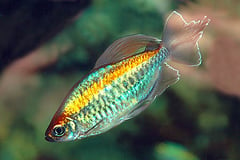
Phenacogrammus interruptusCongo Tetra
Alestidae · authority not recorded
The Congo tetra, Phenacogrammus interruptus, is a tetra from parts of the River Congo drainage in the Democratic Republic of Congo. Wild populations are endemic there, but most fish in the trade are bred commercially in the Far East and Eastern Europe. Usually sold as a drab, greyish juvenile, it colours up as it matures, and males develop extended caudal filaments and a greatly extended dorsal fin. It is sensitive to water quality and easily frightened when not kept in numbers.

Piabucus dentatusPiabuco Tetra
Characidae · authority not recorded
The piabuco tetra, Piabucus dentatus, is a large tetra from coastal waters of northern South America, from Venezuela to the mouth of the Amazon. A pelagic species of estuaries and floodplain streams, it is often found in turbid, silt-laden water and sometimes in brackish conditions, and reaches 13 cm SL. Oddly for a tetra it will also eat red, filamentous 'black brush' algae. All three species in the genus are rarely seen in the hobby.

Pristella maxillarisX-ray Tetra
Characidae · (Ulrey, 1894)
The X-ray tetra, Pristella maxillaris, is a small characid native to coastal waters of Venezuela, Guyana, Suriname, French Guiana and northern Brazil. In the dry season it lives in clearwater streams, moving into flooded savannah to spawn when the rains come. Peaceful, hardy and inexpensive, it is commercially bred in huge numbers, and a semi-albino 'golden' strain exists. The only species in the genus, it appears in older literature as Pristella riddlei.

Triportheus angulatusDusky Narrow Hatchetfish
Characidae · authority not recorded
The dusky narrow hatchetfish, Triportheus angulatus, is a characin from Ecuador, Venezuela, Peru, Brazil, Bolivia and Argentina. Common in many native habitats, where it is known as sardina, it is not often seen in the hobby. Very strong pectoral muscles let it leap several metres from the water to catch flying insects, and it should always be kept in a group.

Petitella bleheriFirehead Tetra
Characidae · authority not recorded
The firehead tetra, Hemigrammus bleheri, is a characin from blackwater rivers of the Rio Meta and Rio Negro in Colombia and Brazil. Most fish sold as the 'rummy-nose tetra' are this species. Of the three look-alikes, with H. rhodostomus and Petitella georgiae, only H. bleheri has red extending beyond the gill covers, although the red fades in fish in poor condition. Bittencourt et al. (2020) proposed moving it to Petitella. It should be kept in groups of 10 or more.

Petitella georgiaeFalse Rummy-nose
Characidae · authority not recorded
The false rummy-nose, Petitella georgiae, is a small tetra from the Rio Purus in Peru and Brazil and the Rio Negro and Rio Madeira in Brazil. This is one of three very similar species commonly sold as 'rummy-nose tetra', and the lack of a dark blotch at the bottom of the caudal peduncle is one way to separate it from the other two. One of the more tightly shoaling small tetras, it needs a group of at least ten.

Petitella rhodostomaRummy-nose tetra
Characidae · authority not recorded
The rummy-nose tetra, Hemigrammus rhodostomus, is a characin from blackwater rivers of the Rio Orinoco and lower Amazon basin in Venezuela and Brazil. This is the 'real' rummy-nose. Most fish sold under the name are the firehead tetra, H. bleheri, and the 'false' rummy-nose, Petitella georgiae, is also very similar. The head colour, the caudal peduncle blotches and the line from the central caudal band separate the three. Bittencourt et al. (2020) proposed moving it to Petitella.

Thayeria boehlkeiFalse Penguin Tetra
Characidae · authority not recorded
The false penguin tetra, Thayeria boehlkei, is a characin probably restricted to the upper Amazon in Peru and the Rio Araguaia in Brazil. By far the most popular Thayeria in the hobby, it is usually sold as the penguin tetra, a name first given to T. obliqua. Its thick black stripe runs from the lower caudal lobe along the body to the opercle. A schooling species, it should be kept in a group of at least six.
Thayeria ifatiHalf-striped Penguin Tetra
Characidae · authority not recorded
The half-striped penguin tetra, Thayeria ifati, is a characin that appears to be endemic to the rivers Maroni and Approuague in French Guiana. Of the three Thayeria, T. ifati is the least often seen in the hobby. In this species the black stripe is confined to the upper part of the lower caudal lobe, and the dorsal and anal fins develop red tips in good condition. Like its congeners, it swims in an oblique, head-up style.

Thayeria obliquaPenguin Tetra
Characidae · authority not recorded
The penguin tetra, Thayeria obliqua, is a characin from the central Amazon and Rio Tocantins basins and the Rio Guaporé in Brazil. The type species of the genus, it was the original penguin tetra, though T. boehlkei is now usually sold under that name. In T. obliqua the black caudal stripe tapers upwards and fades before reaching the dorsal fin. It should be kept in a group of at least six.

Hyphessobrycon acaciae
Characidae · García-Alzate, Román-Valencia & Prada-Pedreros, 2010
Hyphessobrycon acaciae is a small tetra known only from streams in the middle and upper Río Guamal, part of the Río Meta system in Colombia. The dark lateral band separates it from most Hyphessobrycon in the Orinoco basin, and it is told from the remaining few by counts of fin rays, teeth and scales. The Guamal drains into the upper Meta, which flows into the Río Orinoco.

Hyphessobrycon auca
Characidae · Almirón, Casciotta, Bechara & Ruíz Díaz, 2004
Hyphessobrycon auca is a small characid known only from two ponds in the Esteros del Iberá wetlands of Corrientes province, northern Argentina. The ponds lie on a sand bar deposited by the Paraná during the Pleistocene and hold soft, mildly acidic, rain-fed water. It looks very similar to H. anisitsi and is told apart by its dentition and by the small hooks on the fins of males.

Hyphessobrycon balbus
Characidae · Myers, 1927
Hyphessobrycon balbus is a small characid known only from upper Paraná basin headwaters in the Federal District and Goiás, central Brazil. Most records come from the rio São Bartolomeu, including the Bananal, Santa Maria-Torto and Gama tributary systems.

Hyphessobrycon borealis
Characidae · Zarske, Le Bail & Géry, 2006
Hyphessobrycon borealis is a small characid from French Guiana, recorded from the Oyapock/Oiapoque to the Maroni river systems. It inhabits shallow marginal zones with little current, where it forms large schools. The largest recorded specimen measured 27.8 mm, and the species lacks a humeral spot but has an oval spot on the caudal peduncle.

Hyphessobrycon brumado
Characidae · Zanata & Camelier, 2010
Hyphessobrycon brumado is a small characid known only from the rio Brumado, part of the coastal rio de Contas drainage in Bahia state, eastern Brazil. It was collected from moderately-flowing streams at 971-1048 m with rock and sand substrates. It superficially resembles the silver-tipped tetra, Hasemania nana, but has an adipose fin, and a broad black lateral stripe extends onto the median caudal-fin rays.

Hyphessobrycon eschwartzae
Characidae · Román-Valencia & Ortega, 2013
Hyphessobrycon eschwartzae is a small, laterally-striped characid known only from the Río Madre de Dios watershed in southeastern Peru. It has been collected in the Tambopata National Reserve and north of Puerto Maldonado. Lima et al. (2014) placed it in a narrowly defined H. heterorhabdus group with H. heterorhabdus and H. amapaensis, marked by a dark midlateral stripe, a red stripe above it and a red upper half to the eye.

Alestopetersius brichardiCherry Red Congo Tetra
Alestidae · Poll, 1967
The cherry red Congo tetra, Alestopetersius brichardi, is an alestid from the middle Congo and tributaries such as the Busira and Ruki in DR Congo. It has also been sold under the misapplied names A. nigropterus and A. ansorgii. Adult males develop extended median caudal-fin rays, with a broad dark lateral stripe running from behind the eye to their tip, and the species is lively and somewhat skittish but generally peaceful.

Alestopetersius nigropterusAfrican Rainbow Tetra
Alestidae · Poll, 1967
The African rainbow tetra is an alestid from the Congo River system around Kinshasa, DR Congo, normally traded as Alestopetersius nigropterus. Neither that name nor A. cf. ansorgii, the other it is sold under, appears to be correct: the true A. nigropterus is endemic to Lake Mai-Ndombe and little or not exported, and A. ansorgii is a synonym of Nannopetersius ansorgii. Lively and somewhat skittish but generally peaceful, it suits a larger community aquarium.

Alestopetersius smykalaiBlue Diamond Tetra
Alestidae · Poll, 1967
The blue diamond tetra, Alestopetersius smykalai, is an alestid from the Imo and Niger drainages in Nigeria. The only member of its genus found outside the Congo system, it has a prominent dark, roughly diamond-shaped marking on the caudal peduncle, and adult males lack extended median caudal-fin rays. Very rare in the hobby, it is considered Vulnerable by the IUCN because of rainforest loss, dams and habitat degradation in the Niger delta.

Astyanax leopoldiLeopold's Tetra
Characidae · Géry, Planquette & Le Bail, 1988
Leopold's tetra, Astyanax leopoldi, is a characid native to the Approuague and Oyapock river basins in French Guiana and Brazil. It is most common in fast-flowing waters, where it swims in large shoals in marginal or calmer areas. Like most Astyanax, it is rarely offered for sale.

Axelrodia rieseiRuby Tetra
Characidae · Géry, 1966
The ruby tetra, Axelrodia riesei, is a tiny characid known only from the upper Río Meta basin in Colombia, part of the Orinoco system. It is less often seen in the hobby than A. stigmatias, presumably because of its remote, restricted range, and differs from it in its deeper body and red colour, which can fade after a period in aquaria. It is said to inhabit blackwater environments, and its small size and somewhat specialised requirements make it a poor community fish.

Axelrodia stigmatias
Characidae · (Fowler, 1913)
Axelrodia stigmatias is a tiny characid from the western Amazon region in Brazil and Peru, sometimes traded as the 'white star' or 'pepper' tetra. It resembles A. riesei but has a more elongate body and is silvery yellow in life where that species is red. It is said to inhabit blackwater environments, and given its small size and somewhat specialised requirements it is best kept alone or with diminutive, non-aggressive characids and small catfishes.

Bario sanctaefilomenaeRed-eye Tetra
Characidae · authority not recorded
The red-eye tetra, Bario sanctaefilomenae, is a characin from Brazil, Paraguay and Argentina, living mostly in clear rivers that feed the Pantanal. All fish in the trade are captive-bred in huge numbers and are unfussy about water chemistry and diet. Somewhat boisterous, it suits a community of active tankmates such as similarly sized tetras, rainbowfish and barbs, and can intimidate sedate species such as anabantoids or dwarf cichlids.
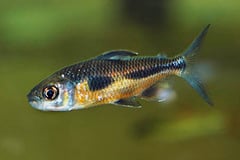
Bryconaethiops boulengeriBoulenger's Featherfin Tetra
Alestidae · authority not recorded
Boulenger's featherfin tetra, Bryconaethiops boulengeri, is a large alestid characin from the Congo river basin and Lake Tanganyika. Rarely imported, it is a peaceful shoaling species for a community of larger fish, and is farmed commercially for food in its native countries. It grows to 250 mm SL.

Bryconalestes longipinnisLong-finned Tetra
Alestidae · (Günther, 1864)
The long-finned tetra, Brycinus longipinnis, is an alestid characin from West Africa, found from Gambia to the Democratic Republic of Congo and Gabon. It inhabits large rivers and, unusually for the genus, also moves into smaller streams and lightly brackish estuaries. Not imported often, it ships poorly but usually proves hardy once acclimatised, though it is very sensitive to deteriorating water conditions.

Chalceus erythrurusTucanfish
Characidae · authority not recorded
The tucanfish, Chalceus erythrurus, is a large characin from parts of the Amazon basin in Peru and Brazil. It lives in the surface waters of floodplain rivers and lakes. The red or yellow caudal fin separates it from the pink-tailed C. macrolepidotus. Fast and a renowned jumper, it needs a lot of swimming space and a well-fitting cover, and it does best singly or in a group of more than six.

Charax condeiSmall-scale Glass Tetra
Characidae · authority not recorded
The small-scale glass tetra, Charax condei, is a characin known only from the Rio Negro basin, Brazil, where it inhabits blackwater streams. Rarely seen, it occasionally shows up in the trade as a contaminant among shipments of more popular species, and older literature sometimes calls it Asiphonichthys condei. A micropredator, it threatens much smaller tankmates and should be kept in a group of at least six.

Corynopoma riiseiSwordtail Characin
Characidae · authority not recorded
The swordtail characin, Corynopoma riisei, is an unusual tetra from northern Venezuela, the Villavicencio area of Colombia and the island of Trinidad. Males have caudal glands that release pheromones to attract females, plus gill glands found in only a handful of glandulocaudinids, and females are inseminated by the males. Mainly a surface dweller, it needs open swimming space and a group of at least 6-8, since males can squabble.

Exodon paradoxusBucktooth Tetra
Characidae · authority not recorded
The bucktooth tetra, Exodon paradoxus, is a scale-ripping characin widespread in the Brazilian Amazon. The only member of its genus, it has teeth that allow it to tear scales from other fishes. It will relentlessly attack silver-coloured or shiny tankmates, even larger predators, so it is best kept as a large shoal in a species setup. Scaleless and non-reflective fish are generally left alone.

Gymnocorymbus ternetziBlack Widow Tetra
Characidae · authority not recorded
The black widow tetra, Gymnocorymbus ternetzi, is a characid from the Rio Paraguay and Guaporé basins in Brazil, Bolivia and Argentina. All the fish in the trade are captive bred and unfussy about water chemistry and diet. The intense black of juveniles fades as they grow. Long-finned and 'golden' (leucistic) forms exist, the latter often sold as the 'white skirt tetra', and artificially dyed fish also turn up, a stressful process that often shortens their lifespan considerably.

Hemigrammus belottiiDash-dot Tetra
Characidae · authority not recorded
The dash-dot tetra, Hemigrammus belottii, is a small characin from the Rio Solimões, Negro and Maroni basins in Brazil and French Guiana. It is not common in the trade, and most specimens come in as contaminants among batches of more popular species. Like all Hemigrammus, its taxonomic status is Incertae Sedis, and most experts agree the genus needs a full revision.
Hemigrammus cupreusShiny Copper Tetra
Characidae · authority not recorded
The shiny copper tetra, Hemigrammus cupreus, is a small characin known only from the Rio Solimões in Brazil. It lives in the turbid white water of the river itself and in flooded habitats including the lakes known as várzeas, where conditions are far less acidic than in blackwater. Not common in the hobby, it occasionally shows up as a contaminant among imports of more popular species.

Hemigrammus erythrozonusGlowlight Tetra
Characidae · authority not recorded
The glowlight tetra, Hemigrammus erythrozonus, is a small characin known only from the Rio Essequibo in Guyana. Hardy and inexpensive, it is one of the best choices for a newcomer to fishkeeping. All fish in the trade are mass-bred on commercial farms, and a selectively-bred albino form is also sold. In nature it lives in forested tributaries with tannin-stained, often highly acidic water, and it is more colourful in acidic conditions.
Hemigrammus hyanuaryJanuary Tetra
Characidae · authority not recorded
The January tetra, Hemigrammus hyanuary, is a small characin from the Amazon basin in Peru and Brazil. Also known as the costello or green neon tetra, it resembles an elongated head and tail light tetra, H. ocellifer, and is occasionally confused with it. The type specimen came from Lake Hyanuary near Manaus. It inhabits slow-moving rivers, tributaries and floodplain lakes and tends to lose colour in alkaline water.

Hemigrammus ulreyiBroken-line Tetra
Characidae · authority not recorded
The broken-line tetra, Hemigrammus ulreyi, is a small characin known only from the Brazilian part of the Rio Paraguay basin. Other species are frequently misidentified as H. ulreyi, and the true fish is quite scarce in the hobby. It inhabits slow-moving rivers and tributaries. Like all Hemigrammus, its taxonomic status is Incertae Sedis, and most experts agree the genus needs a full revision.

Holopristis pulchraPretty Tetra
Characidae · authority not recorded
The pretty tetra, Holopristis pulchra, is a small characin endemic to the Upper Amazon in Peru, found in slow-moving tributaries under forest cover. Also known as the garnet or black wedge tetra, it is hardy, inexpensive and a good choice for the beginner. The vast majority on sale in the UK come from commercial farms in Eastern Europe, and it does well in most general community tanks.

Hyphessobrycon flammeusFlame Tetra
Characidae · Myers, 1924
The flame tetra, Hyphessobrycon flammeus, is a small characid from Rio de Janeiro and São Paulo states in Brazil. Popular in the hobby, it is bred commercially in several countries and also sold as 'red', 'fire', 'rio' and 'Von Rio' tetra. In nature it is now uncommon or even extinct across much of its range, and the São Paulo populations may have been introduced by aquarists or breeders.

Hyphessobrycon peruvianusPeruvian Tetra
Characidae · Ladiges, 1938
The Peruvian tetra, Hyphessobrycon peruvianus, is a characid known only from the upper Amazon basin in Peru. Popular in the trade, it is sometimes confused with H. loretoensis and H. metae and has repeatedly appeared under the latter name in aquarium literature. A more elongate body, a dark band reaching the tips of the median caudal-fin rays and red markings at the base of both caudal lobes set it apart.

Hyphessobrycon pyrrhonotusFlame-back Bleeding Heart Tetra
Characidae · Burgess, 1993
The flame-back bleeding heart tetra, Hyphessobrycon pyrrhonotus, is a characid endemic to the rio Negro system in Amazonas state, Brazil. The smallest of the three 'bleeding heart' species, it alone has a red, wedge-shaped patch along the upper body from below the dorsal fin to the base of the caudal. It lives in shallow blackwater tributaries near Barcelos, among roots, branches and leaf litter.

Iguanodectes adujai
Iguanodectidae · Géry, 1970
Traded as the 'red line lizard tetra', Iguanodectes adujai is a characin from the rio Negro in Brazil and the upper Río Orinoco in Venezuela. It is exported alongside the similar-looking I. geisleri, and differs in lacking the black lateral stripe beneath the red stripe and in having 28 to 34 anal-fin rays (20 to 25 in I. geisleri). It is assumed to live in smaller tributaries containing pristine blackwater.

Iguanodectes geisleri
Iguanodectidae · Géry, 1970
Iguanodectes geisleri is a characin from the rios Madeira and Negro in Brazil and the upper Río Orinoco in Venezuela. Traded with the similar-looking I. adujai as the 'red line lizard tetra', it differs in having a black lateral stripe beneath the red stripe and 20 to 25 anal-fin rays (28 to 34 in I. adujai). Adult males carry red markings in the pectoral, pelvic, anal and caudal fins.

Iguanodectes spilurusGreen Line Lizard Tetra
Iguanodectidae · (Günther, 1864)
The green line lizard tetra, Iguanodectes spilurus, is a characin found throughout the Amazon, Orinoco, Essequibo and Tocantins river systems. The most widespread Iguanodectes species, it has also been called the 'slender', 'spindle' or 'iguana' tetra, and differs from its congeners in its translucent dorsal and anal fins, lack of a red lateral stripe and prominent dark caudal-fin marking. It is sensitive to poor water conditions.

Knodus borkiBlue Tetra
Characidae · authority not recorded
The blue tetra, Knodus borki, is a small characid from Colombia and Brazil, found in rivers, streams and tributaries. Its colour is often so intense that many who first see it for sale assume it has been artificially coloured, though it will not develop its best colours in sparse surroundings. It may nip the fins of conspecifics and long-finned fishes, which a group of 8-10 in a larger tank helps to limit.

Ladigesia roloffiJelly Bean Tetra
Alestidae · Géry, 1968
The jelly bean tetra, Ladigesia roloffi, is a small alestid from Sierra Leone, known with certainty only from the Kasewe Forest reserve. Also called the 'Sierra Leone dwarf characin', it is the only member of its genus and grows to around 31 mm SL. The IUCN assesses it as Endangered, and over 97% of Sierra Leone's primary forest has been destroyed, surviving only in protected reserves such as Kasewe. Soft, acidic water is a prerequisite for breeding.

Megalamphodus bentosiOrnate Tetra
Characidae · (Durbin, 1908)
The ornate tetra, Megalamphodus bentosi, is a small characid whose type locality lies on the main channel of the lower Amazon at Óbidos, Brazil. It is very similar to a number of congeners, some of them undescribed, and the rosy tetra is the one most often seen in the trade. It may also be sold as 'Bentos' tetra' or 'white-tipped tetra'. It mostly inhabits sluggish tributaries, side arms and forest lakes, often around submerged roots, branches or plants.

Megalamphodus erythrostigmaBleeding Heart Tetra
Characidae · (Fowler, 1943)
The bleeding heart tetra, Megalamphodus erythrostigma, is a characid from the upper Amazon basin where the borders of Brazil, Peru and Colombia meet. The best-known of three similar species in the 'bleeding heart' subgroup, it has the reddish humeral spot found in no other characid. Generally peaceful, although adult males are territorial to an extent, it mostly inhabits sluggish tributaries, side arms and forest lakes.

Megalamphodus socolofiLesser Bleeding Heart Tetra
Characidae · (Weitzman, 1977)
The lesser bleeding heart tetra, Megalamphodus socolofi, is a characid known only from the rio Negro basin and the rio Nhamundá in Brazil. One of three similar species in the 'bleeding heart' subgroup, it shares their reddish humeral spot, found in no other characid. Generally peaceful, although adult males are territorial to an extent, it mostly inhabits sluggish tributaries, side arms and forest lakes.

Mimagoniates microlepisBlue Tetra
Characidae · authority not recorded
The blue tetra, Mimagoniates microlepis, is a characid from southeastern Brazil, found from southern Bahia to northern Rio Grande do Sul. Not to be confused with Knodus borki, also sold as 'blue tetra', it is much scarcer in the hobby, less boisterous and lacks that species' tendency to nip fins. It inhabits flowing clear-water streams and small rivers of coastal floodplains, and is a predominantly surface-dwelling fish.

Moenkhausia cerosCeros Tetra
Characidae · authority not recorded
The ceros tetra, Moenkhausia ceros, is a small characid from the Amazon basin in Peru and Brazil. Rare in the UK hobby, it occasionally shows up as a contaminant among imports of more popular species. It inhabits slow-moving rivers, tributaries and floodplain lakes. Moenkhausia is used as a catch-all for many small characins, and most experts agree the genus needs a full revision.

Nematobrycon palmeriEmperor Tetra
Characidae · Eigenmann, 1911
The emperor tetra, Nematobrycon palmeri, is a characid endemic to the San Juan and Atrato basins in Colombia. Virtually all fish in the trade are captive bred, and it is hardy and unfussy about water chemistry. Males are told apart from N. lacortei by their blue iris, and the smaller Inpaichthys kerri, often misidentified as this species, has an adipose fin, which Nematobrycon lacks.

Paracheirodon simulansGreen Neon Tetra
Characidae · (Géry, 1963)
The green neon tetra, Paracheirodon simulans, is a small characid from the rio Negro and Orinoco drainages of Brazil, Colombia and Venezuela. An exclusive inhabitant of blackwater, it lives only in the upper, terra firme reaches of tributaries and is sometimes traded as 'false neon tetra' or 'blue neon tetra'. A greener lateral stripe that extends to the caudal-fin base and duller red flanks separate it from P. innesi and P. axelrodi.

Prionobrama filigeraGlass Bloodfin Tetra
Characidae · authority not recorded
The glass bloodfin tetra, Prionobrama filigera, is a characid recorded from the Amazon drainage in Ecuador, Colombia, Peru, Bolivia and Brazil. It is told from the other bloodfin tetra, Aphyocharax anisitsi, by its more elongate body and the lack of red in the anal and ventral fins. An active, pelagic species of the upper water layers, it grows to around 6 cm and should be kept in groups of at least six to eight.

Trochilocharax ornatusHummingbird Tetra
Characidae · Zarske, 2010
The hummingbird tetra, Trochilocharax ornatus, is a tiny characid from Amazonian Peru, reaching only 17 mm. Traded as 'crystal rainbow tetra' and 'orange-tailed glass tetra', it is much sought after. The type series came from an aquarium import out of Iquitos, and sources conflict over whether it comes from the río Ampiyacu or the rio Nanay.

Tucanoichthys tucano
Characidae · Géry & Römer, 1997
Tucanoichthys tucano is a miniature characid known only from the rio Uaupés system in the upper Negro basin, Brazil. Adults are less than 17 mm SL, with a conspicuous dark lateral stripe, and the type locality is a small blackwater creek. Much sought after, it is peaceful but not an ideal community fish, given its small size and somewhat specialised requirements.

Iguanodectes variatus
Iguanodectidae · Géry, 1993
Iguanodectes variatus is a characin from Brazil, recorded from the Guaporé, Madeira, Branco, Trombetas and Urubu river systems in the Amazon basin. It belongs to a small genus of elongate fishes in the family Iguanodectidae and grows to around 103 mm SL.

Brycon cephalusRed-tailed Brycon
Characidae · authority not recorded
The red-tailed brycon, Brycon cephalus, is a large characid from the upper Amazon basin in Peru, Bolivia and Brazil, known in Brazil as the matrinxã. It migrates twice a year over large distances between nutrient-poor tributaries and silt-laden white water rivers, where it spawns. B. rubricauda and B. orbignyanus resemble it closely. An active, pelagic shoaling fish with sharp teeth, it grows to 220 mm SL and needs a very large, well-covered tank as it jumps.
Salminus brasiliensisDorado
Characidae · authority not recorded
The dorado, Salminus brasiliensis, is a large characid from Brazil, Bolivia, Paraguay, Uruguay and Argentina, growing to 1000 mm SL. A highly prized game fish in some of its native waters, it turns up as juveniles in some aquatic stores, but it is not suited to captive life in any respect. Housing one for life is beyond the reach of virtually all hobbyists.