Taeniacara candidi
Last revised 2026Edit this page
On this page11 sections
Quick factsEdit
Difficulty4 of 8 measures
- Space
- medium tank
- Water
- needs soft, acidic water
- Temp
- needs warm water, held steady
- Diet
- unknown
- Temperament
- territorial
- Social
- unknown
- Compatibility
- unknown
Other demands
Each of these can raise the rating on its own, whatever the measures above say.
- Hardiness
- unknown
- Needs 27 °C or warmer
Taeniacara candidi is a dwarf cichlid from Brazil, ranging from the lower Rio Negro along the Amazon as far as the Rio Tapajós. It needs very specific water parameters and is seen as a challenge even by experienced keepers, commonly sitting at the bottom of the tank for a day or more after a water change. Said to be one of the most aggressive dwarf cichlids, it has a slimmer body than most Apistogramma, and the female guards the fry very aggressively.
Distribution
EditHabitat
Write a noteEditNative to Brazil, where its range extends from the lower Rio Negro along the Amazon as far as the Rio Tapajós.
Aquarium size
Write a noteEdit45 ∗ 38 ∗ 30 cm18 ∗ 15 ∗ 12 in - ~51 litres~13 US gal
Maintenance
Write a noteEditTaeniacara candidi require a densely planted tank with plenty of hiding places (these can be covered by bits of driftwood, bogwood, mopani wood or clay/plastic garden pots).
Water conditions
EditTemperature: T. candidi prefer higher temperatures - 81 to 86°f (27 to 30°c).
pH: Very acidic - 4.5 to 5.8
Hardness: Very soft, usually no more than 1°dH.
These recommendations come from this profile’s own figures. They contain affiliate links, so we may earn a commission.
Diet
Write a noteEditTaeniacara may not accept dried food. Make sure a varied diet of frozen foods are given, though live foods will undoubtedly be preferred. Be prepared to find an easily renewable source of live foods for this fish.
Behaviour and compatibility
Write a noteEditTaeniacara candidi are said to be one of the most aggressive dwarf cichlids around. Some reports intone that the male is hyper-aggressive, whereas other reports tell of the female being the boss of the T. candidi setup. If more than one male is placed in a tank smaller than 48", it is highly likely that the dominant male will kill all of the other males.
Sexual dimorphism
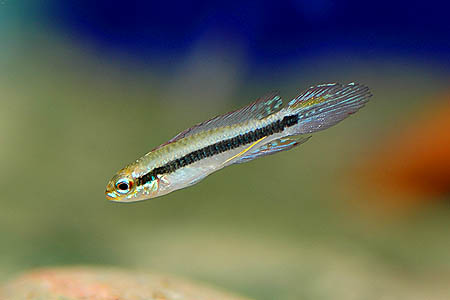
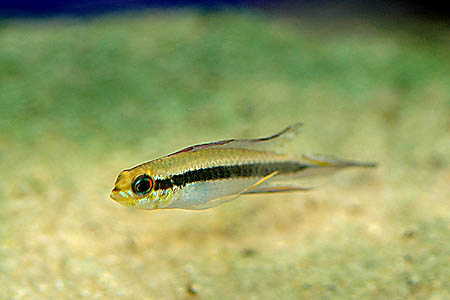
Write a noteEditMales are bigger with more vivid patterning, females are smaller but still possess a blue-spotted caudal fin.
Reproduction
Write a noteEditSome reports indicate that breeding Taeniacara candidi is extremely difficult. However, there have been frequent reports of T. candidi breeding in the home aquarium. Some people have had luck breeding this species of Taeniacara in water with pH as high as 7, but it is generally accepted that a very acidic pH combined with very low GH will be required to breed Taeniacara candidi.
Notes
EditTaeniacara candidi are the source of much discussion amongst dwarf cichlid keepers. They are a highly attractive species, but require very specific water parameters and as such are seen as a challenge amongst even experienced south american cichlid keepers.
T. candidi are renowned for not liking water changes - they will commonly get "moody" after a water change, and will sulk at the bottom of the tank for over a day in some cases. Try to keep new water at the same temperature as the T. candidi tank (this can be achieved by using an aquarium heater with a thermostat in a bucket of water for a few hours before siphoning into the tank).
The genus Taeniacara is still under consideration - this fish was once known as Apistogramma weisei and it may be that in the near future, it will be part of the Apistogramma genus again. This fish exhibits similar behaviour to species of the Apistogramma genus, with the mother of a spawn guarding the fry very aggressively. Taeniacara candidi possess a slimmer body than most of the Apistogramma genus, but are equally attractive.
Species images · 2
These photographs are used with each photographer's permission.
Send a photographDistribution
Profile completeness18 of 24
75% complete
Also missing: taxonomic authority, a common name, etymology.
Community
Questions about Taeniacara candidi?
Ask on Discord