Trachelyichthys decaradiatus
Last revised 2012Edit this page
On this page11 sections
Quick factsEdit
Difficulty3 of 8 measures
- Space
- medium tank
- Water
- needs a steady pH
- Temp
- flexible
- Diet
- unknown
- Temperament
- unknown
- Social
- unknown
- Compatibility
- unknown
Other demands
Each of these can raise the rating on its own, whatever the measures above say.
- Hardiness
- unknown
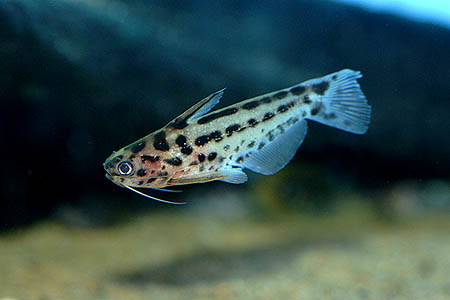
Trachelyichthys decaradiatus is a small auchenipterid catfish known only from the Rupununi River in Guyana. It is very similar to T. exilis but has the eye set further back and a broader, shorter humeral process, and neither is seen very often in the hobby. Unlike most auchenipterids it usually feeds by day, and it is peaceful and does best in a group.
Distribution
EditHabitat
Write a noteEditThe river and its tributaries.
Aquarium size
Write a noteEdit60 ∗ 38 ∗ 30 cm24 ∗ 15 ∗ 12 in - ~68 litres~18 US gal.
Maintenance
Write a noteEditIdeally suited to a heavily planted setup and will show its best colours in such surroundings. It doesn't appreciate bright conditions and we suggest the use of floating plants to diffuse the light entering the tank. Allow open spaces between areas of planting to allow swimming space.
Water conditions
EditTemperature: 20 – 28 °C68 – 82 °F
pH: 6.5-7.0
Hardness: 8-15°H
These recommendations come from this profile’s own figures. They contain affiliate links, so we may earn a commission.
Diet
Write a noteEditIt prefers live and frozen foods such as bloodworm, earthworms, prawns etc., but most will also take small pellets or flakes. Unlike most Auchenipterids it will usually feed during daylight hours.
Behaviour and compatibility
Write a noteEditSafe with all but the smallest of fry and therefore suitable for most community aquaria. Ideally, keep it in a South American biotope aquarium with tetras, dwarf cichlids and other peaceful catfish such as Corydoras sp. and smaller Loricariids. It' is totally unaggressive towards conspecifics and is happier when kept in a group.
Sexual dimorphism
Write a noteEditMales have a heavily modifed anal fin, which is used in a similar fashion to the gonopodium possessed by livebearers. Females are much rounder than males when gravid.
Reproduction
Write a noteEditUnreported in aquaria.
Notes
EditVery similar to its congener T. exilis, it can be distinguished by looking at the position of the eye which is set much further forward in exilis. Also, the humeral process (long spine extending from the back of the gill plate), is broader and shorter in this species than exilis. Neither are seen very often in the hobby.
Species images · 1
These photographs are used with each photographer’s permission.
Send a photographProfile completeness16 of 24
67% complete
Also missing: a recorded distribution, taxonomic authority, a common name, etymology.
Community
Questions about Trachelyichthys decaradiatus?
Ask on Discord