River
Rupununi
Only species with a profile on Seriously Fish are counted.
- Species
- 14
- Families
- 10
- Photographed
- 14 of 14
- Difficulty rated
- 14 of 14
Basin
Also in the Essequibo basinspecies recorded from both
Shares fishes with rivers elsewherespecies recorded from both
Runs through
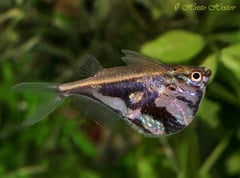
Carnegiella strigataMarbled Hatchetfish
Gasteropelecidae · (Günther, 1864)
The marbled hatchetfish, Carnegiella strigata, is a hatchetfish from the Amazon and Orinoco basins and coastal rivers of Guyana and Suriname. Popular in the hobby, it is collected for the trade mostly in the rio Negro basin in Brazil. Its larger size and dark, marbled pattern set it apart from congeners, though the pattern varies and the wide range may be open to question. It appears to live only in blackwater.
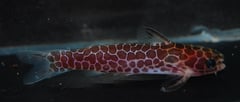
Centromochlus reticulatusReticulated Driftwood Catfish
Auchenipteridae · (Mees, 1974)
The reticulated driftwood catfish, Centromochlus reticulatus, is a small auchenipterid first known from the upper Rupununi River basin in Guyana. Its secretive, mostly nocturnal habits mean it may have been overlooked elsewhere, and it has been recorded from the rio Preto da Eva near Manaus, Brazil. Sometimes traded as 'purple oil catfish', it is highly gregarious and ideally kept in groups of at least eight.

Colomesus asellusAmazon Puffer
Tetraodontidae · (Müller & Troschel, 1849)
The Amazon puffer, Colomesus asellus, is a freshwater puffer found throughout much of the Amazon basin, with records north to Guyana and Venezuela. Also traded as the South American puffer or 'SAP', it is told from congeners by a transverse row of dermal flaps across the chin. It lives mostly in well-oxygenated river habitats, is intolerant of organic waste, and forms loose aggregations, so a group of 6 or more is best, away from the general community.
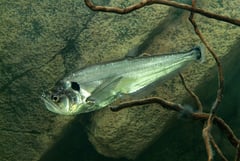
Cynodon gibbus
Cynodontidae · (Agassiz, 1829)
Cynodon gibbus is a cynodontid from much of the Amazon basin, the middle and lower Orinoco, and the Rupununi River in Guyana. A pelagic fish of main river channels and larger tributaries, it grows to around 280 mm SL. It is rare in the trade but arguably more suitable for the home aquarium than some of its better-known relatives, given its size and relatively docile behaviour. Being easily dominated, it is best kept alone or with similarly sized, non-aggressive fishes.
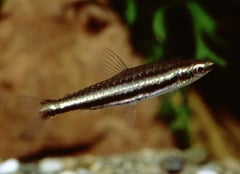
Nannostomus digrammusTwostripe Pencilfish
Lebiasinidae · (Fowler, 1913)
The twostripe pencilfish, Nannostomus digrammus, is a lebiasinid from the central Amazon basin in Brazil and the Rupununi basin in Guyana. Rare in the hobby, it usually arrives as bycatch among shipments of other fishes. It is most similar to N. bifasciatus but has an adipose-fin, and its small size and timid nature make it a poor community fish.
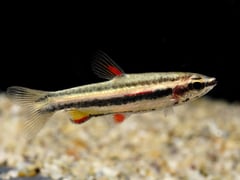
Nannostomus marginatusDwarf Pencilfish
Lebiasinidae · Eigenmann, 1909
The dwarf pencilfish, Nannostomus marginatus, is a lebiasinid of Guyana, Suriname and the middle-to-lower Amazon in Peru, Colombia and Brazil. Enduringly popular, it lacks the red body colour of males of the related N. mortenthaleri and N. rubrocaudatus, showing three dark lateral stripes with no red or purple between them. Colour varies between populations, and its small size and timid nature make it a poor community fish.

Pterophyllum leopoldiRoman Nose Angelfish
Cichlidae · (Gosse, 1963)
The roman nose angelfish, Pterophyllum leopoldi, is a cichlid from the lower Rio Negro in Brazil and the Rupununi and Essequibo basins of Guyana. It can be told from other members of the genus by up to 11 vertical stripes, a dark patch over the operculum and the roman nose that gives it its name. Reportedly one of the more aggressive species in the genus towards conspecifics, it should be kept in a group of four or more to prevent bullying.
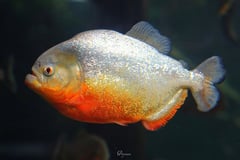
Pygocentrus nattereriRed Bellied Piranha
Serrasalmidae · Kner, 1858
The red bellied piranha, Pygocentrus nattereri, occurs through much of the Amazon basin and south into the Paraná and Uruguay river systems. Famed as a rapacious predator, it is among the most notorious freshwater fishes in the world. According to Herbert Axelrod (1976), the myth began with a feeding frenzy staged for Theodore Roosevelt in Brazil in 1913. Usually only juveniles form aggregations, and the species is relatively easy to breed in the aquarium.

Satanoperca leucostictaWhitespot Eartheater
Cichlidae · (Müller & Troschel, 1849)
The whitespot eartheater, Satanoperca leucosticta, is a cichlid from the Guiana Shield in Guyana, Suriname, eastern Venezuela and northern Brazil. Farmed in several countries, it is frequently available in the ornamental trade. It is often confused with S. jurupari but is easily recognised by the prominent white spots or vermiform markings on the sides of the head. A larvophilous maternal mouthbrooder, it has been bred in aquaria.

Aequidens tetramerusSaddle Cichlid
Cichlidae · (Heckel, 1840)
The saddle cichlid, Aequidens tetramerus, is a cichlid found across much of northern South America, from the Amazon and Orinoco basins to the Guianas. The type species of its genus, it occurs in several colour forms, and fish from Ecuador and Peru are sought after for the red or orange colouration on the lower head and belly. As currently recognised it is likely to represent a group of related fishes, some of which may be described as distinct species.
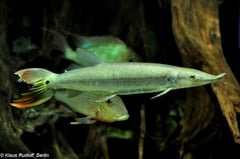
Boulengerella cuvieri
Ctenoluciidae · (Spix & Agassiz, 1829)
Boulengerella cuvieri is a pelagic ctenoluciid characin from much of the Amazon basin, the Río Orinoco and coastal drainages of the Guianas. The largest officially recorded specimen measured 675 mm, but it appears to grow larger, possibly beyond 800 mm. Given that size and its natural behaviour it is largely unsuitable for the home aquarium. Its entire dorsal-fin base lies ahead of the anal-fin origin, a character shared only with B. lucius and B. xyrekes among ctenoluciids.
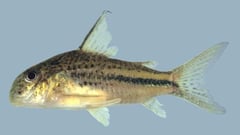
Hoplisoma bondiBlackstripe Cory
Callichthyidae · (Gosline, 1940)
The blackstripe cory, Hoplisoma bondi, long known as Corydoras bondi, is an armoured catfish from Venezuela, Guyana and Suriname, including the Essequibo and Courantyne systems. It was once considered common in the hobby, but many fish traded under the name may be the similar H. sipaliwini or H. coppenamense. H. sipaliwini has larger body spots and a dark marking on the first dorsal-fin rays, while H. coppenamense is more orangish.
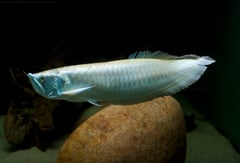
Osteoglossum bicirrhosumSilver Arowana
Osteoglossidae · (Cuvier, 1829)
The silver arowana, Osteoglossum bicirrhosum, is a large predator from the Amazon basin, plus river systems in Guyana and French Guiana. Reaching 80 cm, it is largely unsuitable for the home aquarium, and although juveniles are readily available, few private aquarists can house an adult long-term. Juveniles have a single dark lateral stripe, while in those of its only congener, O. ferreirai, most of the body and fins are dark.
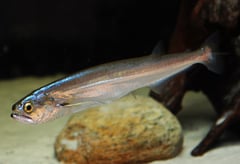
Rhaphiodon vulpinusBiara
Cynodontidae · Spix & Agassiz, 1829
The biara, Rhaphiodon vulpinus, is a dogtooth characin found from the Orinoco and Amazon basins south to the Río de la Plata in Argentina. The only member of its genus, it grows to 600 to 800 mm and is an obligate piscivore, and it is suitable only for public installations or the very largest private aquaria. Juveniles are seen for sale quite regularly, most often without adequate information on their long-term care.