Every species
Filters
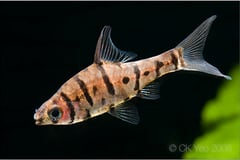
Eirmotus insignis
Tan & Kottelat, 2008
Max length36mm SL1.4in SLTank60 × 30cm24 × 12inTemp20–26°C68–79°FpH5.0–7.0Eirmotus insignis is a small cyprinid known only from the Kapuas basin in West Kalimantan, Borneo, and Belitung Island off Sumatra. It inhabits shady, slow-moving rainforest streams and swamps with dense vegetation. One of four similar species in the genus, it is traded alongside E. octozona as the 'false eight-banded barb' and is told apart mainly by the black markings on its dorsal fin.
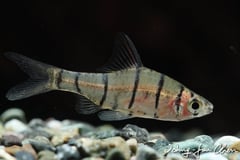
Eirmotus octozona
Schultz, 1959
Max length36mm SL1.4in SLTank60 × 30cm24 × 12inTemp22–26°C72–79°FpH5.0–7.0Eirmotus octozona is a small cyprinid with eight dark body bars, known from Johor state in Peninsular Malaysia. The type series came from aquarium fish said to originate at Bueng Boraphet in Thailand, where it has never been recorded since, and if it occurs in Thailand it is probably restricted to the peninsula. It is sold, along with E. insignis, as the 'false eight-banded barb'.
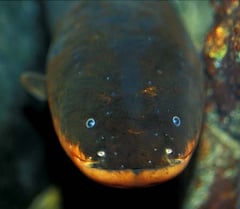
Electrophorus electricusElectric Eel
authority not recorded
Max length2500mm SL98in SLTanknot recordedTemp23–28°C73–82°FpH5.5–7.0The electric eel, Electrophorus electricus, is a nocturnal predator from Venezuela, Guyana, Suriname, French Guiana, Peru and Brazil. Up to 80% of its body holds electricity-producing organs: a weak field lets it navigate and locate prey despite very poor eyesight, and bursts of over 600 volts stun prey and can disable a human. It grows to 250 cm and is best kept singly and alone.
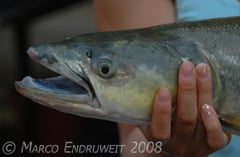
Elopichthys bambusa
(Richardson, 1845)
Max length2000mm SL79in SLTanknot recordedTempnot recordedpHnot recordedElopichthys bambusa is a large predatory cyprinid of eastern Asia, from the Amur River in Russia to the Lam drainage in northern Vietnam. Growing to 2 m and 40 kg, it is entirely unsuitable for the home aquarium, though young individuals appear in the ornamental trade on an irregular basis. The only species in its genus, it is an important food fish over much of its range.
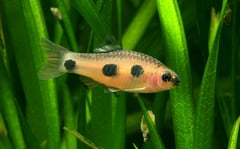
Enteromius candens
(Nichols & Griscom, 1917)
Max length35mm SL1.4in SLTank45 × 30cm18 × 12inTemp17–24°C63–75°FpH5.0–7.0Enteromius candens is a small African barb from the Congo basin in northern and central DR Congo, mainly between Lisala and Kisangani. It lives in slow-moving, shady rainforest streams and swamps with soft, acidic, brown-stained water. Rare in the trade and sporadically collected, it can be told from the better-known E. hulstaerti, which has a bluer body, larger dark markings and yellow fins in males. Its shy nature suits it to a tank of similarly small, peaceful species.
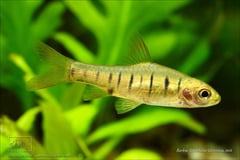
Enteromius fasciolatusAfrican Banded Barb
(Günther, 1868)
Max length60mm SL2.4in SLTank75 × 30cm30 × 12inTemp20–26°C68–79°FpH5.0–6.5The African banded barb, Enteromius fasciolatus, is a small cyprinid widely distributed in Central Southern Africa, from Angola to Zimbabwe. For many years it was imported as Barbus/Barbodes barilioides, now a junior synonym, and it is also called the blue banded or Angola barb. It has 10 to 15 blue-black vertical bars and lives in slow-flowing, heavily vegetated lake shallows, floodplain lagoons and rainforest streams.
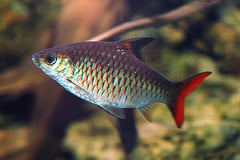
Enteromius guiraliAfrican Blackfin Barb
(Thominot, 1886)
Max length155mm SL6in SLTank150 × 45cm60 × 18inTemp22–26°C72–79°FpH5.5–6.5The African blackfin barb, Enteromius guirali, is a cyprinid recorded only from Cameroon and Gabon, including the Sanaga and Ogooué basins. Primarily a river fish, it also enters affluent streams and tributaries. It is rare in the hobby and little is known of its captive care, though one lone fish kept by a forum member behaved well, and a batch of what appeared to be a different species has been imported under the same name.
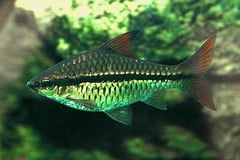
Enteromius holotaeniaSpotscale Barb
(Boulenger, 1904)
Max length120mm SL5in SLTank120 × 45cm48 × 18inTemp24–30°C75–86°FpH6.0–7.0The spotscale barb, 'Barbus' holotaenia, is a cyprinid from Central West Africa, found principally in the Ogooué and Congo river systems. It has been recorded right across DR Congo and appears to be primarily riverine. Rare in the hobby, it has been suggested as the closest surface-dwelling relative of the Congo blind barb, Caecobarbus geertsii, a claim the profile considers questionable.
Enteromius hulstaertiAfrican Butterfly Barb
(Poll, 1945)
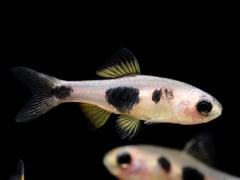
Max length35mm SL1.4in SLTank45 × 30cm18 × 12inTemp17–24°C63–75°FpH5.0–6.5The African butterfly barb, Enteromius hulstaerti, is a cyprinid endemic to DR Congo, in rainforest south and east of the main Congo River channel. It reappeared in the trade in 2006 after an absence of 25 years. It lives in slow-moving, shady rainforest streams and swamps with very soft, acidic, brown-stained water, and its shy, retiring nature makes it unsuitable for most community tanks.
Enteromius jae
(Boulenger, 1903)
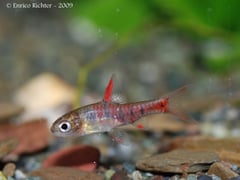
Max length40mm SL1.6in SLTank45 × 30cm18 × 12inTemp17–24°C63–75°FpH5.0–6.5Enteromius jae is a small, delicate African barb from Cameroon, Equatorial Guinea, Gabon and the two Congos, sometimes sold as 'jae' or 'charcoal' barb. Populations vary in colour and pattern with locality, and the forms should never be mixed in the aquarium, to avoid crossbreeding. It lives in shady rainforest streams and swamps with soft, acidic, brown-stained water, and its shy nature makes it unsuitable for most community aquaria.
Enteromius sublineatus
(Daget, 1954)
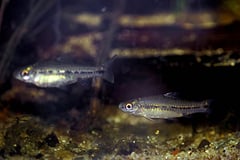
Max length100mm SL3.9in SLTank120 × 30cm48 × 12inTemp22–27°C72–81°FpH6.0–7.0Enteromius sublineatus is a widespread West African barb found in river basins from Senegal east to Cameroon, including the Niger and Volta. It is very variable in patterning and can be difficult to identify: Upper Niger fish show three elongate midlateral markings, Middle Niger fish a continuous band and Volta fish four spots. It may prove to be a complex of closely-related species. Little is known of its captive care.
Epalzeorhynchos bicolorRed-Tailed Black Shark
(Smith, 1931)
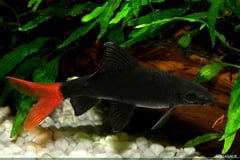
Max length125mm SL5in SLTank120 × 45cm48 × 18inTemp20–26°C68–79°FpH6.0–8.0The red-tailed black shark, Epalzeorhynchos bicolor, is a cyprinid native to central and western Thailand, in the Mae Klong and Chao Phraya basins. Declared extinct in 1996, it was found again in 2011 and 2014 and is considered critically endangered, while all fish in the trade are commercially produced. It becomes increasingly territorial as it grows, especially towards similar-looking species, and can live for over 15 years.

Epalzeorhynchos frenatumRainbow Shark
(Fowler, 1934)
Max length150mm SL6in SLTank120 × 45cm48 × 18inTemp20–26°C68–79°FpH6.5–8.0The rainbow shark, Epalzeorhynchos frenatum, is a cyprinid reportedly native to Thailand, Laos and Cambodia. Recorded from the Mae Klong, Chao Phraya and Mekong basins, many of its wild populations have dwindled or vanished, and large numbers are farmed for the trade, including an albino and an anerythristic form sometimes misidentified as E. munense. It becomes increasingly territorial as it grows and can live for over 15 years.
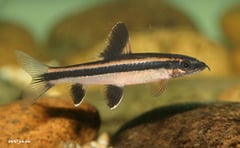
Epalzeorhynchos kalopterumFlying Fox
(Bleeker, 1850)
Max length160mm SL6in SLTank120 × 45cm48 × 18inTemp20–26°C68–79°FpH6.0–7.5The flying fox, Epalzeorhynchos kalopterum, is a cyprinid from southern Thailand, Peninsular Malaysia and the Greater Sunda Islands. Fishes sold as 'false flying fox' or 'Siamese flying fox', such as Garra cambodgiensis and Gyrinocheilus aymonieri, are often confused with it, but it has white-edged red and black fins and two pairs of barbels. It grows increasingly territorial with age and can live for over 15 years.

Epalzeorhynchos munense
(Smith, 1934)
Max length120mm SL5in SLTank120 × 45cm48 × 18inTemp20–26°C68–79°FpH6.5–7.5Epalzeorhynchos munense is a cyprinid from the Mun river and other tributaries of the middle Mekong in Thailand and Laos. It resembles E. bicolor and E. frenatum but has a black head, body and anal fin, red caudal and dorsal fins, and black margins on the pelvic and pectoral fins. A record from the Tonlé Sap system may refer to E. frenatum.
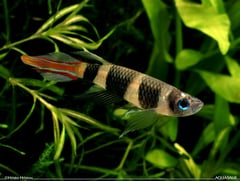
Epiplatys annulatusClown Killifish
(Boulenger, 1915)
Max length35mm SL1.4in SLTank45 × 30cm18 × 12inTemp20–26°C68–79°FpH4.0–7.0The clown killifish, Epiplatys annulatus, is a small killifish from coastal lowlands of southern Guinea, Sierra Leone and northwestern Liberia. Also traded as 'rocket killifish' and 'banded panchax', it has four very broad dark bars alternating with yellowish ones. Fin colour varies between populations, which aquarists keep labelled by locality, and it is relatively easy to breed.
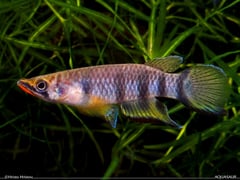
Epiplatys dagetiRed-chinned Panchax
Poll, 1953
Max length45mm SL1.8in SLTank60 × 30cm24 × 12inTemp20–30°C68–86°FpH5.0–7.0The red-chinned panchax, Epiplatys dageti, is a killifish from coastal savanna in southwestern Ghana, southern Côte d'Ivoire and southern Liberia. An aquarium stalwart since the red-throated form was first exported from Monrovia in 1908, it is relatively hardy and easy to breed, and a good choice for those new to killifishes. The Monrovia fish is often labelled E. dageti monroviae in aquarium literature.
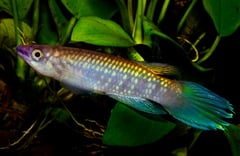
Epiplatys fasciolatusBanded Epiplatys
(Günther, 1866)
Max length80mm SL3.1in SLTank80 × 30cm31 × 12inTemp20–27°C68–81°FpH5.0–7.0The banded epiplatys, Epiplatys fasciolatus, is a killifish from coastal Guinea-Bissau, Guinea and Sierra Leone to western Liberia. It mostly inhabits freshwater swamps and minor tributary streams, in grassy savannah at some localities and rainforest at others. Males carry metallic blue or green pigmentation on the body and fins, with a red submarginal band on the anal and lower caudal fins.
Epiplatys lamotteiRed-spotted Panchax
Daget, 1954
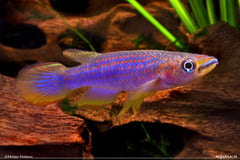
Max length60mm SL2.4in SLTank80 × 30cm31 × 12inTemp18–23°C64–73°FpH5.0–7.0The red-spotted panchax, Epiplatys lamottei, is a killifish with a restricted range in southeastern Guinea and northern Liberia. Known from the upper Niger, Lofa, Saint Paul and Saint John drainages, it inhabits small streams and minor tributaries, and is threatened by deforestation and mining across some of its range. The flanks carry large dark bars and longitudinal bands made up of small red spots.
Epiplatys mesogramma
Huber, 1980
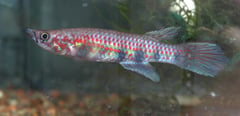
Max lengthnot recordedTanknot recordedTempnot recordedpHnot recordedEpiplatys mesogramma is a killifish endemic to the Ubangi (or Oubangui) River drainage in southwestern Central African Republic. The Ubangi is the largest right-bank tributary of the Congo and drains an enormous region, but this species is known from only a handful of localities.