Every species
Filters

Devario sp. 'giraffe'
authority not recorded
Max length80mm SL3.1in SLTank120 × 30cm48 × 12inTemp18–26°C64–79°FpH6.0–8.0Devario sp. 'giraffe' is an unidentified devario from Myanmar, first collected in 2007, about which very little is known. Its name refers to a giraffe-like colour pattern, with the stripes broken up towards the front of the body into spots, rings and vertical bars. It has a deep, bulky body.
Devario sp. 'purple cypris'
authority not recorded
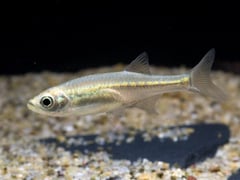
Max length45mm SL1.8in SLTank75 × 30cm30 × 12inTempnot recordedpHnot recordedDevario sp. 'purple cypris' is a small, unidentified devario that has appeared in the aquarium trade only on a handful of occasions. It has been widely misidentified as Inlecypris jayarami, but has 9 or 10 lateral bars that increase in size towards the tail, 12 anal-fin rays and a blunter head.

Devario xyropsBlue Moon 'Danio'
Fang & Kullander, 2009
Max length80mm SL3.1in SLTank120 × 45cm48 × 18inTemp18–26°C64–79°FpH6.0–8.0The blue moon 'danio', Devario xyrops, is a devario known only from small streams draining the western slope of the Rakhine Yoma in western Myanmar. Before its description it was sometimes called D. sp. 'broken line'. A dark blotch of 4 or 5 short vertical bars on the front of the flank and a wide dark P stripe behind it are shared only with D. anomalus, which has a shallower body and more lateral line scales.
Dianema longibarbisPorthole Catfish
authority not recorded
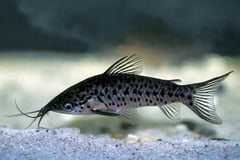
Max length100mm SL3.9in SLTank90 × 38cm36 × 15inTemp24–28°C75–82°FpH5.5–7.5The porthole catfish, Dianema longibarbis, is a peaceful callichthyid catfish from the Amazon basin in Peru and Brazil. It is named for the row of spots running along the lateral line. All specimens in the trade are wild-caught and new imports tend to be delicate and susceptible to disease, but once acclimatised it usually proves very hardy and can live for over 10 years.
Dianema urostriatumFlagtail Catfish
authority not recorded
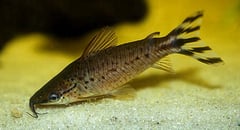
Max length125mm SL5in SLTank120 × 38cm48 × 15inTemp25–28°C77–82°FpH6.0–8.0The flagtail catfish, Dianema urostriatum, is a peaceful callichthyid catfish from parts of the Brazilian Amazon basin. It lives away from the main river channels in slower creeks, tributaries, floodplain lakes and ponds. All specimens in the trade are wild-caught and new imports can be delicate, but once acclimatised it usually proves very hardy and adaptable, and suits the larger community tank.
Dichotomyctere fluviatilisGreen Puffer
(Hamilton, 1822)
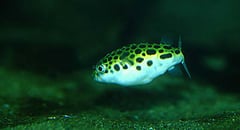
Max length170mm SL7in SLTank120 × 30cm48 × 12inTemp24–28°C75–82°FpH7.8–9.0The green puffer, Dichotomyctere fluviatilis, is a widespread puffer from South and Southeast Asia, found in slow-moving rivers and estuaries. It is often confused with D. nigroviridis and Tetraodon schoutedeni but has a more slender, streamlined shape. Though often sold in freshwater, it is a true brackish species and needs a specific gravity of around 1.005 to 1.010 to survive long term. It is still often sold as Tetraodon fluviatilis.
Dichotomyctere nigroviridisGreen Spotted Puffer
(Marion de Procé, 1822)
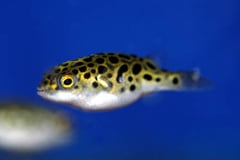
Max length170mm SL7in SLTank120 × 30cm48 × 12inTemp24–28°C75–82°FpH7.5–8.5The green spotted puffer, Dichotomyctere nigroviridis, is a widespread puffer from South and Southeast Asia, found in both brackish and fresh water. It is often confused with D. fluviatilis and Tetraodon schoutedeni. Although often sold as a community fish, it nips slow-moving or long-finned tankmates and some individuals become spiteful with age. It is still often sold as Tetraodon nigroviridis.
Dichotomyctere ocellatusFigure Eight Puffer
(Steindachner, 1870)
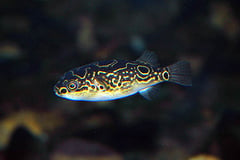
Max length80mm SL3.1in SLTank75 × 30cm30 × 12inTemp22–26°C72–79°FpH6.5–7.5The figure eight puffer, Dichotomyctere ocellatus, is a small puffer from Cambodia, Malaysia and Indonesia. It lives in rivers and coastal waters, most often in freshwater but frequently in brackish conditions. Very sensitive to deteriorating water quality, it tends to live longer with a little marine salt added. It nips the fins of slow-moving or long-finned fish, and single specimens usually live longer in captivity than groups. It is still often sold as Tetraodon biocellatus.

Dicrossus filamentosusLyretail Checkerboard Cichlid
authority not recorded
Max length102mm SL4in SLTank60 × 30cm24 × 12inTemp27–30°C81–86°FpH5.0–6.5The lyretail checkerboard cichlid, Dicrossus filamentosus, is a cichlid from the Rio Orinoco in Colombia and Venezuela and the Brazilian Rio Negro. Formerly placed in Crenicara, it shares Dicrossus with D. maculatus, which looks similar but lacks the lyretailed caudal fin. Shy by nature, it needs a well-planted, dimly lit tank with plenty of hiding places, and very soft, acidic water to breed.

Dicrossus maculatusSpadetailed Checkerboard Cichlid
Steindachner, 1875
Max length53mm SL2.1in SLTank60 × 30cm24 × 12inTemp26–30°C79–86°FpH3.4–5.4The spadetailed checkerboard cichlid, Dicrossus maculatus, is a cichlid from the Rio Tapajós, Rio Maués and nearby areas of the Brazilian Amazon. Not commonly available in the trade, it is sometimes mistaken for D. filamentosus. A challenge to breed, it needs extremely acidic, very soft water for the eggs to hatch, and a brooding female herds her fry around the tank with signals from her ventral fins.

Dimidiochromis compressicepsMalawi Eye-Biter
authority not recorded
Max length250mm SL10in SLTank150 × 38cm60 × 15inTemp23–28°C73–82°FpH7.5–8.8The Malawi eye-biter, Dimidiochromis compressiceps, is a predatory cichlid endemic to Lake Malawi, where it is widely distributed. An ambush predator, it hides head-down among Vallisneria beds, its laterally compressed body and dark stripe from snout to tail helping to conceal it. Despite its name it mainly hunts small fish, and eye-eating happens infrequently in nature and rarely, if ever, in aquaria with well-fed specimens.

Discherodontus ashmeadi
(Fowler, 1937)
Max length135mm SL5in SLTank120 × 45cm48 × 18inTemp23–26°C73–79°FpH6.0–7.5Discherodontus ashmeadi is a cyprinid apparently native to the Mae Klong and Mekong river basins in Thailand, Laos and Cambodia. The type species of its genus, it inhabits clear, fast-flowing minor rivers and forest streams. Like its congeners it is notoriously delicate and difficult to ship: it goes into shock and loses scales very easily when removed from the water, and damaged areas tend to become infected.
Discherodontus halei
(Duncker, 1904)
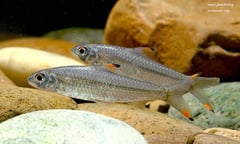
Max length100mm SL3.9in SLTank120 × 45cm48 × 18inTemp21–26°C70–79°FpH6.0–7.5Discherodontus halei is a cyprinid with an apparently disjunct range: Pahang in Peninsular Malaysia, and the Mae Klong and Chao Phraya in Thailand. It inhabits clear, fast-flowing minor rivers and forest streams, and orange pigmentation in the dorsal and caudal fins helps separate it from congeners. Like others in the genus it is notoriously delicate and difficult to ship, losing scales very easily when removed from the water.
Discherodontus schroederi
(Smith, 1945)
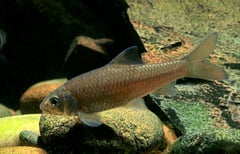
Max length100mm SL3.9in SLTank120 × 30cm48 × 12inTemp23–26°C73–79°FpH6.0–7.5Discherodontus schroederi is a cyprinid native to the Mae Klong and Chao Phraya river basins in Thailand. Said to be the hardiest member of the genus, it is rarely collected for the aquatic trade, presumably because it is the least colourful of the Thai species. Juveniles can be confused with D. ashmeadi, but its dark dorsal blotch fades to a thin distal band with age, and its barbels are noticeably longer than in other members of the genus.
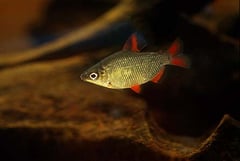
Distichodus affinisSilver Distichodus
authority not recorded
Max length200mm SL8in SLTank120 × 30cm48 × 12inTemp23–27°C73–81°FpH6.0–8.0The silver distichodus, Distichodus affinis, is an active citharinid from the Lower and Central Congo basin. It develops bright red fins as it matures and some specimens a pink sheen on the underside, and these variations may indicate different species. It will eat most greenery, so it suits a tank furnished with smooth rocks and driftwood better than a planted one.
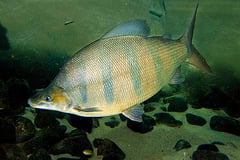
Distichodus lusossoLong-nosed Distichodus
authority not recorded
Max length375mm SL15in SLTanknot recordedTemp22–26°C72–79°FpH6.5–7.5The long-nosed distichodus, Distichodus lusosso, is a citharinid from rivers in Cameroon, the Republic of Congo and Democratic Republic of Congo. One of only a handful of Distichodus seen with any regularity in the hobby, it loses much of its juvenile colour and patterning as it matures. It resembles D. sexfasciatus but has a narrow, pointed head, and some specimens become very spiteful with age.
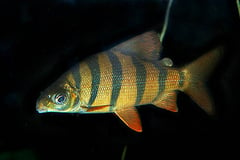
Distichodus sexfasciatusSix-banded Distichodus
authority not recorded
Max length750mm SL30in SLTank240 × 90cm96 × 36inTemp22–26°C72–79°FpH6.0–7.5The six-banded distichodus, Distichodus sexfasciatus, is a large citharinid from Cameroon, the Democratic Republic of Congo and Tanzania. The most common Distichodus in the hobby, it is often sold for the general community tank, which its temperament and size do not suit: it reaches 75 cm, though rarely more than 40 cm in aquaria. Juveniles are orange and black striped with red fins, but much of this colour fades as the fish grows.
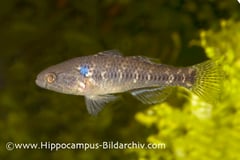
Dormitator lebretonisClay Goby
authority not recorded
Max length120mm SL5in SLTanknot recordedTemp22–26°C72–79°FpH7.0–8.5The clay goby, Dormitator lebretonis, is an eleotrid from coastal Western Africa, where it lives in estuaries, lagoons and mangroves. Mainly found in brackish water, it makes a peaceful addition to the brackish or hardwater community of medium-sized fish, though it will eat anything that fits in its mouth. Adults develop a pattern of reds and blues, and it was formerly placed in the defunct genus Batanga.
Duringlanis perugiaeOil Catfish
(Steindachner, 1882)
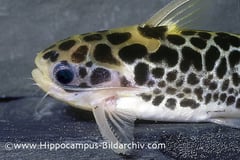
Max length60mm SL2.4in SLTank45 × 30cm18 × 12inTemp24–30°C75–86°FpH4.9–8.0The oil catfish, Duringlanis perugiae, is a small auchenipterid catfish from Peru and Ecuador. It lives around the shorelines of swift-flowing rivers with sandy substrates and no aquatic plants. By day it squeezes into spaces little bigger than itself, emerging in the evening to feed close to the surface in the flow. It breeds quite easily given strong flow and plenty of small crevices.

Ectodus descampsiiDescamp's Strange-Tooth Cichlid
authority not recorded
Max length104mm SL4in SLTank90 × 30cm36 × 12inTemp24–27°C75–81°FpH7.5–9.0Descamp's strange-tooth cichlid, Ectodus descampsii, is a shy cichlid endemic to Lake Tanganyika, between Moliro and Utinta Bay. It inhabits open water over sand and is gregarious, so a group of at least eight is recommended. An undescribed fish, Ectodus sp. 'north', is sometimes imported under this name and has a smaller adult size and a black dorsal spot towards the front of the fin (in the middle in E. descampsii).