Every species
Filters
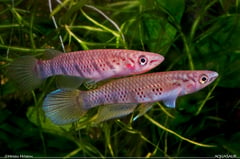
Epiplatys sexfasciatusSix-barred Panchax
Gill, 1862
Max length70mm SL2.8in SLTank80 × 30cm31 × 12inTemp20–27°C68–81°FpH5.0–7.0The six-barred panchax, Epiplatys sexfasciatus, is a killifish from coastal regions between Gabon and Ghana. Well established in the hobby in several forms, it has a confusing taxonomy, and some authors restrict it to northwestern Gabon and Equatorial Guinea and treat other populations as subspecies. It mostly inhabits freshwater swamps and minor tributary streams, and is relatively easy to breed.
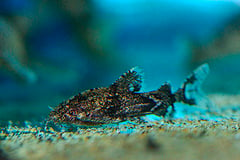
Erethistes filamentosus
(Blyth, 1860)
Max length40mm SL1.6in SLTank45 × 30cm18 × 12inTemp20–24°C68–75°FpH6.0–7.0Erethistes filamentosus is a small erethistid catfish from the Ataran, Salween and Sittang river drainages of Myanmar and Thailand. It lives in shallow, fast-flowing water over rocks and spends much of its time buried in the substrate or hiding in caves. The Catalog of Fishes places it in Erethistes and FishBase in Hara, and its outwardly pointing pectoral-fin denticles are a Hara character.

Eretmodus cyanostictusStriped Goby Cichlid
Boulenger, 1898
Max length80mm SL3.1in SLTank90 × 30cm36 × 12inTemp24–28°C75–82°FpH8.0–9.0The striped goby cichlid, Eretmodus cyanostictus, is one of the goby cichlids endemic to Lake Tanganyika, living in the surge zone of rocky shores. It scrapes algae from the rocks with specialised teeth and has a swim bladder rendered useless to reduce buoyancy. Delicate in aquaria, it needs the highest water quality, a higher pH than many Tanganyikans and a specialised diet, and is not recommended for beginners.
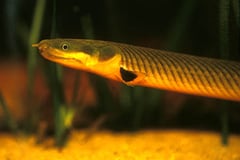
Erpetoichthys calabaricusRopefish
authority not recorded
Max length900mm SL35in SLTank150 × 60cm60 × 24inTemp23–30°C73–86°FpH6.0–7.5The ropefish, Erpetoichthys calabaricus, is a nocturnal polypterid from shallow, heavily vegetated waters in Western Africa. The only member of its genus, it is closely related to Polypterus, and its divided swim bladder serves as an accessory breathing organ, so it can drown if denied atmospheric air. It grows to 90 cm and will eat tankmates it can fit in its mouth.
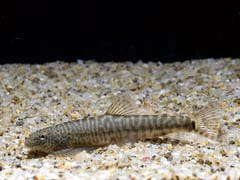
Erromyzon sinensis
(Chen, 1980)
Max length55mm SL2.2in SLTank75 × 30cm30 × 12inTemp18–24°C64–75°FpH6.0–7.5Erromyzon sinensis is a gastromyzontid loach from the Xi Jiang (West River) system in southern China, mostly in Guangxi. It is extremely rare to nonexistent in the aquarium trade, although its name has been widely misapplied to congeners such as the unidentified E. sp. 'ER02'. An obligate bottom-dweller, it lives in shallow, fast-flowing, highly-oxygenated headwaters and minor tributaries, clinging to rocks with its flattened body and horizontally-orientated paired fins.
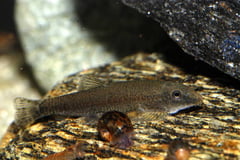
Erromyzon sp. 'ER01'
authority not recorded
Max length45mm SL1.8in SLTank60 × 30cm24 × 12inTemp18–24°C64–75°FpH6.5–8.0Erromyzon sp. 'ER01' is an unidentified gastromyzontid loach, probably native to the Xi Jiang (West River) system in southern China. Its range is unconfirmed: the fish pictured arrived as a contaminant in a shipment of Beaufortia kweichowensis. It appears somewhat similar to Erromyzon yangi. Like its congeners it needs the clean, well-oxygenated, fast-flowing water of shallow headwaters and minor tributaries.
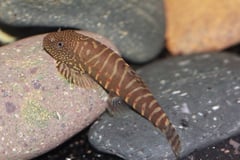
Erromyzon sp. 'ER02'
authority not recorded
Max length50mm SL2.0in SLTank60 × 30cm24 × 12inTemp18–24°C64–75°FpH6.5–8.0Erromyzon sp. 'ER02' is an unidentified gastromyzontid loach from southern China, traded as Erromyzon sp. 'red spots'. Other trade names include 'Strawberry Spot Sucker Loach', and it has also been sold as a Gastromyzon or Pseudogastromyzon species. No other Erromyzon is known with a dark base colour, thin paler vertical bars on the body and similar spots on the head, and older fish develop red spots along the lateral line.
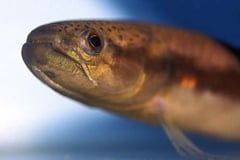
Erythrinus erythrinusRed Wolf Fish
authority not recorded
Max length200mm SL8in SLTank120 × 30cm48 × 12inTemp22–26°C72–79°FpH5.5–7.5The red wolf fish, Erythrinus erythrinus, is a predatory erythrinid from Peru, French Guiana, Venezuela, Trinidad and Tobago and Brazil. Colour and pattern vary with collection locality, and genetic differences between populations suggest it is a species complex. A modified swim bladder lets it breathe in oxygen-deficient, stagnant water. It is very intolerant of conspecifics, often fighting them to the death, and will strike at nets and siphon tubes with its sharp teeth.
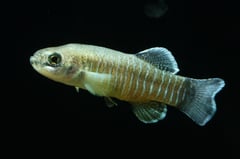
Esmaeilius arakensisArak Toothcarp
(Teimori, Esmaeili, Gholami, Zarei, & Reichenbacher, 2012)
Max length35mm SL1.4in SLTank120 × 30cm48 × 12inTemp8–32°C46–90°FpH7.0–8.5The Arak toothcarp, Esmaeilius arakensis, appears to be endemic to a handful of natural springs near Arak in the Namak Lake basin, northern Iran. It was in the hobby for several years before its description, as Aphanius sp. 'Namak' or 'Namak River'. Externally it looks very similar to its closest relatives A. farsicus and A. sophiae. Aggressive spawning behaviour and its water requirements make it a poor choice for the community aquarium.
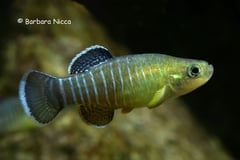
Esmaeilius persicusFarsi Toothcarp
(Jenkins, 1910)
Max length60mm SL2.4in SLTank120 × 30cm48 × 12inTemp8–32°C46–90°FpH6.5–8.0The Farsi toothcarp, Esmaeilius persicus, is endemic to the Lake Maharlu basin near Shiraz in Fars Province, southern Iran. The hypersaline lake supports no fish, so it lives in the surrounding springs, pools, lagoons and marshes of fresh to brackish water. Males look very like those of its close relative E. sophiae, but females have stripes on the flanks where E. sophiae has spots. Most fish in the hobby come from Barm-e-shur spring.
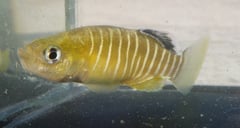
Esmaeilius vladykoviZagros Toothcarp
(Coad, 1988)
Max length60mm SL2.4in SLTank120 × 30cm48 × 12inTemp12–32°C54–90°FpH6.2–8.5The Zagros toothcarp, Esmaeilius vladykovi, is restricted to a small area of the Zagros mountains in Chahārmahāl o Bakhtiyārī province, Iran. It lives over 2000 m above sea level in slow freshwater streams, pools and marshes of the upper Karun River basin. The dark dorsal fin of males separates it from its closest relative A. sophiae. Males are relatively peaceful towards one another, and it swims in large schools in nature.

Esomus caudiocellatus
Ahl, 1924
Max length40mm SL1.6in SLTank120 × 30cm48 × 12inTemp20–26°C68–79°FpHnot recordedEsomus caudiocellatus is a cyprinid from Myanmar, collected from the Salween river system in the east of the country and in northwestern Thailand. It lacks the dark lateral stripe of its congeners and has a prominent dark marking on the caudal peduncle. Like other Esomus it has greatly enlarged pectoral fins and very long maxillary barbels. Some hobbyists have recorded a wasting disease in Esomus spp. that usually kills within a couple of weeks.

Esomus danricaFlying Barb
(Hamilton, 1822)
Max length70mm SL2.8in SLTank120 × 30cm48 × 12inTemp20–26°C68–79°FpH6.0–8.0The flying barb, Esomus danrica, is a cyprinid with an enormous range across Pakistan, Nepal, Bangladesh, most of India, Myanmar and Sri Lanka. It shows a marked preference for shallow, slow-moving and standing waters such as rice paddies with dense vegetation, and is generally absent from major river channels. Reports on its suitability for community aquaria are mixed, with some keepers seeing a pronounced tendency to nip fins.

Esomus longimanusMekong Flying Barb
(Lunel, 1881)
Max length80mm SL3.1in SLTank120 × 30cm48 × 12inTemp20–28°C68–82°FpH6.0–8.0The Mekong flying barb, Esomus longimanus, is a cyprinid from the Mekong basin in Thailand, Laos, Cambodia and Vietnam, and the Tonlé Sap system. It favours shallow, slow-moving and standing waters with dense aquatic vegetation, such as ditches, marshes and rice paddies. Like other Esomus it has greatly enlarged pectoral fins and very long maxillary barbels, and it jumps well enough to escape through the tiniest gaps.

Esomus metallicusStriped Flying Barb
Ahl, 1923
Max length75mm SL3.0in SLTank120 × 30cm48 × 12inTemp20–26°C68–79°FpH6.0–7.0The striped flying barb, Esomus metallicus, is a cyprinid found from the Salween basin in Myanmar east across Thailand to Laos and Cambodia. It is abundant over most of this range and moves into rice paddies and other flooded ground at the onset of the wet season, returning to permanent water when the flooding recedes. Its lateral stripe grows more intense towards the tail and ends at the caudal-fin base.

Etroplus canarensisCanara Pearlspot Cichlid
Day, 1877
Max length110mm SL4in SLTank120 × 45cm48 × 18inTemp22–32°C72–90°FpH6.0–7.5The Canara pearlspot cichlid, Etroplus canarensis, appears to be endemic to the Kumaradhara-Netravati river system in southern Karnataka, India. Also known as the banded chromide or 'roman numeral' cichlid, it lives only in oxygen-rich fresh water, unlike its euryhaline relatives. Unmanaged collection raised concerns over its status, and commercial breeding in Southeast Asia has since reduced the pressure on wild stocks. Sexual maturity takes around 24 months.

Etroplus suratensisGreen Chromide
(Bloch, 1790)
Max length350mm SL14in SLTanknot recordedTemp20–30°C68–86°FpH7.0–8.5The green chromide, Etroplus suratensis, is a euryhaline cichlid from peninsular India and Sri Lanka, growing to 350 mm SL. It mostly inhabits brackish estuaries, coastal lagoons and lower river reaches. Not especially popular in the hobby, it is an important food fish, and some populations have crashed through over-exploitation. In Sri Lanka's Negombo Lagoon Pseudetroplus maculatus has been seen acting as its cleaner while also eating its eggs and fry.
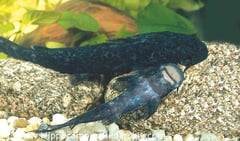
Euchilichthys guentheri
authority not recorded
Max length190mm SL7in SLTank120 × 30cm48 × 12inTemp23–27°C73–81°FpH6.4–7.4Euchilichthys guentheri is a mochokid catfish from the Democratic Republic of Congo, where it inhabits fast-flowing areas of rivers. It is very rare in the hobby. It is told apart from similar Chiloglanis species by its elliptical mouthparts and larger adult size, reaching 19 cm. It needs strong flow and well-oxygenated water, and becomes territorial with conspecifics as it matures.

Exodon paradoxusBucktooth Tetra
authority not recorded
Max length150mm SL6in SLTank120 × 45cm48 × 18inTemp23–28°C73–82°FpH5.5–7.5The bucktooth tetra, Exodon paradoxus, is a scale-ripping characin widespread in the Brazilian Amazon. The only member of its genus, it has teeth that allow it to tear scales from other fishes. It will relentlessly attack silver-coloured or shiny tankmates, even larger predators, so it is best kept as a large shoal in a species setup. Scaleless and non-reflective fish are generally left alone.
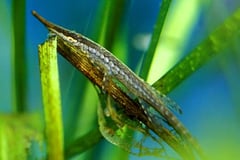
Farlowella vittataTwig Catfish
Myers, 1942
Max length150mm SL6in SLTank90 × 30cm36 × 12inTemp24–27°C75–81°FpH6.0–7.0The twig catfish, Farlowella vittata, is a stick-like loricariid from the Orinoco river basin in Colombia and Venezuela. This is the most common Farlowella in hobbyists' tanks, although much of the literature refers to it as F. acus, which has a shorter, less slender rostrum. It is super sensitive to poor water quality and should only go into an established aquarium with a good biofilm, algae or dried leaves.