Erythrinus erythrinus
Red Wolf Fish
Last revised 2026Edit this page
On this page11 sections
Quick factsEdit
Difficulty5 of 8 measures
- Space
- large tank
- Water
- flexible
- Temp
- needs a steady temperature
- Diet
- won't eat dried food
- Temperament
- eats smaller fish
- Social
- unknown
- Compatibility
- unknown
Other demands
Each of these can raise the rating on its own, whatever the measures above say.
- Hardiness
- unknown
Before you buy
Needs a tight-fitting lid as this species is known to jump
Make sure the cover is very tightly fitting as it can and will escape if given the opportunity.
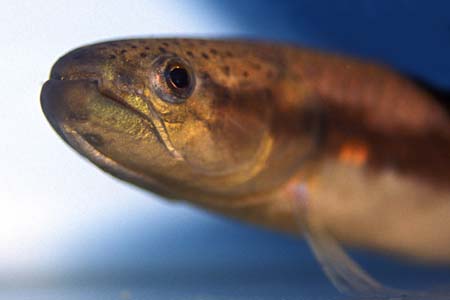
The red wolf fish, Erythrinus erythrinus, is a predatory erythrinid from Peru, French Guiana, Venezuela, Trinidad and Tobago and Brazil. Colour and pattern vary with collection locality, and genetic differences between populations suggest it is a species complex. A modified swim bladder lets it breathe in oxygen-deficient, stagnant water. It is very intolerant of conspecifics, often fighting them to the death, and will strike at nets and siphon tubes with its sharp teeth.
Distribution
EditHabitat
Write a noteEditAquarium size
Write a noteEdit120 ∗ 30 ∗ 30 cm48 ∗ 12 ∗ 12 in - ~108 litres~29 US gal.
Maintenance
Write a noteEditIdeally keep it in a heavily planted tank with plenty of floating vegetation, which will allow it to exhibit its natural behaviour. In a brightly lit or sparsely decorated tank, it tends to spend a lot of its time hidden away. It can be kept in unplanted tanks, but at the very least provide lots of hiding places and refuges. Make sure the cover is very tightly fitting as it can and will escape if given the opportunity.
Water conditions
EditTemperature: 22 – 26 °C72 – 79 °F
pH: Very adaptable and unfussy regarding water chemistry. Anywhere in the range 5.5-7.5 is ok.
Hardness: 2-25°H.
These recommendations come from this profile’s own figures. They contain affiliate links, so we may earn a commission.
Diet
Write a noteEditFeeds on both insects and fish in nature. In the aquarium its diet should consist of meaty fare such as earthworms, prawns, mussels and white fish such as lancefish. It usually refuses dried foods, although some specimens have been known to accept them over time. Many hobbyists feed predatory species such as this on large quantities of live 'feeder' fish, but there is no real benefit to this. Also, there is always the risk of introducing disease or parasites when feeding live fish.
Behaviour and compatibility
Write a noteEditDespite its fearsome appearance, it can be combined with other similarly-sized species in a large tank. In order to see it act naturally, though, it's much better off when kept alone as a single specimen. Smaller fish will be eaten and it's very intolerant of conspecifics, often fighting with them to the death.
Sexual dimorphism
Write a noteEditUnknown. Mature females are likely to be rounder in the belly than males.
Reproduction
Write a noteEditHas not been bred in the hobby.
Notes
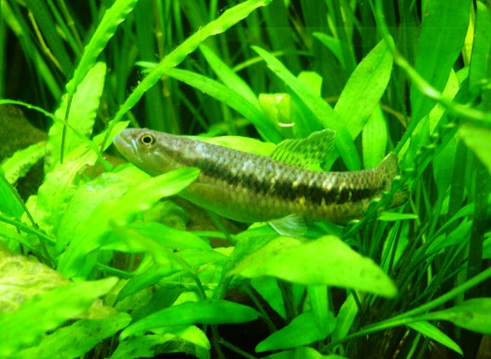
EditA species for the specialist, E. erythrinus is also known as the rainbow wolf fish or red hi-fin wolf fish. It is quite variable in colour and pattern depending on collection locality. There is a variant from Peru that has a bright orange belly. Recent studies have highlighted genetic differences in these different populations, suggesting that E. erythrinus is actually a species complex, rather than a single species. There is currently one other recognised species in the genus, E. kessleri, but it's virtually unheard of in the hobby.
All the variants have a modified swim bladder that acts as an accessory breathing organ, allowing the fish to survive in oxygen-deficient and stagnant waters. It's also been known to travel over land for short distances to new habitats when seasonal waters begin to dry up.
Interestingly, in French Guiana, juvenile specimens are known to mimic the colour pattern of the female of a particular species of Rivulus killifish, which shares its habitat. Male Rivulus are attracted to the mimic, only to meet with an untimely demise. As the Erythrinus grows it develops more colour and ceases this strategy.
Take care when performing tank maintenance of this species, as its mouth is filled with sharp teeth, and the fish show no fear, often striking at any new object placed in the tank, such as siphon tubes or nets.
Species images · 2
These photographs are used with each photographer’s permission.
Send a photographProfile completeness18 of 24
75% complete
Also missing: a recorded distribution, taxonomic authority, etymology.
Community
Questions about Erythrinus erythrinus?
Ask on Discord