Every species
Filters
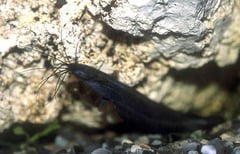
Heteropneustes fossilisLiver Catfish
authority not recorded
Max length300mm SL12in SLTank120 × 45cm48 × 18inTemp21–25°C70–77°FpH6.0–8.0The liver catfish, Heteropneustes fossilis, is a catfish from Iran, Pakistan, India, Nepal, Sri Lanka, Bangladesh, Myanmar and the Andaman Islands. Also known as the stinging or fossil catfish, it carries venom sacs at the base of the pectoral spines and its sting is very painful, so it is not recommended for the inexperienced. Exceptionally hardy and long-lived, it can breathe atmospheric air to a certain extent and survives in sluggish, oxygen-deficient swamps and ditches.

Holopristis ocelliferaHead-and-tail light Tetra
authority not recorded
Max length45mm SL1.8in SLTank60 × 38cm24 × 15inTemp24–28°C75–82°FpH5.5–7.5The head-and-tail light tetra, Holopristis ocellifera, is a small characin from Guyana, Suriname, French Guiana, Peru and Brazil. Also known as the beacon tetra, it is hardy, inexpensive and one of the best choices for a newcomer to fishkeeping. Wild fish are rarely offered, since it is commercially bred in huge numbers for the trade, and a selectively bred albino form is also available.

Holopristis pulchraPretty Tetra
authority not recorded
Max length45mm SL1.8in SLTank60 × 38cm24 × 15inTemp23–27°C73–81°FpH5.5–7.0The pretty tetra, Holopristis pulchra, is a small characin endemic to the Upper Amazon in Peru, found in slow-moving tributaries under forest cover. Also known as the garnet or black wedge tetra, it is hardy, inexpensive and a good choice for the beginner. The vast majority on sale in the UK come from commercial farms in Eastern Europe, and it does well in most general community tanks.
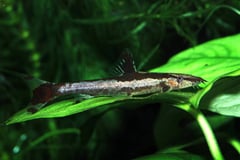
Homaloptera bilineata
Blyth, 1860
Max length100mm SL3.9in SLTank120 × 30cm48 × 12inTemp20–25.5°C68–78°FpH6.0–7.5Homaloptera bilineata is a 'lizard' loach from the Sittaung and Salween basins of Myanmar and tributaries of the Mae Klong in western Thailand. Uniquely in the genus, the dark markings running back from the snout form two distinct stripes meeting at the dorsal fin and do not form saddles. An obligate dweller of swift, oxygen-saturated streams, it needs clean, well-oxygenated water and is best kept in a group of six or more.
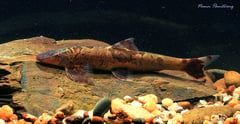
Homaloptera confuzona
Kottelat, 2000
Max length85mm SL3.3in SLTank120 × 30cm48 × 12inTemp20–25.5°C68–78°FpH6.0–7.5Homaloptera confuzona is a 'lizard' loach mostly recorded from the Mekong basin in Laos and Cambodia, and from smaller drainages in southern Thailand. It appears in the trade from time to time, though not always identified correctly. It resembles H. orthogoniata and H. parclitella, but its saddle-shaped markings are more irregular, up to four in number, and often restricted to the upper half of the body.
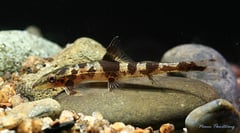
Homaloptera ogilviei
Alfred, 1967
Max length50mm SL2.0in SLTank60 × 30cm24 × 12inTemp20–25.5°C68–78°FpH6.0–7.5Homaloptera ogilviei is a small 'lizard' loach recorded through much of the Malay Peninsula in both Malaysia and southern Thailand. Quite rare in the trade, it is sometimes imported as bycatch and sold as 'lizard' or 'gecko' loach. Its paired fins are orientated vertically, unlike those of other members of the genus, and in aquaria it perches on the tips of its fins at rest. It favours slower stretches among plants, roots or leaf litter.
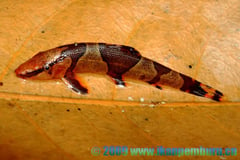
Homaloptera orthogoniataSaddle-back Loach
Vaillant, 1902
Max length95mm SL3.7in SLTank120 × 30cm48 × 12inTemp20–25.5°C68–78°FpH6.0–7.5The saddle-back loach, Homaloptera orthogoniata, is a 'lizard' loach endemic to Borneo, known from rivers in Sarawak and Kalimantan. It was historically said to occur across much of Indochina. It is rare in the hobby, and most images online and in the literature show H. confuzona or H. parclitella. It always has three large, saddle-shaped markings on the back, the third between the dorsal and caudal fins.
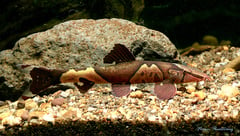
Homaloptera parclitella
Tan & Ng, 2005
Max length80mm SL3.1in SLTank120 × 30cm48 × 12inTemp20–25.5°C68–78°FpH6.0–7.5Homaloptera parclitella is a 'lizard' loach from Peninsular Malaysia and the Sai Buri, Bang Nara and Kolok river systems of southern Thailand. It was previously considered a form of H. orthogoniata and may be seen identified as such online and in print. It always has two large, saddle-shaped markings on the back, where H. orthogoniata has three, and it lives in swift, clear, oxygen-saturated streams.
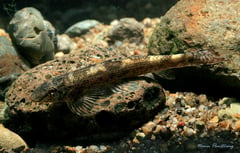
Homalopteroides modestus
(Vinciguerra, 1890)
Max length44mm SL1.7in SLTank60 × 30cm24 × 12inTemp18–25.5°C64–78°FpH6.0–7.5Homalopteroides modestus is a small hillstream loach from the Salween, Mae Klong and Tenasserim rivers of southern Myanmar and western Thailand. Randall and Page (2012) redescribed it from Mae Klong specimens that had previously been identified as the congener H. smithi. A specialised micropredator of swift, clear, oxygen-saturated streams, it needs clean, well-oxygenated water and regular meals of live or frozen food.
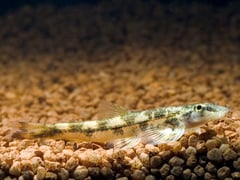
Homalopteroides nebulosus
(Alfred, 1969)
Max length36mm SL1.4in SLTank60 × 30cm24 × 12inTemp20–25.5°C68–78°FpH6.0–7.5Homalopteroides nebulosus is a small hillstream loach described from the Sok River in northern Peninsular Malaysia and since recorded from Borneo. Poorly known in the aquarium hobby, it may never have been exported for the ornamental trade. Its eyes sit in a comparatively raised position on the head, as in H. tweediei, but it has more lateral line scales. Little is known of its habitat, which is presumed to be swiftly-flowing streams and headwaters.
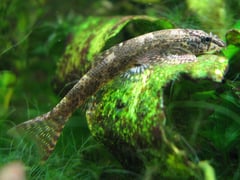
Homalopteroides smithi
(Hora, 1932)
Max length60mm SL2.4in SLTank60 × 30cm24 × 12inTemp20–25.5°C68–78°FpH6.0–7.5Homalopteroides smithi is a hillstream loach from Thailand, Peninsular Malaysia and parts of the Mekong basin in Laos, Cambodia and Vietnam. Perhaps the best-known member of the genus, it is relatively common in the aquarium hobby, and Rainboth (1996) considered it 'probably the commonest member of the genus in the Mekong'. An obligate dweller of swiftly-flowing streams and headwaters, it needs clean, well-oxygenated water.
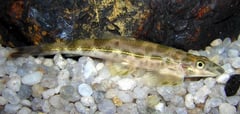
Homalopteroides stephensoni
(Hora, 1932)
Max length65mm SL2.6in SLTank60 × 30cm24 × 12inTemp20–25.5°C68–78°FpH6.0–7.5Homalopteroides stephensoni is a hillstream loach from Borneo, recorded from Kalimantan in Indonesia and from Sabah and Sarawak in Malaysia. Poorly known in the aquarium hobby, it may never have been exported for the ornamental trade. Originally described in Homaloptera, it was placed in Balitoropsis by Kottelat (2012), who subsequently followed Randall and Page (2012) in treating it as a Homalopteroides. Like its congeners it inhabits swiftly-flowing, clear, oxygen-saturated streams.
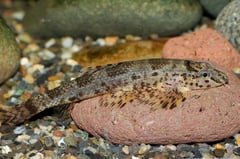
Homalopteroides tweediei
(Herre, 1940)
Max length40mm SL1.6in SLTank45 × 30cm18 × 12inTemp20–25.5°C68–78°FpH6.0–7.5Homalopteroides tweediei is a small hillstream loach from Peninsular Malaysia, the Mekong system and West Kalimantan in Indonesian Borneo. It is often confused with the congener H. smithi. Rainboth (1996) found it less likely to occur in riffles or runs than other members of the genus, and it shows a preference for moderately-flowing stretches of clear, oxygen-rich streams among patches of live or dead vegetation.
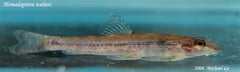
Homalopteroides weberi
(Hora, 1932)
Max length50mm SL2.0in SLTank60 × 30cm24 × 12inTemp20–25°C68–77°FpH6.0–7.5Homalopteroides weberi is a hillstream loach from Sarawak in Malaysian Borneo, described from the Akar River and possibly endemic to the state. Poorly known in the aquarium hobby, it was questioned as a possible synonym of Balitoropsis stephensoni by Kottelat (2012), but Randall and Page consider it distinct. It inhabits swiftly-flowing streams and headwaters with clear, oxygen-saturated water.
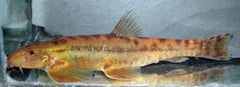
Homalopterula gymnogaster
(Bleeker, 1853)
Max length65mm SL2.6in SLTank80 × 30cm31 × 12inTemp20–27°C68–81°FpH6.0–7.5Homalopterula gymnogaster is a hillstream loach from Sumatra, Indonesia, described from Lake Maninjau and recorded from Jambi province northwards. Tan and Kottelat (2009) describe it as a relatively common highland species of riffles and 'quiet waters'. That makes it unusual, since Homaloptera species are not normally associated with standing water, though it remains unclear whether the fish come from the lakes themselves or their outflowing rivers.
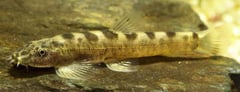
Homalopterula ripleyi
Fowler, 1940
Max length59mm SL2.3in SLTank80 × 30cm31 × 12inTemp20–25.5°C68–78°FpH6.0–7.5Homalopterula ripleyi is a hillstream loach known only from a small area of northern Sumatra, Indonesia, on the eastern slopes of the Barisan range. Fowler (1940) described it from a single specimen as the only member of his new genus Homalopterula. Gerhard Ott and Dirk Dettmers collected it in 2003 for the first time in over 60 years, from small, clear forest streams over bedrock, boulders, rocks and gravel.
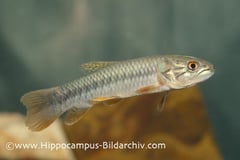
Hoplerythrinus unitaeniatusGold Wolf Fish
authority not recorded
Max length400mm SL16in SLTanknot recordedTemp23–27°C73–81°FpH5.5–7.5The gold wolf fish, Hoplerythrinus unitaeniatus, is a predatory erythrinid widespread throughout much of South America. Also known as the golden trahira, it inhabits small tributaries, swamps, marshes and forest lake margins, and can breathe air using a modified swim bladder. The only member of its genus to appear in the trade with any regularity, it is really a fish for the specialist and is intolerant of conspecifics.
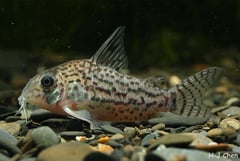
Hoplisoma acrenseAcre Cory
(Nijssen, 1972)
Max length55mm SL2.2in SLTanknot recordedTemp21–25°C70–77°FpH6.0–7.5The Acre cory, Hoplisoma acrense, long known as Corydoras acrensis, is an armoured catfish that appears to be endemic to the rio Juruá basin in Acre State, Brazil. It was apparently described from a single specimen, and little has been written about it since. Peaceful and gregarious, it should be kept in a group of at least 4-6.
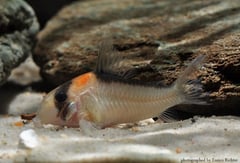
Hoplisoma adolfoiAdolfo's Cory
(Burgess, 1982)
Max length60mm SL2.4in SLTanknot recordedTemp20–26°C68–79°FpH4.0–7.0Adolfo's cory, Hoplisoma adolfoi, long known as Corydoras adolfoi, is an armoured catfish apparently highly endemic to the upper rio Negro near São Gabriel da Cachoeira, Brazil. One of several rio Negro Corydoras with an oblique dark bar along the back, it is most easily confused with H. duplicareum and cannot be separated from it reliably by colour. It inhabits pristine blackwater tributaries and flooded forest.
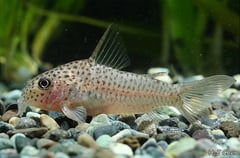
Hoplisoma albolineatumC056
(Knaack, 2004)
Max length50mm SL2.0in SLTanknot recordedTemp22–32°C72–90°FpH6.0–7.5Hoplisoma albolineatum (C056), long known as Corydoras albolineatus, is an armoured catfish from the Río Iténez, or Guaporé, system in Bolivia and Brazil. It has a wide white longitudinal band and unmarked fins, and may be confused with the deeper-bodied H. xinguense. In the wild it forms aggregations of up to several thousand over sandy substrates and sand banks. It is not common in the hobby but is available occasionally.