Every species
Filters
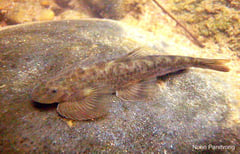
Hemimyzon nanensis
Doi & Kottelat, 1998
Max length57mm SL2.2in SLTank90 × 30cm36 × 12inTemp16–22°C61–72°FpH6.0–8.0Hemimyzon nanensis is a balitorid loach known only from the upper Mae Nam Nan river basin, part of the Chao Phraya system in northern Thailand. It was the first member of the genus recorded outside China and Taiwan. At the type locality it was collected in shallow riffles over algae-covered stones, and in the aquarium it needs clean, well-oxygenated water and a biologically mature set-up.
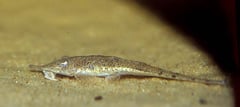
Hemiodontichthys acipenserinusPinocchio Whiptail Catfish
authority not recorded
Max length135mm SL5in SLTank75 × 30cm30 × 12inTemp24–28°C75–82°FpH6.0–7.0The Pinocchio whiptail catfish, Hemiodontichthys acipenserinus, is a loricariid from Guyana, French Guiana, Peru, Bolivia and Brazil. Also known as the knob nosed whiptail, it is hard to confuse with any other Loricariid thanks to its diamond shape seen from above and the enlarged tip of its rostrum. Imports often arrive weak from oxygen deprivation and early losses are high, but once acclimatised it is quite easy to keep over the soft sand in which it partially buries itself.
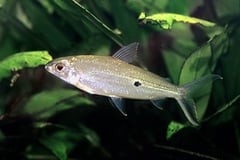
Hemiodus argenteus
authority not recorded
Max length235mm SL9in SLTank120 × 45cm48 × 18inTemp23–27°C73–81°FpH6.0–7.0Hemiodus argenteus is a shoaling hemiodontid characin from Venezuela, Guyana, Suriname and Brazil, where it inhabits floodplain rivers and lakes. Like its congeners it can be very skittish when first introduced but usually settles over time, especially in a large group. Very active and growing to around 235 mm SL, it needs a large tank with a well-fitting cover, as it can leap surprising distances.
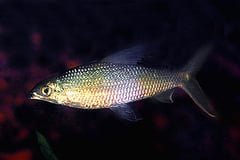
Hemiodus atranalis
authority not recorded
Max length90mm SL3.5in SLTank120 × 30cm48 × 12inTemp23–27°C73–81°FpH6.0–7.0Hemiodus atranalis is a shoaling hemiodontid characin from Guyana, Peru and Brazil, found in floodplain rivers and lakes. Its reported maximum size is only 90 mm, though it probably grows bigger than this. Very active and skittish when first introduced, it usually settles in a large group, and the tank needs a well-fitting cover since it can leap surprising distances.
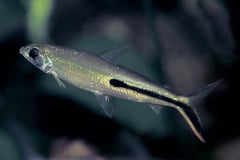
Hemiodus gracilisSlender Hemiodus
authority not recorded
Max length160mm SL6in SLTank120 × 45cm48 × 18inTemp23–27°C73–81°FpH5.8–7.2The slender hemiodus, Hemiodus gracilis, is a shoaling characin from Venezuela and Brazil, found in floodplain rivers and lakes. Probably the most often seen member of the genus in the hobby, it is sometimes sold as the red or red-tailed hemiodus. Very active and nervous when first introduced, it settles best in a large group in a spacious tank with a well-fitting cover.
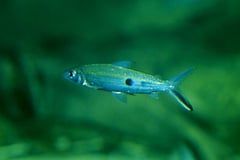
Hemiodus orthonops
authority not recorded
Max length250mm SL10in SLTank120 × 45cm48 × 18inTemp22–26°C72–79°FpH6.5–7.5Hemiodus orthonops is a large, shoaling hemiodontid characin from Brazil, Paraguay and Argentina, where it inhabits floodplain rivers and lakes. Growing to around 250 mm SL and very active, it needs a tank of at least 120 cm with a well-fitting cover. Like its congeners it can be nervous when first introduced but usually settles over time, especially in a large group.
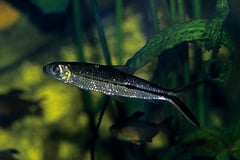
Hemiodus ternetzi
authority not recorded
Max length105mm SL4in SLTank120 × 30cm48 × 12inTemp23–27°C73–81°FpH6.0–7.0Hemiodus ternetzi is a shoaling hemiodontid characin known only from the Rio Tocantins basin in Brazil. It can be identified by its black lateral stripe, which extends to behind the eye, and a dorsal fin with no pigmentation. Like other Hemiodus it can be skittish when first introduced but usually settles, especially in a large group.
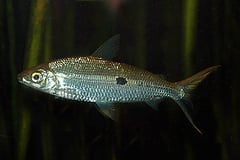
Hemiodus unimaculatus
authority not recorded
Max length215mm SL8in SLTank120 × 45cm48 × 18inTemp22–26°C72–79°FpH5.5–7.5Hemiodus unimaculatus is a large, shoaling hemiodontid characin from Guyana, Suriname, French Guiana and Brazil. It inhabits floodplain lakes and fast-moving parts of rivers and grows to around 215 mm SL. Somewhat flighty, it needs a spacious, well-covered tank and a large group to settle, and in nature it is known to spawn during the wet season.

Henicorhynchus caudimaculatus
(Fowler, 1934)
Max length150mm SL6in SLTanknot recordedTempnot recordedpHnot recordedHenicorhynchus caudimaculatus is a riverine cyprinid from the middle to lower Mekong basin and the Chao Phraya, in China, Laos, Thailand and Cambodia. It is most often collected in mid-to-large channels, although in the Mekong basin it also enters smaller tributaries and inundated fields. It has a pair of small maxillary barbels and 5-6 faint, thin stripes along each flank, and has also been placed in Cirrhinus, Bangana, Labeo and Gymnostomus in the last few decades.

Henicorhynchus entmema
(Fowler, 1934)
Max length150mm SL6in SLTanknot recordedTempnot recordedpHnot recordedHenicorhynchus entmema is a cyprinid from the middle to lower Mekong basin in Laos, Thailand and Cambodia, and the Chao Phraya and Mae Klong in Thailand. It is considered one of the most abundant species in the massive seasonal migrations of cyprinids in the mainstream Mekong, and enters inundated forests in the wet season. The body is relatively slender and plain silver, with no dark marking on the caudal peduncle, and the snout often projects strongly.

Henicorhynchus ornatipinnis
(Roberts, 1997)
Max length100mm SL3.9in SLTanknot recordedTempnot recordedpHnot recordedHenicorhynchus ornatipinnis is a small cyprinid known only from the Mekong River system in Laos, Thailand and Cambodia. It appears to favour still or slow-moving, often temporarily-inundated, marginal habitats away from the major river channels. Barbels are completely absent, the caudal peduncle is very deep, and the pectoral, pelvic and anal fins are usually reddish-orange or rose-tinted.

Henicorhynchus siamensisSiamese Mud Carp
(Sauvage, 1881)
Max length150mm SL6in SLTanknot recordedTempnot recordedpHnot recordedThe Siamese mud carp, Henicorhynchus siamensis, is a cyprinid from the Mekong, Chao Phraya and Mae Klong basins in Laos, Thailand, Cambodia and Vietnam. Common in the Mekong main channel and larger tributaries, it moves into inundated zones to spawn in the wet season and is abundant in the massive seasonal migrations of cyprinids. It has a relatively deep, plain silver body and a large, broad head.
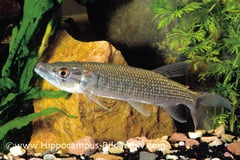
Hepsetus odoeAfrican Pike Characin
authority not recorded
Max length700mm SL28in SLTank180 × 60cm72 × 24inTemp25–28°C77–82°FpH6.0–7.5The African pike characin, Hepsetus odoe, is a predatory characin of West and Central Africa, found from the Sassandra in Ivory Coast to Kribi in Cameroon and in the Niger, Volta and Chad basins. It is an ambush predator with a fearsome set of teeth that superficially resembles the European pike. Juveniles appear in the trade, but it reaches 70 cm in nature and is strictly for the specialist with a very large aquarium.

Herichthys carpintisPearlscale Cichlid
(Jordan & Snyder, 1899)
Max length305mm SL12in SLTank120 × 38cm48 × 15inTemp24–26°C75–79°FpH7.0The pearlscale cichlid, Herichthys carpintis, is a large cichlid from northern Mexico, found in lagoons around the mouth of the Panuco drainage. It is often mislabelled as the Texas or green Texas cichlid, though the Texas cichlid is a different species, H. cyanoguttatus. Not difficult to keep or breed, it digs, can be territorial and sometimes downright aggressive, and males may turn on females when spawning.

Herichthys cyanoguttatusTexas Cichlid
authority not recorded
Max length300mm SL12in SLTanknot recordedTempnot recordedpH6.0–7.5The Texas cichlid, Herichthys cyanoguttatus, is native to the Rio Grande drainage in the southern United States and Mexico. The only cichlid occurring naturally in the USA, it is highly belligerent and territorial, digs constantly and needs a tank of at least 120 cm for a single specimen. The similar H. carpintis is sometimes sold under its name and has larger, scattered flank spots, where H. cyanoguttatus shows obvious lateral rows of small spots.

Heros efasciatusSeverum
authority not recorded
Max length300mm SL12in SLTank120 × 45cm48 × 18inTemp22.2–28.9°C72–84°FpH5.5–7.0The severum, Heros efasciatus, is a cichlid from the Amazon main channel and the Rio Solimoes, also recorded from the Rio Xingu. One of the most popular and readily available cichlids in the hobby, it is sold in the standard green form and in gold. Many buyers do not realise it grows fairly large, often 20 to 25 cm in aquaria, and it needs a tank of at least 120 cm. Outside spawning it is fairly mild-mannered for its size.

Heros notatusSpotted Severum
authority not recorded
Max length300mm SL12in SLTank120 × 38cm48 × 15inTemp22.2–28.9°C72–84°FpH6.0–7.0The spotted severum, Heros notatus, is a cichlid endemic to the Rio Negro basin in Brazil, where it inhabits blackwater rivers and tributaries. Rarely seen, it is occasionally offered by specialist cichlid or South American dealers. Not a particularly aggressive species, though males may squabble with conspecifics, it suits a larger cichlid community, and much smaller fish will almost certainly be eaten.

Herotilapia multispinosaRainbow Cichlid
authority not recorded
Max length175mm SL7in SLTank90 × 38cm36 × 15inTemp22–28°C72–82°FpH7.0–8.0The rainbow cichlid, Herotilapia multispinosa, is a Central American cichlid from eastern Honduras and throughout Nicaragua and Costa Rica. Peaceful by Central American standards, it suits fishkeepers who do not want the more aggressive species, and can live with tetras, barbs and smaller peaceful cichlids. In nature it inhabits turbid lakes, swamps and marshes with soft, muddy substrates, and in the aquarium it typically reaches around 10 cm.

Heterandria formosaLeast Killifish
(Girard, 1859)
Max length20mm SL0.8in SLTanknot recordedTemp20–26°C68–79°FpH7.0–8.0The least killifish, Heterandria formosa, is a tiny livebearer from the United States, found in heavily vegetated margins of still or sluggish water. The smallest known livebearing fish, it is peaceful but not a community fish in the general sense, as the males reach only 2 cm and many commonly kept species will eat them. It is sometimes confused with the much more aggressive mosquito fish of the genus Gambusia.
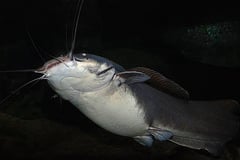
Heterobranchus longifilisVundu
authority not recorded
Max length1500mm SL59in SLTank180 × 60cm72 × 24inTemp20–27°C68–81°FpH5.5–7.5The vundu, Heterobranchus longifilis, is a clariid catfish widespread throughout Africa and one of the largest freshwater fishes on the continent. Growing to 150 cm, it is highly predatory, must be kept alone, and suits only public aquaria or a hobbyist able to house it properly. Its very long adipose fin separates it from similar members of the genus.