Every species
Filters
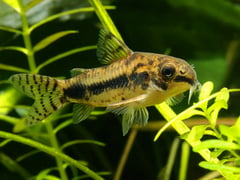
Hoplisoma habrosumSalt and Pepper Cory
(Weitzman, 1960)
Max length35mm SL1.4in SLTank60 × 30cm24 × 12inTemp20–26°C68–79°FpH5.5–7.5The salt and pepper cory, Hoplisoma habrosum, long known as Corydoras habrosus, is a tiny armoured catfish from left bank tributaries of the upper Orinoco in Colombia and Venezuela. Most records come from the Río Apure watershed in the Llanos, where it apparently favours lagoons, streams, inundated forest and grassland with little flow. Also called 'dainty cory' and 'Venezuelan pygmy cory', it has 2-3 dark markings along the side of the body, against 4-5 in the similar H. cochui.
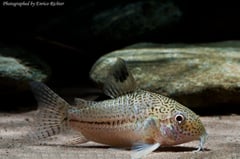
Hoplisoma juliiJulii Cory
(Steindachner, 1906)
Max length55mm SL2.2in SLTank90 × 30cm36 × 12inTemp20–26°C68–79°FpH5.5–7.5The julii cory, Hoplisoma julii, long known as Corydoras julii, is an armoured catfish from coastal river systems south of the Amazon delta in northeastern Brazil. Also known as 'leopard cory' or 'three-lined cory', it is often confused with H. trilineatum from the upper Amazon, and many fish traded as C. julii are that species. H. julii has numerous small, distinct spots on the head, where H. trilineatum has vermiform markings, though some H. trilineatum are spotted too.
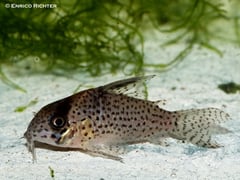
Hoplisoma kaneiC026
(Grant, 1998)
Max length50mm SL2.0in SLTank90 × 30cm36 × 12inTemp20–26°C68–79°FpH5.5–7.5Hoplisoma kanei, long known as Corydoras kanei, is an armoured catfish that appears to be native to the rio Negro basin in Brazil, possibly only the rio Branco drainage. Before description it was assigned the 'C' numbers C026 and C046. It is most easily confused with H. atropersonatum and sometimes traded as that species, but has dark markings in the anal and caudal fins, more numerous and smaller dark spots on the body, and a darker base colouration.
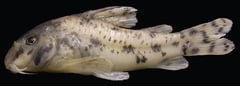
Hoplisoma lacrimostigmata
(Tencatt, Britto & Pavanelli, 2014)
Max length34mm SL1.3in SLTank60 × 30cm24 × 12inTemp20–25°C68–77°FpHnot recordedHoplisoma lacrimostigmata, long known as Corydoras lacrimostigmata, is a small armoured catfish known only from the rio Ivaí basin, in the rio Paraná drainage of Paraná state, southern Brazil. It has three nasal pores and four to six small, rounded black blotches along the centre of the flank. It is most similar to H. flaveolum, but has fewer serrations on the pectoral- and dorsal-fin spines, a slightly pointed snout and a more slender body.
Hoplisoma leucomelasBlackfin Cory
(Eigenmann & Allen, 1942)
Max length55mm SL2.2in SLTank90 × 30cm36 × 12inTemp22–26°C72–79°FpHnot recordedThe blackfin cory, Hoplisoma leucomelas, long known as Corydoras leucomelas, is an armoured catfish from the upper Amazon in Peru. It schools in very large numbers over soft substrates in blackwater rivers, and is exported in huge numbers, often in 'mixed' or 'spotted Corydoras' consignments with the similar Brochis agassizii, B. ambiacus, B. gomezi and H. schwartzi. An obvious dark band through the eye separates it from B. agassizii and B. ambiacus, and its dark dorsal marking extends into the upper body.
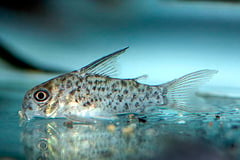
Hoplisoma loretoense
authority not recorded
Max length50mm SL2.0in SLTank45 × 38cm18 × 15inTemp22–25°C72–77°FpH6.0–7.2Hoplisoma loretoense, long known as Corydoras loretoensis, is an armoured catfish from the upper Amazon in Peru, growing to around 50 mm SL. The profile singles out its very long dorsal spine. Nothing is recorded of its habitat.
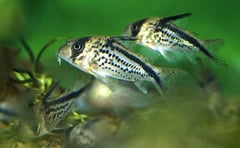
Hoplisoma loxozonum
authority not recorded
Max length55mm SL2.2in SLTank45 × 38cm18 × 15inTemp21–24°C70–75°FpH6.0–7.2Hoplisoma loxozonum, long known as Corydoras loxozonus, is an armoured catfish from the Rio Meta basin in Colombia, also referred to by its C-number, C082. Its habitat in the wild is unknown. It prefers slightly lower temperatures than many Corydoras, which matters when choosing tankmates.
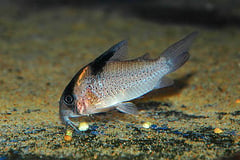
Hoplisoma melanistiumSpotted Cory
authority not recorded
Max length55mm SL2.2in SLTank45 × 30cm18 × 12inTemp22–26°C72–79°FpH6.0–7.0The spotted cory, Hoplisoma melanistium, long known as Corydoras melanistius, is an armoured catfish from coastal rivers and tributaries of Guyana, Suriname and French Guiana. It can be told from the similar Brochis delphax by its 12-13 dorsal-fin rays, against usually 7 in B. delphax. Two subspecies once assigned to it are now H. brevirostre and B. ambiacus.
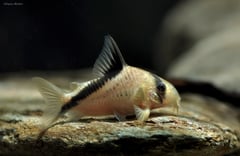
Hoplisoma meliniFalse Bandit Cory
(Lönnberg & Rendahl, 1930)
Max length50mm SL2.0in SLTank80 × 30cm31 × 12inTemp20–26°C68–79°FpH4.0–7.0The false bandit cory, Hoplisoma melini, long known as Corydoras melini, is an armoured catfish from tributaries of the rios Negro, Caquetá and Orinoco in Brazil and Colombia. Its oblique dark bar along the back splits into two above the caudal peduncle, a feature shared only with H. davidsandsi, from which the dark markings on its flanks separate it. The rio Tiquié population is known in the hobby as 'C084', and a similar, slightly larger form from Peru as 'C085'.
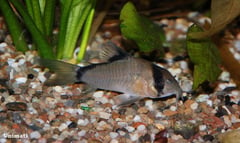
Hoplisoma metaeBandit Cory
(Eigenmann, 1914)
Max length50mm SL2.0in SLTank80 × 30cm31 × 12inTemp20–26°C68–79°FpH6.0–7.5The bandit cory, Hoplisoma metae, long known as Corydoras metae, is an armoured catfish endemic to the upper Río Meta, an Orinoco tributary in eastern Colombia. It appears to be absent from the lower Meta and has not been recorded in Venezuela. Also called 'masked' or 'Meta' cory, it has an oblique dark bar on the rear of the body that ends at the caudal-fin base without splitting, and no other dark markings on the body.
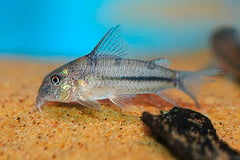
Hoplisoma nattereriNatterer's Cory
authority not recorded
Max length65mm SL2.6in SLTank45 × 30cm18 × 12inTemp20–23°C68–73°FpH6.0–7.6Natterer's cory, Hoplisoma nattereri, long known as Corydoras nattereri, is an armoured catfish from coastal zones of southern Brazil between Espírito Santo and Paraná. Also known as the blue cory, it needs slightly cool conditions, in which many commonly available fish fail to thrive.
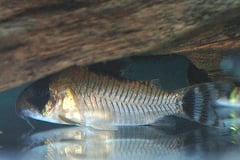
Hoplisoma oiapoquenseFlag-tailed Panda Cory
authority not recorded
Max length55mm SL2.2in SLTank45 × 38cm18 × 15inTemp23–28°C73–82°FpH6.0–7.2The flag-tailed panda cory, Hoplisoma oiapoquense, long known as Corydoras oiapoquensis, is an armoured catfish from the upper Rio Oyapock in French Guiana and Brazil. It lives alongside the near-identical Brochis condiscipulus, and the two are often found shoaling together. The only external differences seem to be the longer snout and wider distribution in the Oyapock of B. condiscipulus.
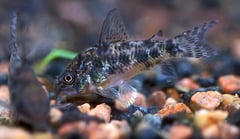
Hoplisoma paleatumPepper Cory
authority not recorded
Max length70mm SL2.8in SLTank61 × 38cm24 × 15inTemp22–26°C72–79°FpH6.0–7.0The pepper cory, Hoplisoma paleatum, long known as Corydoras paleatus, is an armoured catfish from southern Brazil, Uruguay, Paraguay and Argentina. Along with the bronze cory it is one of the most commonly found corys in the hobby. Most fish on sale are captive bred for the trade, and wild-caught specimens are much more vividly coloured. In nature it lives in rivers, tributaries and standing waters including pools and small lakes.
Hoplisoma pandaPanda Cory
authority not recorded
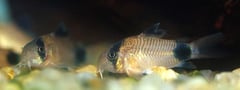
Max length50mm SL2.0in SLTank45 × 30cm18 × 12inTemp22–25°C72–77°FpH6.0–7.4The panda cory, Hoplisoma panda, long known as Corydoras panda, is an armoured catfish from the upper Amazon in Peru, named for dark and light markings that recall the giant panda. Wildly expensive when first imported in the late 1970s, it is now mass-produced, and virtually all fish in the trade are farmed. Wild fish live in clear and blackwater streams that cool to around 19 °C when Andean meltwater arrives.
Hoplisoma petracinii
(Calviño & Alonso, 2010)
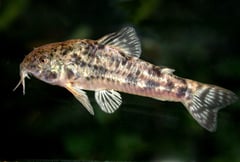
Max length38mm SL1.5in SLTank60 × 30cm24 × 12inTemp10–20°C50–68°FpH7.0–8.0Hoplisoma petracinii, long known as Corydoras petracinii, is an armoured catfish known only from one ephemeral stream in the Río San Lorenzo watershed of Salta province, Argentina. It shows adaptations to life among rocks in flowing water, including a cryptic colour pattern, short dorsal and pectoral spines and reduced body depth. The stream runs almost dry for much of the year and is under great ecological pressure from the nearby city of Salta, road building and dumping of refuse.
Hoplisoma polystictum
authority not recorded
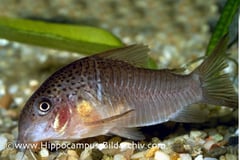
Max length50mm SL2.0in SLTank45 × 30cm18 × 12inTemp20–25°C68–77°FpH6.0–7.6Hoplisoma polystictum, long known as Corydoras polystictus, is a small armoured catfish from the upper Rio Paraguay in the Brazilian state of Mato Grosso. It inhabits small tributaries, creeks, areas of flooded forest and sand banks. It may be confused with H. simile but is easily distinguished by its unpatterned caudal peduncle, since H. simile has a blueish smudge-like marking there. Very peaceful, it is best kept in a group of at least six.
Hoplisoma schwartziSchwartz's Cory
authority not recorded
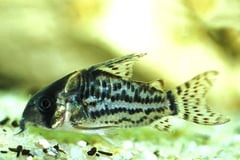
Max length70mm SL2.8in SLTank60 × 38cm24 × 15inTemp22–24°C72–75°FpH6.0–7.5Schwartz's cory, Hoplisoma schwartzi, long known as Corydoras schwartzi, is an armoured catfish endemic to the Rio Purus drainage in Brazil. It inhabits small tributaries, creeks, areas of flooded forest and sand banks. Very peaceful, it is best kept in a group of at least six, and although it can be spawned like many other Corydoras, spawning is apparently tricky to induce in this species.
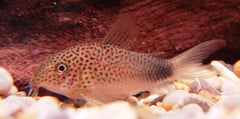
Hoplisoma simileSmudge Spot Cory
authority not recorded
Max length60mm SL2.4in SLTank45 × 30cm18 × 12inTemp21–27°C70–81°FpH5.6–7.0The smudge spot cory, Hoplisoma simile, long known as Corydoras similis, is an armoured catfish from the Rio Madeira basin in Brazil. Several species can be confused with it at first glance, including Gastrodermus guapore, H. caudimaculatum, C. ourastigma and Brochis spectabilis, but they are easily told apart on close examination. H. caudimaculatum has a much darker, better-defined blotch at the caudal peduncle, and the long-snouted C. ourastigma has a grey or black blotch where H. simile has a blueish one.
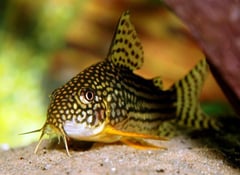
Hoplisoma sterbaiSterba's Cory
authority not recorded
Max length65mm SL2.6in SLTank45 × 30cm18 × 12inTemp24–28°C75–82°FpH6.0–7.6Sterba's cory, Hoplisoma sterbai, long known as Corydoras sterbai, is a peaceful armoured catfish from Bolivia and Brazil, marked with light spots on a dark head. Almost all fish in the trade are produced commercially on farms. The head pattern separates it from the similar Brochis haraldschultzi, in which the markings are dark on a light background, and it is generally considered one of the easiest Corydoras to spawn.
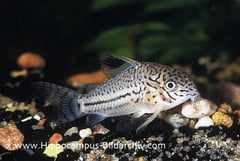
Hoplisoma trilineatumThree-lined Cory
authority not recorded
Max length55mm SL2.2in SLTank45 × 30cm18 × 12inTemp22–26°C72–79°FpH5.8–7.2The three-lined cory, Hoplisoma trilineatum, long known as Corydoras trilineatus, is an armoured catfish from the Amazon basin in Colombia, Peru and Brazil and coastal rivers of Suriname. Most of the fish sold as C. julii are in fact this species, and the two are very hard to tell apart without knowing where the fish were collected. Peaceful and hardy, it ranks among the very best choices for the newcomer to catfish and is one of the easiest Corydoras to spawn.