Every species
Filters
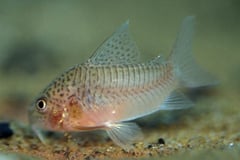
Hoplisoma xinguenseXingu Cory
(Nijssen, 1972)
Max length37mm SL1.5in SLTank45 × 38cm18 × 15inTemp22–26°C72–79°FpH6.0–7.2The Xingu cory, Hoplisoma xinguense, long known as Corydoras xinguensis, is a small spotted armoured catfish from creeks in the upper Rio Xingu basin in Mato Grosso, Brazil. It is also sold as the dust cory, and fish traded under the C-numbers C055 and C105 to C108 have all been identified as this species. Dias et al. (2024) moved it to Hoplisoma as Hoplisoma xinguense. One of the smaller corys, it is best kept in a group of ten or more.
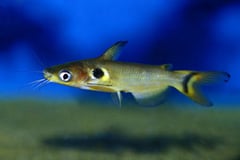
Horabagrus brachysomaSun Catfish
authority not recorded
Max length450mm SL18in SLTanknot recordedTemp23–25°C73–77°FpH6.0–7.5The sun catfish, Horabagrus brachysoma, is a large bagrid catfish endemic to the state of Kerala in south-western India. Also sold as the bullseye, solar, eclipse or golden red-tailed catfish, it is often marketed as a general community fish, but at 45 cm it suits only communities of other large fish. The smaller H. nigricollaris is similar, and the two can be told apart by the black shoulder marking, a vaguely circular blotch in this species.
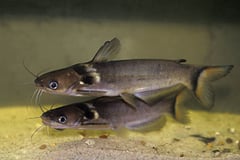
Horabagrus nigricollarisBlack Collared Catfish
authority not recorded
Max length300mm SL12in SLTank120 × 45cm48 × 18inTemp23–25°C73–77°FpH5.5–7.5The black collared catfish, Horabagrus nigricollaris, is a bagrid catfish endemic to the Chalakudy River in Kerala, south-western India. The rarer of the two species in the genus in the hobby, it resembles the much larger H. brachysoma. Both are usually sold as juveniles, and in this species the black shoulder marking extends up and over the top of the body, giving the collar that names it.
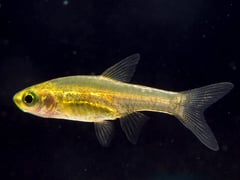
Horadandia atukorali
Deraniyagala, 1943
Max length30mm SL1.2in SLTank45 × 30cm18 × 12inTemp20–26°C68–79°FpH5.5–7.5Horadandia atukorali is a miniature cyprinid from Sri Lanka and southern India, where it is restricted to Kerala, Tamil Nadu and Puducherry. Its small adult size evolved through miniaturisation, and it shows a preference for sluggish and still waters such as rice paddies, swamps and weedy ponds. Very peaceful but timid, it does best alone or with other diminutive species in a densely-planted tank.
Hyalobagrus flavusShadow Catfish
authority not recorded
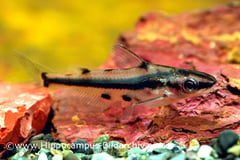
Max length45mm SL1.8in SLTank45 × 30cm18 × 12inTemp21–26°C70–79°FpH5.5–7.0The shadow catfish, Hyalobagrus flavus, is a small bagrid catfish from the Batang Hari drainage in Sumatra and the Mentaya basin in Borneo. For many years it has been imported as Pelteobagrus ornatus. Unlike most catfish it is diurnal and spends much of its time swimming in shoals in midwater, and it suits a peaceful community with soft, acidic water.
Hydrocynus goliathGiant Tigerfish
authority not recorded
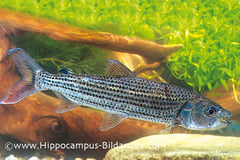
Max length2100mm SL83in SLTanknot recordedTemp24–28°C75–82°FpH6.5–7.5The giant tigerfish, Hydrocynus goliath, is a huge predatory alestid from large rivers and lakes of Tanzania and the Democratic Republic of Congo. A voracious piscivore with dagger-shaped, interlocking teeth, it is one of the world's most infamous game fish. Small specimens are becoming easier to acquire, but its enormous adult size and the danger of maintaining it make it totally unsuited to aquarium life.
Hydrocynus vittatusAfrican Tiger Fish
authority not recorded
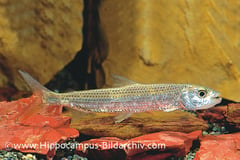
Max length1050mm SL41in SLTank300 × 90cm118 × 36inTemp24–28°C75–82°FpH6.5–8.0The African tiger fish, Hydrocynus vittatus, is a large predatory alestid found throughout Africa, from Egypt to South Africa. A voracious piscivore with dagger-shaped, interlocking teeth, it hunts in large shoals in the wild and is a popular game fish. Small specimens show up quite frequently in dealers' tanks, but even an aquarium of 300 by 90 cm is too small for an adult.
Hydrolycus armatusPayara
(Jardine, 1841)
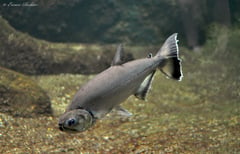
Max length660mm SL26in SLTanknot recordedTemp24–28°C75–82°FpH6.0–8.0The payara, Hydrolycus armatus, is a large, predatory dogtooth characin from the eastern Amazon, the Orinoco and the Essequibo in Guyana. Given its eventual size and natural behaviour it probably should not be considered a home aquarium subject at all, though juveniles are sometimes sold. It is regularly confused with the smaller H. scomberoides, and no other member of the genus has white margins to the anal and caudal fins.
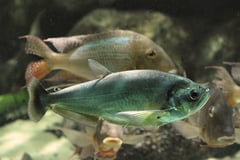
Hydrolycus scomberoidesVampire Tetra
(Cuvier, 1819)
Max length300mm SL12in SLTank210 × 75cm84 × 30inTemp24–28°C75–82°FpH6.0–8.0The vampire tetra, Hydrolycus scomberoides, is a predatory dogtooth characin from the central and upper Amazon in Brazil, Bolivia, Peru and Ecuador. Also sold as 'scomb' and 'sabre tooth tetra', it is regularly confused with the much larger payara, H. armatus. At up to 300 mm it still needs a huge tank and specialist care, and newly-imported specimens often refuse anything but live food.
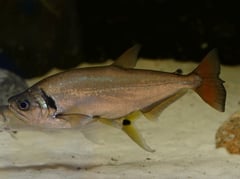
Hydrolycus tatauaia
Toledo-Piza, Menezes & Santos, 1999
Max length455mm SL18in SLTanknot recordedTemp24–28°C75–82°FpH6.0–8.0Hydrolycus tatauaia is a large, predatory dogtooth characin from the lower and central Amazon, the upper Orinoco and coastal drainages of Guyana. A pelagic species of flowing main river channels, it performs long upstream migrations to spawn. Its adult size and natural behaviour mean only a handful of private aquarists have the facilities to house it long-term.
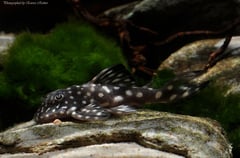
Hypancistrus inspectorL102
Armbruster, 2002
Max length160mm SL6in SLTank120 × 45cm48 × 18inTemp22–30°C72–86°FpH5.0–7.5The snowball pleco (L102), Hypancistrus inspector, is a suckermouth catfish from the upper rio Negro in Brazil and the Casiquiare in Venezuela. Brown to black with large whitish to yellow spots, it is most similar to H. contradens. It is normally collected from rocky rapids, is a cave-spawner with male brood care, and should not be kept with other Hypancistrus in order to prevent hybridisation.
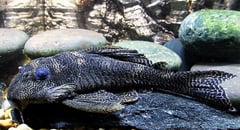
Hypancistrus seideliL066
Sousa, Sousa, Oliveira, Sabaj, Zuanon & Rapp Py-Daniel, 2025
Max length140mm SL6in SLTank120 × 45cm48 × 18inTemp26–30°C79–86°FpH5.0–7.0The king tiger plec, Hypancistrus seideli, is a suckermouth catfish from the lower rio Xingu in Pará state, northern Brazil. Described by Sousa et al. in 2025, it is traded as L066 and L333 and also as 'network pleco' and 'scribbled pleco'. Its colour pattern is highly variable and it is regularly confused with L400. It inhabits turbulent whitewater rapids, much of which is likely to be severely degraded by the Belo Monte dam.
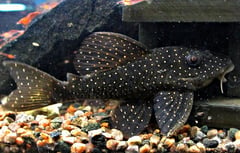
Hypancistrus sp.L004
authority not recorded
Max length100mm SL3.9in SLTank120 × 30cm48 × 12inTemp26–30°C79–86°FpH5.5–7.5L004, the angelicus pleco, is an undescribed Hypancistrus from the lower Tocantins and nearby rivers in Pará state, northern Brazil. It is sometimes traded under the false name 'Peckoltia angelicus'. L004 and L005 are juvenile and adult fish from the same Tocantins population, while L028 and L073 are separate populations from the Guamá and Pará rivers. Peaceful but territorial towards its own kind, it has been bred in aquaria many times.
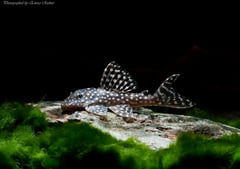
Hypancistrus sp.L136
authority not recorded
Max length90mm SL3.5in SLTank90 × 30cm36 × 12inTemp23–29°C73–84°FpH5.0–7.0L136 is an undescribed Hypancistrus from the rio Negro basin in Amazonas state, Brazil, collected in particular from the rio Demini. Highly variable in colour pattern, it has been assigned a series of L-numbers as a result. A peaceful cave-spawner with male brood care, it has been bred regularly in aquaria, but should not be kept with other Hypancistrus in order to prevent hybridisation.
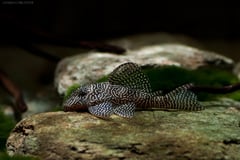
Hypancistrus sp.L260
authority not recorded
Max length90mm SL3.5in SLTank90 × 30cm36 × 12inTemp24–30°C75–86°FpH5.5–7.5L260, the queen arabesque pleco, is an undescribed Hypancistrus known only from the lower rio Tapajós in Pará state, northern Brazil. Among the most popular loricariids in the hobby, it is available on a regular basis. The larger L411 from the rio Jarí looks similar, but in L260 the white vermiculations are significantly finer. The area where it is collected would be largely destroyed should a planned hydroelectric project go ahead.
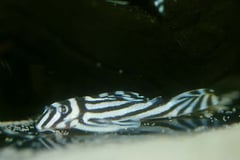
Hypancistrus zebraZebra Plec
Isbrücker and Nijssen, 1991
Max length80mm SL3.1in SLTank60 × 30cm24 × 12inTemp26–30°C79–86°FpH6.0–7.5The zebra plec, Hypancistrus zebra (L046), is a small loricariid catfish from the Rio Xingú basin in Brazil, named for its zebra pattern. Brazil banned its export in 2004 and captive-bred fish are expensive. Shy and easily outcompeted for food, it needs warm water of 26 to 30 °C, high oxygen levels and pristine conditions, and does not suit the general community tank.
Hypergastromyzon humilis
Roberts, 1989
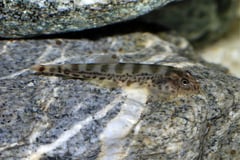
Max length35mm SL1.4in SLTank45 × 30cm18 × 12inTemp20–24°C68–75°FpH6.0–7.5Hypergastromyzon humilis is a small hillstream loach known only from the Melawi basin of the Kapuas system in West Kalimantan, Indonesian Borneo. Not traded specifically, it sometimes turns up as bycatch among shipments of wild-collected Gastromyzon. It is told from those by its small mouth without papillae, and from H. eubranchus, the only other species in the genus, by its 7-8 cream-coloured dorsal bars.

Hyphessobrycon acaciae
García-Alzate, Román-Valencia & Prada-Pedreros, 2010
Max length30mm SL1.2in SLTanknot recordedTempnot recordedpHnot recordedHyphessobrycon acaciae is a small tetra known only from streams in the middle and upper Río Guamal, part of the Río Meta system in Colombia. The dark lateral band separates it from most Hyphessobrycon in the Orinoco basin, and it is told from the remaining few by counts of fin rays, teeth and scales. The Guamal drains into the upper Meta, which flows into the Río Orinoco.

Hyphessobrycon agulha
Fowler, 1913
Max length42mm SL1.7in SLTank80 × 30cm31 × 12inTemp20–28°C68–82°FpH5.5–7.5Hyphessobrycon agulha is a small tetra known with certainty only from the rio Madeira system in the Amazon basin of Brazil, Peru and Bolivia. Relatively rare in the hobby, it is occasionally traded as the 'red-tailed flag tetra'. It lends its name to a group of closely-related species with a dark lower half of the body, especially above the anal fin, and it is very peaceful.

Hyphessobrycon amandaeEmber Tetra
Géry & Uj, 1987
Max length20mm SL0.8in SLTank45 × 30cm18 × 12inTemp20–28°C68–82°FpH5.0–7.0The ember tetra, Hyphessobrycon amandae, is a tiny characid from the rio das Mortes, a tributary of the Araguaia in Mato Grosso, Brazil. Also traded as the 'Amanda's', 'dwarf red', 'red' and 'fire' tetra, it grows to around 20 mm SL. Very peaceful and gregarious, it makes a good dither fish for Apistogramma and other dwarf cichlids and spawns often in a mature aquarium.