Every species
Filters

Hyphessobrycon vilmae
Géry, 1966
Max length30mm SL1.2in SLTank60 × 30cm24 × 12inTemp20–26°C68–79°FpH5.0–7.0Hyphessobrycon vilmae is a small characid that appears to be endemic to the upper rio Tapajós basin in Amazonas and Mato Grosso states, Brazil. It is occasionally traded as 'chocolate neon tetra', and has a continuous, solid dark lateral stripe with no obvious humeral blotch. Generally peaceful, it is best kept in a mixed-sex group of at least 8-10.
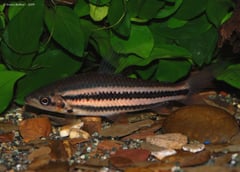
Hypomasticus arcusLipstick Leporinus
(Eigenmann, 1912)
Max length300mm SL12in SLTank210 × 60cm84 × 24inTemp20–28°C68–82°FpH6.0–7.5The lipstick leporinus, Leporinus arcus, is an anostomid from the Orinoco, Essequibo and upper Courantyne basins in Venezuela and the Guianas. It grows to 250 to 300 mm and needs an aquarium with base dimensions of at least 210 by 60 cm.
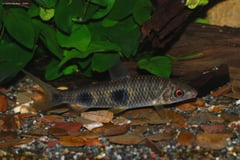
Hypomasticus copelandii
(Steindachner, 1875)
Max length200mm SL8in SLTank180 × 60cm72 × 24inTemp20–28°C68–82°FpH6.0–7.5Leporinus copelandii is an anostomid from the Paraíba do Sul and Doce river systems of southeastern Brazil. It reaches at least 200 mm, and an aquarium with base dimensions of 180 by 60 cm should be the smallest considered.
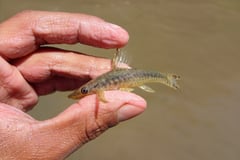
Hypoptopoma incognitum
authority not recorded
Max length95mm SL3.7in SLTank80 × 30cm31 × 12inTemp23.9–27.8°C75–82°FpHnot recordedHypoptopoma incognitum is a loricariid catfish described from the Río Itenez, northeastern Bolivia, and the most widespread member of its genus. It has been recorded through much of the central and lower Amazon basin, the rio Tocantins, and some minor rivers draining straight into the Atlantic in northeastern Brazil.
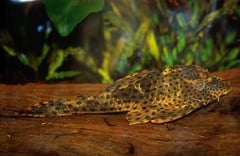
Hypostomus cf. cochliodonSpotted Cochliodon
authority not recorded
Max length230mm SL9in SLTank120 × 45cm48 × 18inTemp21–24°C70–75°FpH6.3–7.2The spotted cochliodon (L050), Hypostomus cf. cochliodon, is an undescribed suckermouth catfish of the Hypostomus cochliodon complex. Like other members of the group it develops a hump-backed profile and spoon-shaped teeth, and eats wood. Its exact distribution is unknown. It grows to around 230 mm SL and is non-territorial enough to keep in a group or with other peaceful loricariids.
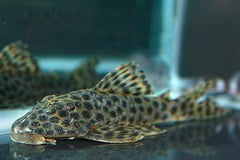
Hypostomus mutucaeLDA10
authority not recorded
Max length75mm SL3.0in SLTank60 × 30cm24 × 12inTemp23–28°C73–82°FpH6.2–7.6LDA10, Hypostomus mutucae, is a small suckermouth catfish from Mato Grosso, Brazil, with its type specimen collected in the Rio Mutuca. It grows to around 75 mm and is peaceful, and it inhabits flowing, highly oxygenated water over sand scattered with rocks. It is often confused with LDA09 but has smaller spots on the head, where LDA09 has larger spots of uniform size all over.
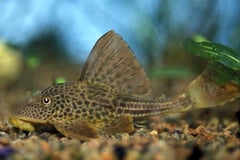
Hypostomus plecostomoidesLDA42
authority not recorded
Max length250mm SL10in SLTank120 × 45cm48 × 18inTemp21–27°C70–81°FpH6.5–8.0Hypostomus plecostomoides (LDA42, LDA38) is a wood-eating suckermouth catfish from the Rio Orinoco drainage in Colombia and Venezuela. A member of the Hypostomus cochliodon complex, it has a hump-backed profile and spoon-shaped teeth. It is very difficult to tell from H. hondae, H. pagei and H. taphorni, and collection locality is often the best guide.
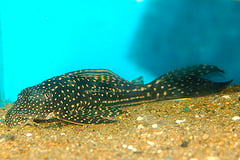
Hypostomus reganiGiant White Spot Plec
authority not recorded
Max length400mm SL16in SLTanknot recordedTemp24–28°C75–82°FpH6.0–7.0The giant white spot plec, Hypostomus regani, is a large suckermouth catfish from Brazil, Paraguay, Uruguay and Argentina. It is very hardy and grows to around 400 mm SL. Peaceful with most tankmates, it is territorial with similarly-sized bottom dwellers, especially its own kind, so a very large tank is needed to keep other large catfish with it.
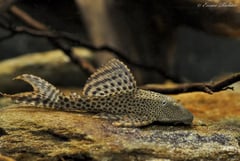
Hypostomus sp.L231
authority not recorded
Max length300mm SL12in SLTank180 × 60cm72 × 24inTemp22–28°C72–82°FpH6.0–7.5L231 is an unidentified Hypostomus, a large suckermouth catfish said to be exported from the upper Amazon region of Peru. Precise details of its origin are lacking. It grows to 250 to 300 mm SL and needs an aquarium of at least 180 by 60 cm, and it is unclear whether it is the same species as the similarly nameless L266.
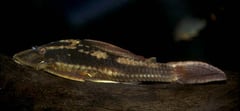
Hypostomus sp.L077
authority not recorded
Max length300mm SL12in SLTank120 × 45cm48 × 18inTemp21–27°C70–81°FpH6.0–7.5L077, the rusty, bruno or violet plec, is an undescribed wood-eating suckermouth catfish of the Hypostomus cochliodon complex from the rio Parnaíba basin in north-eastern Brazil. It grows to around 300 mm SL.
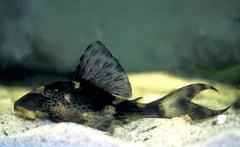
Hypostomus sp.L229
authority not recorded
Max length200mm SL8in SLTank120cm48inTemp23–27°C73–81°FpH6.0–7.5L229 is an undescribed wood-eating suckermouth catfish of the Hypostomus cochliodon complex from the Río Ucayali, Peru. Like others in the group it develops a hump-backed profile and spoon-shaped teeth. It lives around driftwood in flowing parts of rivers and streams, and grows to around 200 mm SL.

Hypselecara coryphaenoidesRio Negro Chocolate Cichlid
authority not recorded
Max length150mm SL6in SLTank120 × 45cm48 × 18inTemp24–30°C75–86°FpH5.0–6.5The Rio Negro chocolate cichlid, Hypselecara coryphaenoides, comes from rivers in Brazil and Venezuela including the Negro, Trombetas and Tapajós. It is much rarer in the trade than H. temporalis, from which it differs in a more elongate body, darker colour and a flank blotch on and above the lateral line. It lives in sluggish forest tributaries with dark, acidic water.

Hypselecara temporalisChocolate Cichlid
authority not recorded
Max length300mm SL12in SLTank120 × 45cm48 × 18inTemp25–30°C77–86°FpH5.0–7.0The chocolate cichlid, Hypselecara temporalis, is a large cichlid from Peru, Colombia, Venezuela and Brazil. It most often inhabits silt-laden, slow-flowing rivers, and has been collected in the Ucayali, Amazonas, Solimões, Amapá and Oyapock. Although it reaches 30 cm, it is quite a placid species and can be kept in a community of large fish in a suitably-sized tank.
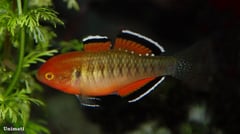
Hypseleotris compressaEmpire Gudgeon
(Krefft, 1864)
Max length120mm SL5in SLTank80 × 30cm31 × 12inTemp20–35°C68–95°FpH5.0–9.1The empire gudgeon, Hypseleotris compressa, is an eleotrid from northern and eastern Australia and southern New Guinea. Breeding is rarely achieved in aquaria because of its complex amphidromous strategy: adults spawn in freshwater streams, but the larvae are washed downstream to the sea and develop there. Plenty of cover and broken lines of sight let weaker individuals escape the attention of dominant fish.
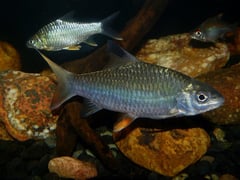
Hypselobarbus jerdoniJerdon's Carp
authority not recorded
Max length460mm SL18in SLTank240 × 120cm96 × 48inTemp20–26°C68–79°FpH6.5–7.5Jerdon's carp, Hypselobarbus jerdoni, is a large cyprinid endemic to India, recorded from Maharashtra, Karnataka, Kerala and Tamil Nadu. A riverine fish of clear, well-oxygenated, running water, it can reach 46 cm and is very rarely encountered in the trade. Very active and a vigorous feeder, it needs a tank of 240 ∗ 120 ∗ 120 cm or more for a group of adults, and many Indian authors consider it endangered.

Hypsibarbus lagleri
Rainboth, 1996
Max length350mm SL14in SLTank240 × 60cm96 × 24inTemp20–26°C68–79°FpH6.0–8.0Hypsibarbus lagleri is a large cyprinid endemic to the middle Mekong basin in Laos, eastern Thailand and Cambodia. It migrates seasonally, living in larger river channels in the dry season and moving into smaller tributaries and flooded forests in the wetter months. Growing to 350 mm, it is a valued food fish, and like most of its congeners is thought to be in decline because of the damming of rivers and agriculture.

Hypsibarbus malcolmiGoldfin Tinfoil Barb
(Smith, 1945)
Max length500mm SL20in SLTanknot recordedTemp20–26°C68–79°FpH6.0–8.0The goldfin tinfoil barb, Hypsibarbus malcolmi, is a large cyprinid from Thailand, Laos, Cambodia and Peninsular Malaysia. It occurs throughout the Mekong system and in the Chao Phraya and Maeklong drainages, and in the Mekong migrates seasonally between larger river channels and flooded forests. Reaching 400 to 500 mm, it is suitable only for public aquaria or the very largest private set-ups.

Hypsibarbus pierreiYellow Eyed Silver Barb
(Sauvage, 1880)
Max length300mm SL12in SLTanknot recordedTempnot recordedpHnot recordedThe yellow eyed silver barb, Hypsibarbus pierrei, is a large cyprinid from the middle and lower Mekong basin in Laos, Thailand, Cambodia and Vietnam. It also occurs in the Dong Nai drainage, and migrates seasonally from larger river channels in the dry season to spawning grounds that remain unknown. Reaching at least 300 mm, it is a valued food fish, and most Hypsibarbus species are thought to be in decline because of the damming of rivers and agriculture.

Hypsibarbus salweenensis
Rainboth, 1996
Max length300mm SL12in SLTanknot recordedTempnot recordedpHnot recordedHypsibarbus salweenensis is a large cyprinid endemic to the Salween river system in Yunnan province, China, eastern Myanmar and northwestern Thailand. It has been collected from submontane headwater streams, larger tributaries and main river channels, and appears to be abundant on a seasonal basis in the lower Salween, suggesting a migratory lifestyle. Growing to at least 300 mm, it belongs to a genus of valued food fishes.

Hypsibarbus vernayi
(Norman, 1925)
Max length216mm SL9in SLTank240 × 60cm96 × 24inTemp20–26°C68–79°FpH6.0–8.0Hypsibarbus vernayi is a cyprinid widespread in mainland Southeast Asia, from the Mekong basin in southern China to northern Peninsular Malaysia. Very similar to H. wetmorei, it has yellow pectoral, pelvic and anal fins (orange to red in H. wetmorei), so yellow-finned fish sold as H. wetmorei or 'lemon fin barb' appear likely to be this species. It prefers flowing water with abundant riparian vegetation and migrates seasonally.