Every species
Filters

Hypsibarbus wetmorei
(Smith, 1931)
Max length250mm SL10in SLTank240 × 60cm96 × 24inTemp20–26°C68–79°FpH6.0–8.0Hypsibarbus wetmorei is a cyprinid widespread in mainland Southeast Asia, from the lower Mekong basin south to the Pahang River in Malaysia. Its orange to red pectoral, pelvic and anal fins separate it from the very similar H. vernayi (yellow), and yellow-finned fish traded as H. wetmorei or 'lemon fin barb' appear likely to be that species. It prefers flowing water with abundant riparian vegetation and grows to 250 mm.

Hypsophrys nicaraguensisNicaragua Cichlid
authority not recorded
Max length250mm SL10in SLTank120 × 45cm48 × 18inTemp23–28°C73–82°FpH7.0–8.0The Nicaragua cichlid, Hypsophrys nicaraguensis, is a Central American cichlid from Nicaragua and Costa Rica, found in lakes and slow-moving rivers. Also known as the spilotum or moga, it exists in several colour forms depending on collection locality, and has been hybridised with the convict cichlid, Archocentrus nigrofasciatus. Relatively peaceful for its size but territorial, it is best kept as a mated pair and spawns in caves.

Iguanodectes adujai
Géry, 1970
Max length62mm SL2.4in SLTank90 × 30cm36 × 12inTemp20–26°C68–79°FpH5.0–7.0Traded as the 'red line lizard tetra', Iguanodectes adujai is a characin from the rio Negro in Brazil and the upper Río Orinoco in Venezuela. It is exported alongside the similar-looking I. geisleri, and differs in lacking the black lateral stripe beneath the red stripe and in having 28 to 34 anal-fin rays (20 to 25 in I. geisleri). It is assumed to live in smaller tributaries containing pristine blackwater.

Iguanodectes geisleri
Géry, 1970
Max length55mm SL2.2in SLTank120 × 30cm48 × 12inTemp20–26°C68–79°FpH5.0–7.0Iguanodectes geisleri is a characin from the rios Madeira and Negro in Brazil and the upper Río Orinoco in Venezuela. Traded with the similar-looking I. adujai as the 'red line lizard tetra', it differs in having a black lateral stripe beneath the red stripe and 20 to 25 anal-fin rays (28 to 34 in I. adujai). Adult males carry red markings in the pectoral, pelvic, anal and caudal fins.

Iguanodectes spilurusGreen Line Lizard Tetra
(Günther, 1864)
Max length102mm SL4in SLTank120 × 45cm48 × 18inTemp20–28°C68–82°FpH5.0–7.5The green line lizard tetra, Iguanodectes spilurus, is a characin found throughout the Amazon, Orinoco, Essequibo and Tocantins river systems. The most widespread Iguanodectes species, it has also been called the 'slender', 'spindle' or 'iguana' tetra, and differs from its congeners in its translucent dorsal and anal fins, lack of a red lateral stripe and prominent dark caudal-fin marking. It is sensitive to poor water conditions.

Iguanodectes variatus
Géry, 1993
Max length103mm SL4in SLTanknot recordedTempnot recordedpHnot recordedIguanodectes variatus is a characin from Brazil, recorded from the Guaporé, Madeira, Branco, Trombetas and Urubu river systems in the Amazon basin. It belongs to a small genus of elongate fishes in the family Iguanodectidae and grows to around 103 mm SL.
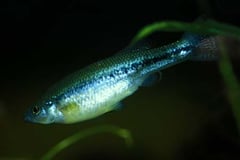
Ilyodon furcidensGoldbreast Goodeid
authority not recorded
Max length70mm SL2.8in SLTank75 × 30cm30 × 12inTemp18–24°C64–75°FpH7.0–8.0The goldbreast goodeid, Ilyodon furcidens, is a livebearer from Jalisco and Colima in Mexico, found in fast-flowing streams and small rivers. Also called the goldbreast splitfin, it is named for its fork-shaped teeth. Like other goodeids it nourishes its developing young through a trophotaenia, and females must be mated separately for each brood. A peaceful fish, it suits a community whose other species can cope with the lower temperatures it needs.

Incisilabeo behri
(Fowler, 1937)
Max length550mm SL22in SLTanknot recordedTemp20–26°C68–79°FpH6.0–8.0Incisilabeo behri is a large cyprinid native to the Mekong river system in southern China, Laos, Thailand, Vietnam and Cambodia. Growing to 450 to 550 mm, it is patently unsuitable for the home aquarium, though juveniles are available on a relatively regular basis. The only member of its genus, it is separated from Bangana by a conspicuous transverse notch across the top of the head, and migrates seasonally up the Sekong, Sesan and Srepok rivers.
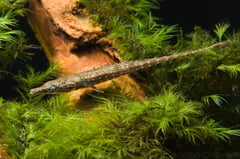
Indostomus crocodilus
Britz & Kottelat, 1999
Max length30mm SL1.2in SLTank40 × 20cm16 × 8inTemp22–27°C72–81°FpH5.0–7.0Indostomus crocodilus is a tiny indostomid, 25 to 30 mm long, from southern Thailand and Kelantan state in northeastern Peninsular Malaysia. Its type series came from a blackwater stream in peat swamp forest, among submerged roots and leaf litter in slow-moving or standing water. A poor competitor, it is best kept alone or with similarly-sized, placid species, and males have dark brown to black bars in the dorsal and anal fins.

Indostomus paradoxusArmoured Stickleback
Prashad & Mukerji, 1929
Max length30mm SL1.2in SLTank40 × 20cm16 × 8inTemp22–27°C72–81°FpH6.5–7.5The armoured stickleback, Indostomus paradoxus, is a tiny fish from Myanmar, described from Lake Indawgyi and recorded in the Ayeyarwady basin. It appears to be considerably more widespread than previously thought, having been found as far south as the river's delta. It is rare in the aquarium hobby, and its name is often misapplied to the closely related I. crocodilus, in which adult males have dark bands in the dorsal and anal fins.

Inlecypris auropurpurea
(Annandale, 1918)
Max length80mm SL3.1in SLTank90 × 30cm36 × 12inTemp20–24°C68–75°FpH6.0–8.0Inlecypris auropurpurea is a cyprinid known only from Lake Inlé and its surrounding watershed in Shan state, eastern Myanmar. It is listed as 'Endangered' on the IUCN Red List after a significant decline, as farming around the lake has increased sedimentation, eutrophication and pollution. A peaceful schooling fish, it suits a densely planted tank with a tightly fitting cover, since it is a particularly accomplished jumper.
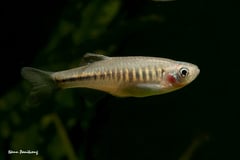
'Inlecypris' maetaengensisFire Bar 'Danio'
(Fang, 1997)
Max length50mm SL2.0in SLTank75 × 30cm30 × 12inTemp20–26°C68–79°FpH6.0–8.0The fire bar 'danio', Inlecypris maetaengensis, is a small cyprinid endemic to the Mae Nam Ping drainage in northern Thailand. Also traded as 'tiger danio', it is most easily confused with 'I.' shanensis and Devario interruptus, and has a complete lateral line with 31 to 35 pored scales and a P stripe of contiguous blotches. It inhabits small, clear, moderate-to-swiftly-flowing streams with no aquatic vegetation.

Inpaichthys kerriPurple Emperor Tetra
authority not recorded
Max length35mm SL1.4in SLTank60 × 38cm24 × 15inTemp24–27°C75–81°FpH5.5–7.0The purple emperor tetra, Inpaichthys kerri, is a small characin from the Rio Aripuanã and upper Rio Madeira basins in Brazil. Also sold as the 'blue emperor', 'regal' or 'royal' tetra, it is sometimes confused with the emperor tetra, Nematobrycon palmeri, but can be told apart by its adipose fin (absent in Nematobrycon). It lives in sluggish, tannin-stained forest tributaries and has been spawned regularly in the hobby.
Iodotropheus sprengeraeRusty Cichlid
authority not recorded
Max length100mm SL3.9in SLTank90 × 30cm36 × 12inTemp25–29°C77–84°FpH7.5–8.8The rusty cichlid, Iodotropheus sprengerae, is a dwarf mbuna endemic to Lake Malawi, around the islands of Boadzulu, Chinyankwazi and Chinyamwezi. One of the least aggressive and smallest mbuna in the hobby, it is easily outcompeted by bigger species and can be kept in smaller tanks. It is sometimes confused with certain populations of Labidochromis vellicans, and as a polygamous maternal mouthbrooder is easily bred.
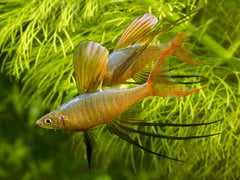
Iriatherina werneriThreadfin Rainbowfish
Meinken, 1974
Max length40mm SL1.6in SLTank60 × 30cm24 × 12inTemp22–30°C72–86°FpH5.0–8.0The threadfin rainbowfish, Iriatherina werneri, is a small rainbowfish from southern New Guinea, Cape York in Queensland and the Northern Territory. Although widely traded and produced on a commercial scale, it is quite delicate with rather specific care requirements and is not a recommended beginner's fish. Easily outcompeted for food, and with long-finned males that some common species nip, it is best kept alone or with fishes of comparable size and disposition.
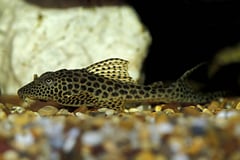
Isorineloricaria acuariusBlue Fin Thresher Pleco
Ray & Armbruster, 2016
Max length269mm SL11in SLTank150cm60inTemp25–29°C77–84°FpH6.0–7.5Isorineloricaria acuarius is a suckermouth catfish from the Apure and middle Orinoco drainages in the Venezuelan Llanos, where it lives on sandy runs in whitewater rivers. Traded as L093 and L195, the blue fin thresher pleco, it was sold as Hypostomus villarsi until it was described in 2016. I. villarsi is a different fish from the Lake Maracaibo basin, with a sharp ridge on each side of the head where I. acuarius has a rounded one.

Ivanacara adoketaZebra Acara
authority not recorded
Max length130mm SL5in SLTanknot recordedTemp22.2–28.9°C72–84°FpHnot recordedThe zebra acara, Ivanacara adoketa, is a cichlid from Brazil that appears to be endemic to the middle and upper rio Negro system. It inhabits dark, shaded rainforest streams where the water is stained brown with humic acids and the pH can be as low as 3.0 or 4.0. Rare in the hobby, it is a bi-parental substrate spawner that uses a cave if available, and its eggs develop only in water of little-to-no detectable hardness.
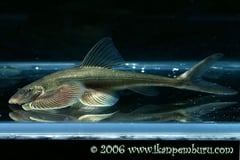
Jinshaia sinensis
(Sauvage & Dabry de Thiersant, 1874)
Max length75mm SL3.0in SLTank90 × 30cm36 × 12inTemp20–24°C68–75°FpH6.0–7.5Jinshaia sinensis is a balitorid loach known only from the Jinsha river basin, the westernmost headwater tributary of the Yangtze in China. Like other balitorids it has a flattened head and body and horizontally extended paired fins that form a powerful sucking cup. It lives only in riffles, runs and cascades of swift, clear, oxygen-saturated water, and the aquarium must be set up to resemble such a habitat.
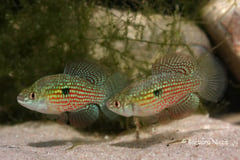
Jordanella floridaeFlorida Flagfish
Goode & Bean, 1879
Max length55mm SL2.2in SLTank60 × 30cm24 × 12inTemp18–30°C64–86°FpH6.5–8.5The Florida flagfish, Jordanella floridae, is a cyprinodontid endemic to peninsular Florida in the United States. It lives in shallow, weedy backwaters, marshes, canals and ditches. A long-standing aquarium favourite, it is produced commercially and wild fish are very rare outside the U.S.A. Contrary to many reports it does not dig pits or exhibit extended parental care, and breeds as a fractional spawner like other cyprinodontids.

Julidochromis dickfeldiBrown Julie
authority not recorded
Max length80mm SL3.1in SLTank75 × 30cm30 × 12inTemp23–27°C73–81°FpH8.0–9.2The brown julie, Julidochromis dickfeldi, is a cave-spawning cichlid endemic to Lake Tanganyika. It inhabits shallow rocky shorelines in the southwest of the lake, between Kapampa and Ndole. There is some speculation over whether it belongs in Julidochromis, since it has a pointed snout, blue edging to the dorsal and anal fins and very dark horizontal stripes. It is aggressive towards conspecifics and should be kept as a pair.