Every species
Filters

Julidochromis marlieriMarlier's Julie
authority not recorded
Max length150mm SL6in SLTanknot recordedTemp23–27°C73–81°FpH7.5–9.5Marlier's julie, Julidochromis marlieri, is a rock-dwelling cichlid endemic to Lake Tanganyika, also sold as the chequered julie. It swims hugging the rock surfaces at any angle, and is found in fairly deep water along rocky shorelines. Adults are very belligerent towards one another, so unless the tank is huge it should be kept as a pair. Several geographical morphs are available, and no two species or morphs of Julidochromis should be kept together as they may hybridise.

Julidochromis ornatusGolden Julie
authority not recorded
Max length80mm SL3.1in SLTanknot recordedTemp23–27°C73–81°FpH7.5–9.0The golden julie, Julidochromis ornatus, is a cave-spawning cichlid endemic to Lake Tanganyika, found mainly in the north of the lake. One of the most common Julie species in aquaria, it may also be sold as the yellow or ornate julie. Most specimens available are tank bred and lack the bright colouration of wild fish. Several geographical morphs and an albino aquarium sport exist, and none should be kept with other Julidochromis as they may hybridise.

Julidochromis reganiRegan's Julie
authority not recorded
Max length300mm SL12in SLTank120 × 30cm48 × 12inTemp23–27°C73–81°FpH7.5–9.0Regan's julie, Julidochromis regani, is the largest species of Julie, a cichlid endemic to Lake Tanganyika. It reaches 30 cm but rarely grows beyond 15 cm in aquaria, and is the least aggressive member of the genus. Less of a rock dweller than its congeners, it is more often found over sand with scattered rocks, though it still spawns in rocky caves. It may also be seen for sale as the striped or convict julie.

Julidochromis transcriptusMasked Julie
Matthes, 1959
Max length65mm SL2.6in SLTanknot recordedTempnot recordedpHnot recordedThe masked julie, Julidochromis transcriptus, is a small cichlid endemic to the rocky coastal zones of northwestern Lake Tanganyika. It is known from between Luhanga and Makabola in the Democratic Republic of the Congo and grows to around 65 mm SL.
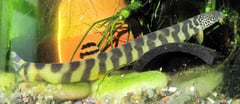
Kichulchoia multifasciata
(Wakiya & Mori, 1929)
Max length120mm SL5in SLTank90 × 30cm36 × 12inTemp20–24°C68–75°FpH6.0–7.5Kichulchoia multifasciata is a cobitid loach known only from river basins of southwestern Korea. It is restricted to shallow, fast-flowing, highly-oxygenated headwaters with riffles and runs, and needs clean, well-oxygenated water in the aquarium. It is most easily told from K. brevifasciata, its only congener, by its body patterning, wrinkled lips and short barbels.

Knodus borkiBlue Tetra
authority not recorded
Max length50mm SL2.0in SLTank75 × 38cm30 × 15inTemp22–26°C72–79°FpH5.5–7.0The blue tetra, Knodus borki, is a small characid from Colombia and Brazil, found in rivers, streams and tributaries. Its colour is often so intense that many who first see it for sale assume it has been artificially coloured, though it will not develop its best colours in sparse surroundings. It may nip the fins of conspecifics and long-finned fishes, which a group of 8-10 in a larger tank helps to limit.

Kosswigichthys asquamatusHazar Toothcarp
Sözer, 1942
Max length40mm SL1.6in SLTank120 × 30cm48 × 12inTemp12–28°C54–82°FpHnot recordedThe Hazar toothcarp, Kosswigichthys asquamatus, is a relict species endemic to Lake Hazar in southeastern Anatolia, Turkey. It has a more elongate body than other Aphanius, almost no scales and conical teeth. The lake water is hard, alkaline and rich in magnesium chloride, and in aquaria it seems to need certain salts for proper egg and fry development. Outside the spawning season it forms schools.
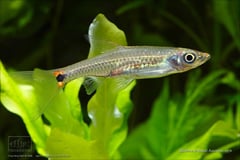
Kottelatia brittani
(Axelrod, 1976)
Max length60mm SL2.4in SLTank75 × 30cm30 × 12inTemp20–26°C68–79°FpH6.0–7.5Kottelatia brittani is a small rasborin cyprinid described from southern Peninsular Malaysia and recorded from the Batang Hari river in Sumatra. Its distribution is unclear, since the type specimens came via a Singapore wholesaler, and there appears to be a possibility that it is endemic to Sumatra. Sold as the 'head and tail light rasbora', it has been confused with Rasbora kalbarensis but is larger, with a more pointed head and intense orange to red blotches on the caudal peduncle.
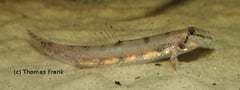
Kottelatlimia hipporhynchos
Kottelat & Tan, 2008
Max length52mm SL2.0in SLTank60 × 30cm24 × 12inTemp23–26°C73–79°FpH4.0–6.5Kottelatlimia hipporhynchos is a small cobitid loach known only from Central Kalimantan in Indonesian Borneo. It lives in slow-moving forest streams with clear, tannin-stained water over white sand, where it rests on the substrate or dives into it, so it must be given a soft sandy substrate. The largest member of the genus, it differs from its congeners in having papillae covering the lips, barbels and lobes of the mouth.
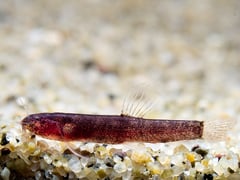
Kottelatlimia katik
(Kottelat & Lim, 1992)
Max length14mm SL0.6in SLTank45 × 30cm18 × 12inTemp23–26°C73–79°FpH3.5–6.5Kottelatlimia katik is a miniature cobitid loach from Johor in Peninsular Malaysia and the Batang Hari drainage of Sumatra, reaching 13.5 mm SL. It is considered paedomorphic, keeping juvenile features such as long fins and long nasal barbels into adulthood. It lives in small forest streams associated with blackwater peat swamps, often in leaf litter, and needs a soft sandy substrate and spotless water.
Kottelatlimia pristes
(Roberts, 1989)
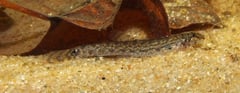
Max length40mm SL1.6in SLTank45 × 30cm18 × 12inTemp21–26°C70–79°FpH3.5–6.5Kottelatlimia pristes is a small cobitid loach from Peninsular Malaysia, Sumatra and Borneo, the most widely-distributed member of its genus. It inhabits small, slow-moving forest streams and peat swamps with tannin-stained water, often in piles of leaf litter. It turns up occasionally in the trade, sometimes as bycatch among other species and under names such as 'Sumatran mini royal loach' or Cobitis cf. sumatranus.

Kryptopterus bicirrhis
(Valenciennes, 1840)
Max length150mm SL6in SLTank120 × 45cm48 × 18inTemp20–28°C68–82°FpH6.0–7.5Kryptopterus bicirrhis is a silurid catfish from much of Southeast Asia, including the Mekong and Chao Phraya and the Greater Sunda Islands. Uncommon in the aquarium trade, its name was widely misapplied to K. vitreolus in older literature, but the two are easily told apart because K. bicirrhis does not have a transparent body in life. It tends to form schools, so four or more should be kept.
Kryptopterus cryptopterusBlue Sheatfish
(Bleeker, 1851)
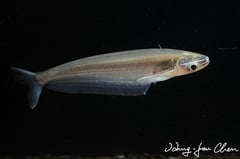
Max length147mm SL6in SLTank120 × 45cm48 × 18inTemp20–27°C68–81°FpH6.0–7.5The blue sheatfish, Kryptopterus cryptopterus, is a silurid catfish from the Malay Peninsula, Singapore, Sumatra, Borneo and Java. It inhabits flowing rivers and larger streams with turbid water, and is sometimes traded as 'smokey glass catfish'. Populations from Thailand, Cambodia, Laos and Vietnam once considered conspecific are now referred to K. geminus, its closest relative, from which it differs in having a wider head and a shorter snout and anal fin.

Kryptopterus geminus
Ng, 2003
Max length171mm SL7in SLTank150 × 45cm60 × 18inTemp20–28°C68–82°FpH6.0–7.5Kryptopterus geminus is a silurid catfish from the lower and middle Mekong in Thailand, Laos, Cambodia and Vietnam, and the lower Chao Phraya. Wild populations were formerly considered K. cryptopterus, and it is likely to be traded as that very similar species. It differs in having a narrower head, a longer snout and anal fin and more laterally-placed eyes, and inhabits flowing rivers and larger streams with turbid water.

Kryptopterus limpok
(Bleeker, 1852)
Max length260mm SL10in SLTank240 × 60cm96 × 24inTemp20–28°C68–82°FpH6.0–7.5Kryptopterus limpok is a silurid catfish widely distributed through Southeast Asia, including the Mekong and the Greater Sunda Islands. It can be told from its congeners by an extremely long mental barbel extending beyond the tip of the pectoral fin. It inhabits flowing rivers and larger streams with turbid water, grows to 260 mm and is almost unheard of in the ornamental trade.
Kryptopterus macrocephalusStriped Glass Catfish
(Bleeker, 1858)
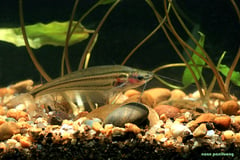
Max length100mm SL3.9in SLTank120 × 30cm48 × 12inTemp20–26°C68–79°FpH4.0–7.0The striped glass catfish, Kryptopterus macrocephalus, is a silurid catfish from Thailand, Malaysia, Singapore and the Greater Sunda Islands. A stenotypic inhabitant of peat swamp forests and associated blackwater streams, it is also known as the false, mottled or tawny glass catfish. Striped and mottled colour forms exist that may or may not be conspecific, and the similar K. piperatus has a pale brown body with scattered dark spots.
Kryptopterus palembangensis
(Bleeker, 1852)
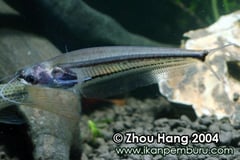
Max length140mm SL6in SLTank120 × 30cm48 × 12inTemp20–28°C68–82°FpH6.0–7.5Kryptopterus palembangensis is a silurid catfish known only from central and southern Sumatra, in the provinces of Jambi and South Sumatra. It is closely related to K. bicirrhis but is told apart by a prominent, dark lateral stripe on each flank. Almost unheard of in the aquarium trade, it may occasionally be exported among shipments of wild fishes from Sumatra.
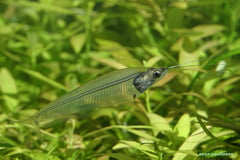
Kryptopterus vitreolusGlass Catfish
Ng & Kottelat, 2013
Max length65mm SL2.6in SLTank90 × 30cm36 × 12inTemp20–26°C68–79°FpH4.0–7.0The glass catfish, Kryptopterus vitreolus, is a transparent silurid catfish from coastal river basins of peninsular and southeastern Thailand. Available in the trade for decades, it was widely misidentified as K. bicirrhis or K. minor until its description in 2013, so older literature uses those names. It is also sold as the 'Asian glass catfish', 'ghost catfish' or 'phantom catfish'. Its status in the wild requires investigation since it is collected intensively and has a restricted range.

Labeo angra
(Hamilton, 1822)
Max length200mm SL8in SLTanknot recordedTempnot recordedpHnot recordedLabeo angra is a benthic cyprinid from Pakistan, Nepal, northern India, Bangladesh and Myanmar, described from the Brahmaputra. It can be identified by a brownish back, yellowish flanks and belly, and a black to bluish stripe from the eye to the caudal-fin base. It undertakes annual spawning migrations within its native river systems.

Labeo bogaViolet Shark
(Hamilton, 1822)
Max length250mm SL10in SLTank240 × 60cm96 × 24inTemp18–24°C64–75°FpH6.0–8.0The violet shark, Labeo boga, is a cyprinid from most major river systems in India, Pakistan, Nepal, Bangladesh and Myanmar. It inhabits major river channels and larger tributaries and grows to 250 mm, needing a tank of at least 240 x 60 cm. It is unsuitable for most home aquaria but turns up in the trade irregularly, also as the 'violet-gilled shark' or 'blushing violet shark'. L. boga as currently recognised probably represents a complex of closely-related species.