Every species
Filters

Labeo calbasuOrangefin Labeo
(Hamilton, 1822)
Max length800mm SL31in SLTanknot recordedTempnot recordedpHnot recordedThe orangefin labeo, Labeo calbasu, is a large cyprinid from Pakistan, Nepal, India, Bangladesh, Myanmar and southern China. Growing to 800 mm, it is an important food and game fish across its native range and is not a suitable subject for the home aquarium. It is known as 'black rohu' in parts of India and Bangladesh, and inhabits the lower reaches of major rivers, lakes and reservoirs.

Labeo chrysophekadionBlack Shark
(Bleeker, 1849)
Max length600mm SL24in SLTanknot recordedTemp20–26°C68–79°FpH6.0–8.0The black shark, Labeo chrysophekadion, is a large cyprinid from Southeast Asia, including the Mekong, Chao Phraya and the Greater Sunda Islands. Also known as the black sharkminnow, it reaches 600 mm and is aggressively territorial towards conspecifics and similarly-shaped fishes. It continues to be sold despite its patent unsuitability for the home aquarium, and an albino form has been selectively bred for the trade.
Labeo cyclorhynchusHarlequin Shark
authority not recorded
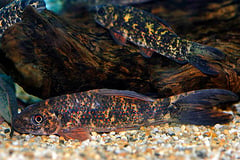
Max length160mm SL6in SLTanknot recordedTemp21–27°C70–81°FpH6.0–7.5The harlequin shark, Labeo cyclorhynchus, is a cyprinid from the middle and lower Congo basin and the Ogooué drainage in Gabon. The patterning of young fish fades with age and adults are much darker. It becomes increasingly territorial as it grows, especially towards similar-looking species, so tankmates need choosing with care. It may still be seen as Labeo variegatus, an invalid name, in older literature and trade lists.

Labeo pierrei
(Sauvage, 1880)
Max length800mm SL31in SLTanknot recordedTempnot recordedpHnot recordedLabeo pierrei is a large cyprinid from the Mekong river system in southern China, Laos, Thailand, Cambodia and Vietnam, and the Dong Nai in Vietnam. It grows to 800 mm and inhabits main river channels and large, deep tributaries. It migrates seasonally, moving upstream into the Sekong, Sesan and Srepok rivers at the onset of the wet season and returning downstream in the dry months.

Labeotropheus fuelleborniFuelleborn's Cichlid
authority not recorded
Max length175mm SL7in SLTank90 × 45cm36 × 18inTemp24–28°C75–82°FpH7.6–8.8Fuelleborn's cichlid, Labeotropheus fuelleborni, is an mbuna endemic to Lake Malawi, found in turbulent shallow water around rocky shorelines. An overhanging snout and chisel-shaped teeth let it graze algae from rocks other species cannot reach. It occurs in many colour forms, including orange and orange blotch females, and forms should not be mixed as they may hybridise. It is aggressive and territorial and should not be kept with peacocks or utaka.

Labeotropheus trewavasaeTrewavas' Cichlid
authority not recorded
Max length113mm SL4in SLTank90 × 45cm36 × 18inTemp24–28°C75–82°FpH7.6–8.8Trewavas' cichlid, Labeotropheus trewavasae, is an mbuna endemic to Lake Malawi, living around rocky shorelines and islands with heavy algal growth. It is told from the similar L. fuelleborni by its more slender body and smaller adult size, and has been recorded at greater depths. Over 40 colour forms are recorded in nature, and they should not be mixed in aquaria as they may hybridise. It is very aggressive towards its own kind.

Labidochromis caeruleusCaeruleus
authority not recorded
Max length100mm SL3.9in SLTank90 × 45cm36 × 18inTemp24–28°C75–82°FpH7.7–8.6Labidochromis caeruleus is a relatively peaceful mbuna from the northern part of Lake Malawi, best known in the hobby for its 'electric yellow' morph. That morph is one of the rarer forms in nature, where the blue and white variety is more widespread, and most fish on sale are tank-bred. It lives among rocks and in beds of Vallisneria. It was originally imported as L. tanganyicae, and should not be mixed with other forms or Labidochromis species as they may hybridise.

Labidochromis sp. "perlmutt"Pearly Labidochromis
authority not recorded
Max length100mm SL3.9in SLTank90 × 45cm36 × 18inTemp24–28°C75–82°FpH7.5–8.5Labidochromis sp. 'perlmutt' is an mbuna endemic to Lake Malawi, known from Higga Reef and Mbamba Bay, where it lives in deep rocky zones. Discovered in 1995, it takes its name from the German for 'mother of pearl', after the pearly white colouration of adults, and is also sold as Labidochromis sp. 'yellow bar'. The Mbamba Bay Island population closely resembles L. caeruleus and the two hybridise freely, so they should not be kept together.
Labiobarbus fasciatus
(Bleeker, 1853)
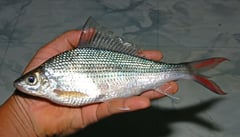
Max length200mm SL8in SLTanknot recordedTempnot recordedpHnot recordedLabiobarbus fasciatus is a labeonin cyprinid from the Pahang River system in Peninsular Malaysia and the islands of Sumatra and Borneo. It has a red caudal fin with a thin dark stripe along each lobe, and longitudinal stripes formed by spots on the scales. Like other Labiobarbus it has two pairs of well-developed barbels and an extremely long dorsal fin, and the genus was known as Dangila for over 100 years.

Labiobarbus leptocheilus
(Valenciennes, 1842)
Max length260mm SL10in SLTank240 × 60cm96 × 24inTemp20–26°C68–79°FpH6.0–8.0Labiobarbus leptocheilus is a large cyprinid widespread in Southeast Asia, from the Mekong and Salween to the Greater Sunda Islands. Different populations vary somewhat in appearance, and it may turn out to represent a group of closely-related species. The Cambodian Mekong population has been considered a distinct species, Labiobarbus lineatus, and that name is widely used in the ornamental trade although it is currently a synonym. It grows to 260 mm SL and needs spotless, well-oxygenated water.
Labiobarbus ocellatus
(Heckel, 1843)
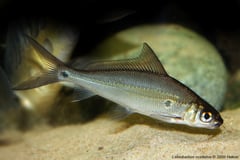
Max length180mm SL7in SLTank150 × 45cm60 × 18inTemp20–28°C68–82°FpH6.0–7.5Labiobarbus ocellatus is a cyprinid from Peninsular Malaysia, Sumatra and Borneo, with a black spot on the shoulder and one on the caudal peduncle. It is occasionally available in the ornamental trade, typically under a name such as 'Bornean eye-spot silver shark' or the invalid scientific name Cirrhinus chinensis. A pelagic species of rivers and some lakes, it moves into seasonally inundated floodplains and forest during the wet season, and grows to 180 mm SL.

Labiobarbus siamensis
(Sauvage, 1881)
Max length200mm SL8in SLTanknot recordedTempnot recordedpHnot recordedLabiobarbus siamensis is a cyprinid from the Mekong in Laos, Thailand and Cambodia, and the Chao Phraya and Bang Pakong in central Thailand. It inhabits rivers and streams of all sizes and moves into inundated floodplains and forests during the wet season. Wild fish feed on small items including phytoplankton, zooplankton, periphyton and benthic algae. Relatively long maxillary barbels, reaching well beyond the eye, help separate it from congeners.

Ladigesia roloffiJelly Bean Tetra
Géry, 1968
Max length31mm SL1.2in SLTank60 × 30cm24 × 12inTemp20–26°C68–79°FpH5.0–7.0The jelly bean tetra, Ladigesia roloffi, is a small alestid from Sierra Leone, known with certainty only from the Kasewe Forest reserve. Also called the 'Sierra Leone dwarf characin', it is the only member of its genus and grows to around 31 mm SL. The IUCN assesses it as Endangered, and over 97% of Sierra Leone's primary forest has been destroyed, surviving only in protected reserves such as Kasewe. Soft, acidic water is a prerequisite for breeding.
Laemolyta taeniataStriped Headstander
(Kner, 1858)
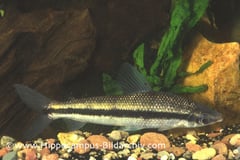
Max length288mm SL11in SLTank120 × 60cm48 × 24inTemp20–28°C68–82°FpH4.0–7.5The striped headstander, Laemolyta taeniata, is an anostomid from the central Amazon basin, also recorded from the Orinoco system in Venezuela. The largest-growing member of the genus, to 288 mm SL, it is rarely seen in the aquarium trade. Something of a habitat generalist, it migrates into flooded forest in the wet season and has been seen in large migratory shoals with Leporinus fasciatus and L. agassizii. Water quality is of the utmost importance, and anostomids are prodigious jumpers.

Laetacara araguaiae
Ottoni & Costa, 2009
Max length35mm SL1.4in SLTanknot recordedTemp24–26°C75–79°FpH6.0–7.0Laetacara araguaiae is a small cichlid from the rio Araguaia basin in central Brazil. Known in the hobby as L. sp. 'Buckelkopf' before it was described, it grows to around 35 mm SL and is a biparental substrate-spawner. Some populations differ from one another in colour pattern, and 7-8 dorsal-fin rays separate it from all congeners.

Laetacara curvicepsDwarf Flag Cichlid
(Ahl, 1924)
Max length50mm SL2.0in SLTanknot recordedTemp20–28°C68–82°FpH4.5–7.5The dwarf flag cichlid, Laetacara curviceps, is a small cichlid from the lower Amazon basin in Brazil. An established aquarium favourite, it has also been called 'flag acara', 'smiling acara', 'sheepshead acara' and 'blunt-headed cichlid'. Populations differ in the degree of red and blue on the body and fins. It favours clear, slow-flowing water over leaf litter and is a biparental substrate-spawner.

Laetacara dorsigeraRedbreast Acara
(Heckel, 1840)
Max length37mm SL1.5in SLTanknot recordedTemp20–28°C68–82°FpH5.0–7.5The redbreast acara, Laetacara dorsigera, is a small cichlid from the Guaporé in Bolivia and Brazil, and the Paraná system further south. Breeding males and females develop conspicuous red cheeks, opercula and belly, a feature L. curviceps lacks. A dark spot in the middle of the dorsal fin is shared only with L. curviceps and L. flamannellus. Populations vary in colour pattern, and it is a biparental substrate spawner growing to around 37 mm SL.

Laetacara flamannellus
Ottoni, Bragança, Amorim & Gama, 2012
Max length40mm SL1.6in SLTanknot recordedTempnot recordedpHnot recordedLaetacara flamannellus is a small cichlid from the eastern coastal rivers of Amapá state, Brazil. It has mostly been collected from shallow, still water among sedge-like plants in grasslands that flood between January and June. An orange ring around the dark spot at the dorsal-fin base separates it from L. curviceps and L. dorsigera, and it may have been traded occasionally as L. curviceps.

Laetacara fulvipinnis
Staeck & Schindler, 2007
Max length75mm SL3.0in SLTanknot recordedTemp20–28°C68–82°FpH4.0–7.0Laetacara fulvipinnis is a cichlid from the Orinoco, the Casiquiare and the upper and middle rio Negro in Venezuela and Brazil. Known in the hobby as L. sp. 'orangeflossen' before it was described, it takes its name from the reddish-yellow anal and caudal fins. It has been collected among leaf litter and submerged vegetation in very shallow, soft, acidic blackwater, and grows to around 74 mm SL. A biparental substrate-spawner, it lays its eggs on a solid surface such as a plant leaf.

Laetacara thayeri
(Steindachner, 1875)
Max length65mm SL2.6in SLTanknot recordedTemp20–28°C68–82°FpH4.5–7.5Laetacara thayeri is a cichlid from the middle and upper Amazon basin in western Brazil and northern Peru. It is relatively rare in the aquarium trade. Ctenoid scales on the sides of the head and the lack of a dark spot at the caudal-fin base separate it from all congeners. Males grow larger than females and develop more-extended dorsal, anal and caudal fins.