Every species
Filters

Megalamphodus sweglesiRed Phantom Tetra
Géry, 1961
Max length35mm SL1.4in SLTank80 × 30cm31 × 12inTemp20–28°C68–82°FpH4.5–7.5The red phantom tetra, Megalamphodus sweglesi, is a small characid endemic to the upper and middle Río Orinoco watershed in Colombia and Venezuela. It apparently favours minor tributaries, oxbows and flooded forests, and in Venezuela is often found in morichals. Bred commercially in several countries, it has been traded in more than one colour form, and Zarske (2014) concluded that the particularly red form sold as 'red' or 'var. rubra' is conspecific.
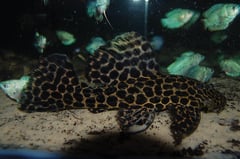
Megalancistrus parananusL113
(Peters, 1881)
Max length588mm SL23in SLTanknot recordedTemp20–28°C68–82°FpH6.0–7.5L113, Megalancistrus parananus, is a large suckermouth catfish from the rios Paraná, Paraguay and Uruguay in Brazil, Paraguay, Uruguay and Argentina. It was formerly thought to include L234, but only L113 appears native to these drainages, while L234 comes from the rio São Francisco. The largest recorded specimen measured 588 mm, and it can behave very aggressively in confined surroundings.
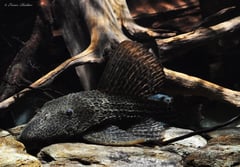
Megalancistrus sp.L234
authority not recorded
Max length600mm SL24in SLTanknot recordedTemp20–30°C68–86°FpH6.0–7.5L234, the dragon hi fin pleco, is a large Megalancistrus catfish known only from the rio São Francisco system in eastern Brazil. The L-number was previously applied to Megalancistrus parananus, but that species is native to the Paraná, Paraguay and Uruguay drainages, so L234 appears to be an unidentified species. It grows to 500 to 600 mm and can behave very aggressively in confined surroundings.
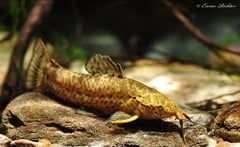
Megalechis pictaBar-tailed Hoplo
(Müller & Troschel, 1849)
Max length120mm SL5in SLTank120 × 45cm48 × 18inTemp18–28°C64–82°FpH5.0–7.5The bar-tailed hoplo, Megalechis picta, is a callichthyid catfish widely distributed east of the Andes in Brazil, Venezuela and Guyana. It is recorded from the Amazon, Orinoco and upper Essequibo systems. Previously referred to as M. thoracata, it can be told from that species by a dark vertical bar in the caudal-fin and a longer dorsal-fin spine. Peaceful and hardy, it can even tolerate hypoxic conditions, and the male builds a nest.
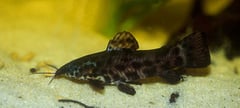
Megalechis thoracataSpotted Hoplo
authority not recorded
Max length150mm SL6in SLTank120 × 38cm48 × 15inTemp18–28°C64–82°FpH6.0–8.0The spotted hoplo, Megalechis thoracata, is a callichthyid catfish widespread across northern South America, living primarily in still waters. Still widely referred to as Hoplosternum thoracatum, it can breathe atmospheric air, absorbing the oxygen through the intestine, and this lets it endure poor conditions in the wild. It is also eaten as a food fish in parts of South America.
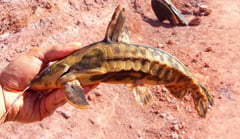
Megalodoras uranoscopusGiant Raphael Catfish
authority not recorded
Max length700mm SL28in SLTank240 × 120cm96 × 48inTemp21.1–25°C70–77°FpHnot recordedThe giant Raphael catfish, Megalodoras uranoscopus, is a large doradid recorded from the Essequibo, Tocantins and Amazon river systems. It is also known in the US as the 'ripsaw catfish', and older literature often refers to it as M. irwini, now a junior synonym. Growing to 600 to 700 mm, it is very peaceful and can be combined with many other species in suitably sized systems.

Mekongina erythrospila
Fowler, 1937
Max length450mm SL18in SLTanknot recordedTemp20–26°C68–79°FpH6.0–8.0Mekongina erythrospila is a large cyprinid endemic to the middle and lower Mekong River system in Laos, Thailand, Cambodia and Vietnam. It tends to inhabit medium to large river channels with fast-flowing water and rocky beds. Occasionally in the ornamental trade, it grows to 400 to 450 mm and is unsuitable for most private aquaria. It can be aggressively territorial towards conspecifics and similarly-shaped fishes.

Melanochromis auratusGolden Mbuna
authority not recorded
Max length110mm SL4in SLTank120 × 45cm48 × 18inTemp24–28°C75–82°FpH7.6–8.8The golden mbuna, Melanochromis auratus, is a cichlid endemic to Lake Malawi, common down the western coast and along the southern end of the lake. One of the most aggressive and territorial mbuna, it is not recommended for the beginner. Mature males turn dark, unlike the golden females and juveniles, and older females often darken until they superficially resemble males. Other Melanochromis should not be kept with it, as they may hybridise.

Melanochromis chipokae
authority not recorded
Max length120mm SL5in SLTank120 × 45cm48 × 18inTemp24–28°C75–82°FpH7.6–8.8Melanochromis chipokae is an mbuna endemic to Lake Malawi, found only around Chindunga Rocks, a reef just off the island of Chipoka. One of the predatory 'pike auratus' group, it eats fry as well as crustaceans and algae. Females and juvenile males are easily confused with M. auratus, but have a more pointed mouth and a fully striped caudal fin. Arguably the most aggressive mbuna, it is not recommended for the beginner.

Melanochromis lepidiadaptes
authority not recorded
Max length120mm SL5in SLTank90 × 45cm36 × 18inTemp24–28°C75–82°FpH7.6–8.8Melanochromis lepidiadaptes is an mbuna endemic to Lake Malawi, found only in a limited area around Makanjila Point on the eastern side. Originally sold as M. fuscus and then M. sp. 'lepidophage', it apparently feeds almost solely on the scales of other species in nature, though not other mbuna. Relatively peaceful for a Melanochromis, it suits a Lake Malawi aquarium with cichlids of similar size and disposition.
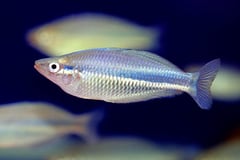
Melanotaenia affinisNew Guinea Rainbowfish
authority not recorded
Max length120mm SL5in SLTank120 × 30cm48 × 12inTemp20–30°C68–86°FpH6.5–8.0The New Guinea rainbowfish, Melanotaenia affinis, is a rainbowfish from Papua New Guinea. It was one of the first rainbowfish species to be imported for the hobby in any numbers. Three geographical variants are found in the hobby: the widespread 'standard' form, the 'Pagwi' form from a tributary of the Sepik River, and the 'Bluewater Creek' form known from a single location near Madang. They look superficially similar and differ only in small details of colour and patterning.
Melanotaenia australisWestern rainbowfish
authority not recorded
Max length120mm SL5in SLTank120 × 30cm48 × 12inTemp22–27°C72–81°FpH6.5–8.0The western rainbowfish, Melanotaenia australis, is a rainbowfish from Australia and probably the commonest rainbowfish species there. Once classified in the M. splendida complex, it has since proved genetically distinct from that group, with two clear lineages within it. Colour and patterning vary widely by locality, and the different morphs should not be mixed in the aquarium because they hybridise freely. Juveniles are much drabber than adults, and full colour can take over 12 months to develop.
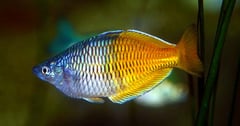
Melanotaenia boesemaniBoeseman's rainbowfish
authority not recorded
Max length110mm SL4in SLTank120 × 30cm48 × 12inTemp27–30°C81–86°FpH7.0–8.0Boeseman's rainbowfish, Melanotaenia boesemani, is a rainbowfish from Indonesia, known only from the Ajamaru lakes and nearby Lakes Hain and Aitinjo. One of the most popular rainbowfish in the hobby, it is almost always sold as farmed stock from the Far East and Eastern Europe. The species is rare in nature and on the IUCN red list, and collection of breeding stock for the trade has had a massively detrimental effect on it. The drab juveniles usually offered for sale can take over 12 months to colour up.
Melanotaenia fluviatilisAustralian Rainbowfish
authority not recorded
Max length100mm SL3.9in SLTank90 × 30cm36 × 12inTemp20–25°C68–77°FpH6.5–8.0The Australian rainbowfish, Melanotaenia fluviatilis, is a rainbowfish from Queensland and New South Wales, Australia. Also known as the Murray River or crimson-spotted rainbowfish, it is easily confused with the very similar M. duboulayi, with which it was once grouped as a single species. Its range extends further south than any other rainbowfish, and it can withstand relatively cool temperatures, though it becomes less active and loses colour if kept that cold.
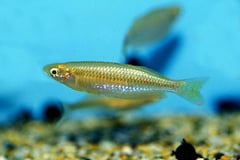
Melanotaenia gracilisSlender Rainbowfish
authority not recorded
Max length75mm SL3.0in SLTank75 × 30cm30 × 12inTemp22–28°C72–82°FpH7.0–8.0The slender rainbowfish, Melanotaenia gracilis, is a small rainbowfish from the Drysdale and Carson Rivers in the Kimberley, north-western Australia. It is uncommonly seen in the hobby because it comes from such a remote area, and the IUCN lists it as at risk. Unlike many members of the genus, it lives in sparse, rocky, slow-moving stretches of river and in isolated pools during the dry season.
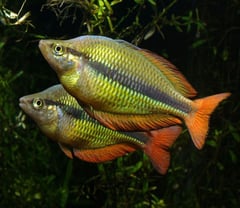
Melanotaenia herbertaxelrodiLake Tebera Rainbowfish
authority not recorded
Max length90mm SL3.5in SLTank90 × 30cm36 × 12inTemp20–26°C68–79°FpH7.0–8.0The Lake Tebera rainbowfish, Melanotaenia herbertaxelrodi, is a rainbowfish endemic to the Lake Tebera basin in the Central Highlands of New Guinea. It inhabits clear, heavily vegetated water in the lake and its surrounding streams, and is probably at risk from overfishing. Mature fish are among the more colourful rainbowfish, and they show their best colours in a heavily planted tank with high water quality.
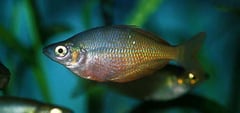
Melanotaenia irianjayaIrian Jaya Rainbowfish
authority not recorded
Max length120mm SL5in SLTank90 × 30cm36 × 12inTemp23–26°C73–79°FpH6.5–8.0The Irian Jaya rainbowfish, Melanotaenia irianjaya, is a rainbowfish from Indonesia, recorded only around Bintuni Bay in Irian Jaya. It can be identified by the longer middle rays in the dorsal and anal fins, a feature usually associated with the closely related genus Glossolepis. It is not often seen in the hobby. In nature it lives in slow and fast-flowing rainforest streams with little aquatic vegetation, using submerged logs and branches for cover.
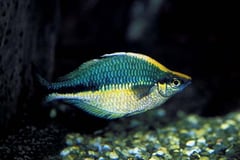
Melanotaenia lacustrisLake Kutubu Rainbowfish
authority not recorded
Max length120mm SL5in SLTank120 × 30cm48 × 12inTemp20–25°C68–77°FpH7.0–9.0The Lake Kutubu rainbowfish, Melanotaenia lacustris, is a rainbowfish endemic to Lake Kutubu and the River Soro in Papua New Guinea. The lake is threatened by overfishing, much of it for the aquarium trade, and by oil development, and the species has 'vulnerable' status on the IUCN red list. Juveniles are much drabber than the blue adults and are usually sold as 'blue' rainbowfish or similar. Full colour can take over 12 months to develop.
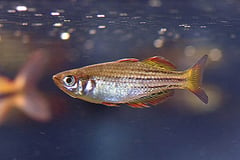
Melanotaenia maccullochiDwarf Rainbowfish
authority not recorded
Max length70mm SL2.8in SLTank60 × 30cm24 × 12inTemp20–30°C68–86°FpH5.5–8.0The dwarf rainbowfish, Melanotaenia maccullochi, is a small rainbowfish from Papua New Guinea and Australia. Several geographical variants are available, differing in colour, patterning and sometimes size, and they should not be mixed in aquaria because they may hybridise. Some are so distinct that they may turn out to be different species. It is found in a wide range of habitats, from clear streams to turbid, tannin-stained ponds.
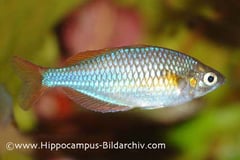
Melanotaenia praecoxNeon Dwarf Rainbowfish
authority not recorded
Max length80mm SL3.1in SLTank60 × 30cm24 × 12inTemp23–28°C73–82°FpH6.8–7.5The neon dwarf rainbowfish, Melanotaenia praecox, is a small rainbowfish endemic to the Mamberamo river system in New Guinea, Indonesia. It inhabits swiftly flowing tributaries of the main river and the surrounding swamps and marshes. Peaceful and small enough for many community aquaria, it shows its best colours in a heavily planted tank with floating plants to diffuse the light.