Every species
Filters
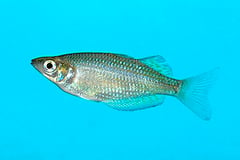
Melanotaenia rubrostriataRed-striped Rainbowfish
(Ramsay & Ogilby, 1886)
Max length125mm SL5in SLTank120 × 30cm48 × 12inTemp24–30°C75–86°FpHnot recordedThe red-striped rainbowfish, Melanotaenia rubrostriata, is a rainbowfish from Indonesia and Papua New Guinea. Long treated as a subspecies of M. splendida and one of the most colourful of its former subspecies, it lives among vegetation and debris in the tributaries and swamps of coastal plain rivers. The different forms should not be mixed with each other or with M. splendida in the aquarium because they may hybridise, and the drab juveniles can take over 12 months to colour up.
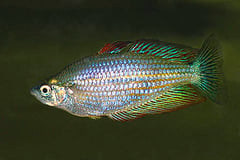
Melanotaenia splendidaEastern Rainbowfish
(Peters, 1866)
Max length150mm SL6in SLTank120 × 30cm48 × 12inTemp20–30°C68–86°FpH5.0–8.0The eastern rainbowfish, Melanotaenia splendida, comes from Australia and now includes the checkered rainbowfish, once M. s. inornata. It varies widely in colour and patterning by locality, and fish are often sold with a place name added to the species name. The different forms should not be mixed with each other or with the red-striped rainbowfish in the aquarium because they may hybridise. Full colour can take over 12 months to develop.
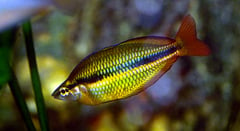
Melanotaenia trifasciataBanded Rainbowfish
authority not recorded
Max length150mm SL6in SLTank120 × 30cm48 × 12inTemp24–33°C75–91°FpH6.5–8.0The banded rainbowfish, Melanotaenia trifasciata, is a rainbowfish from Australia, most commonly seen in flowing streams and tributaries. Colour and patterning vary widely by locality, and the morphs are often sold with the collection locality added to the scientific name. They should never be mixed in the aquarium because they hybridise freely. Several species are thought to be involved, and a reclassification will probably follow.

Mesoheros festaeRed Terror
(Boulenger, 1899)
Max length508mm SL20in SLTank210 × 60cm84 × 24inTemp25–29°C77–84°FpH6.0–8.0The red terror, Mesoheros festae, is a large, territorial cichlid from the Rio Esmeraldas in Ecuador and the Rio Tumbes in Peru. Males reach around 20 inches and females 12, and anything the fish can fit in its large mouth will be seen as food. Pairing is troublesome, since the weaker fish of an incompatible pair is likely to be killed, so a pair is best grown on from six juveniles. An introduced population also exists in Singapore.

Mesonauta festivusFlag Cichlid
authority not recorded
Max length100mm SL3.9in SLTank120 × 38cm48 × 15inTemp24–28°C75–82°FpH6.0–8.0The flag cichlid, Mesonauta festivus, is a cichlid recorded from Venezuela, Peru, Brazil, Bolivia and Paraguay. It lives in well planted, slower-moving waters. Flag cichlids are found in most aquatic stores, but the fish usually sold under the name is M. insignis. It is peaceful, but becomes more aggressive when breeding.

Mesonauta insignis
authority not recorded
Max length100mm SL3.9in SLTank120 × 38cm48 × 15inTemp26–30°C79–86°FpHnot recordedMesonauta insignis is a cichlid from the Orinoco and Negro drainages in Brazil and Venezuela. It looks very similar to M. festivus, and there is some debate that it is the fish sold in aquatic stores as the flag cichlid. Both species are probably sold under that name, depending on where the fish were caught and exported from. A peaceful cichlid, it becomes more aggressive when breeding.
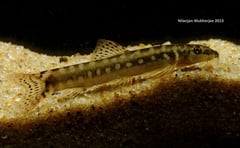
Mesonoemacheilus guentheri
(Day, 1867)
Max length60mm SL2.4in SLTank60 × 30cm24 × 12inTemp19–25.5°C66–78°FpH6.0–7.5Mesonoemacheilus guentheri is a loach from the Western Ghats of southern India, described from the Nilgiri Hills and since recorded in Kerala. Outside India it is most often seen as bycatch among shipments of M. triangularis. It is often confused with M. herrei, since both have rows of yellowish, dark-edged spots, but its spots are rounded where those of M. herrei are 'Y' or 'V' shaped. Some aquarists report it as peaceful and others as territorial and aggressive.
Mesonoemacheilus herrei
Nalbant & Bãnãrescu, 1982
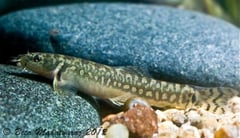
Max length60mm SL2.4in SLTank60 × 30cm24 × 12inTemp18–25.5°C64–78°FpH6.0–7.5Mesonoemacheilus herrei is a loach from the Anaimalai Hills of the Western Ghats in Tamil Nadu, southern India. It is unclear if it has ever been exported outside India, though the odd specimen may turn up among shipments of M. guentheri or M. triangularis. It was earlier considered synonymous with M. guentheri and shares its rows of yellowish, dark-edged spots, which in this species are 'Y' or 'V' shaped.
Mesonoemacheilus petrubanarescui
(Menon, 1984)
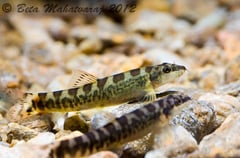
Max length50mm SL2.0in SLTank60 × 30cm24 × 12inTemp18–25.5°C64–78°FpH6.0–7.5Mesonoemacheilus petrubanarescui is a loach from the Netravati and Kabini river basins in the Western Ghats of southern India. It may be endemic to these two drainages. The dorsal surface carries 7-8 dark, saddle-shaped markings and the flanks a varying number of broken bars. It is unclear if it has been traded outside India, but it may turn up among shipments of M. guentheri or M. triangularis.
Mesonoemacheilus triangularisZodiac Loach
(Day, 1865)
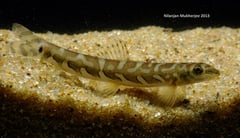
Max length60mm SL2.4in SLTank75 × 30cm30 × 12inTemp18–25.5°C64–78°FpH6.0–7.5The zodiac loach, Mesonoemacheilus triangularis, is a loach from the Western Ghats of Kerala and Tamil Nadu in southern India. Also called the 'Batik loach', it is relatively common in the aquarium trade. Pale, black-edged saddles along the back and a similar set of bars from the belly set it apart from its congeners. Aquarists differ on its temperament, some finding it peaceful and others territorial and aggressive.
Metynnis argenteus
authority not recorded
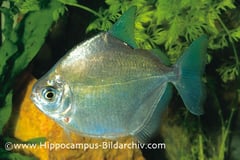
Max length150mm SL6in SLTank180 × 38cm72 × 15inTemp24–28°C75–82°FpH6.0–7.0Metynnis argenteus is a silver dollar, a relative of the piranhas probably endemic to the Rio Tapajós drainage in Brazil. It is very similar to M. hypsauchen, and both are sold in the hobby as 'silver dollar'. The two are virtually identical in appearance and care, but M. hypsauchen has a black blotch above and behind each eye. An avid plant-eater, it is best kept in a group of at least five and may eat much smaller fish.
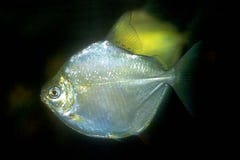
Metynnis hypsauchenSilver Dollar
authority not recorded
Max length150mm SL6in SLTank180 × 38cm72 × 15inTemp24–28°C75–82°FpH6.0–7.0The silver dollar, Metynnis hypsauchen, is a relative of the piranhas with a patchy distribution in Guyana, Brazil, Peru and Bolivia. Sometimes called the plain metynnis, it is sold under the same name as the very similar M. argenteus and differs in the black blotch above and behind each eye. A striped form is not a distinct species. An avid plant-eater, it is best kept in a group of at least five.
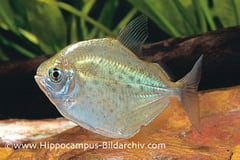
Metynnis lippincottianus
(Cope, 1870)
Max length130mm SL5in SLTank150 × 38cm60 × 15inTemp23–27°C73–81°FpH6.0–7.0Metynnis lippincottianus is a spotted silver dollar from Brazil and French Guiana, found in the lower and middle Amazon and the Oyapock system. It is occasionally seen for sale, sometimes as 'silver dollar', and its spotted pattern tells it apart from M. argenteus and M. hypsauchen. The spots are less pronounced than in M. maculatus, with which it shares a common name. The precise extent of its range is unclear.
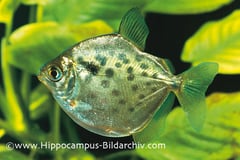
Metynnis maculatusSpotted Metynnis
(Kner, 1858)
Max length148mm SL6in SLTank180 × 45cm72 × 18inTemp20–28°C68–82°FpH5.0–7.5The spotted metynnis, Metynnis maculatus, is a silver dollar probably confined to the upper rio Madeira and upper rio Paraguai in Bolivia and Brazil. It is most often confused with M. argenteus and M. lippincottianus, but it has more midlateral scales and more spines on the ventral keel than either. It schools in nature and needs a very large tank with a group of six or more.

Metzia bounthobi
Shibukawa, Phousavanh, Phongsa & Iwata, 2012
Max length61mm SL2.4in SLTanknot recordedTempnot recordedpHnot recordedMetzia bounthobi is a cyprinid known only from the Nam Ou River basin, a Mekong tributary in northern Laos. It has been collected from hill streams with clear, slow to moderately fast-flowing water. It differs from all its congeners in having more branched anal-fin rays and more lateral line scales, and the genus itself remains unresolved in taxonomic terms.
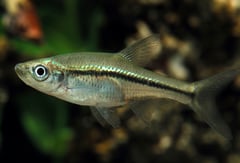
Metzia formosae
(Oshima, 1920)
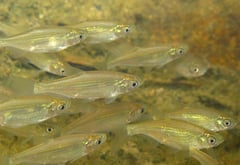
Max length75mm SL3.0in SLTanknot recordedTempnot recordedpHnot recordedMetzia formosae is a small cyprinid from northern Taiwan, Hainan, Hong Kong, southern China and northern Vietnam. It is identified by its upturned mouth and a black stripe along the flank from the gill opening to the caudal-fin base. It inhabits slow-moving to still, well-vegetated waters, including streams, rice paddies, ditches and canals. The genus remains unresolved in taxonomic terms.
Metzia lineata
(Pellegrin, 1907)
Max length100mm SL3.9in SLTanknot recordedTempnot recordedpHnot recordedMetzia lineata is a cyprinid from southern China, Hainan, Hong Kong and the Red River basin of northern Vietnam. Populations from the upper Pearl River and from Vietnam differ from those elsewhere, which suggests several species may be included under the name. It lives in slow-moving to still, well-vegetated waters. It has been introduced to other river systems in China and to northern Laos.
Microcobitis misgurnoides
(Rendahl, 1944)
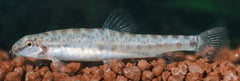
Max length41mm SL1.6in SLTank45 × 30cm18 × 12inTemp20–24°C68–75°FpH5.5–7.0Microcobitis misgurnoides is a small cobitid loach from central Vietnam and the Mekong system in eastern Laos, growing to 41 mm SL. It was described in Cobitis and stayed there for over 60 years until Bohlen and Harant (2011) moved it to the new genus Microcobitis. It apparently lives in groups, and a soft, sandy substrate probably suits it best.

Microctenopoma ansorgiiOrnate ctenopoma
authority not recorded
Max length70mm SL2.8in SLTanknot recordedTemp20–27°C68–81°FpH5.5–7.5The ornate ctenopoma, Microctenopoma ansorgii, is an anabantoid from the Congo basin in the Republic of Congo and Democratic Republic of Congo. The most colourful of the African anabantoids, it is relatively rare in the hobby because its habitat of densely vegetated small streams is hard to collect from. It can be difficult to acclimatise but is very hardy once settled, and it is a slow-moving fish that is easily out-competed at feeding time.

Microctenopoma fasciolatumBanded ctenopoma
authority not recorded
Max length80mm SL3.1in SLTank75 × 30cm30 × 12inTemp24–28°C75–82°FpH6.5–7.5The banded ctenopoma, Microctenopoma fasciolatum, is an anabantoid from the Congo basin and a handful of rivers in Cameroon. In nature it is found in clear water with plenty of surface and overhanging vegetation. Less shy than M. ansorgei, it is still slow-moving and easily out-competed by boisterous species. Males are territorial. A bubblenester, it has been bred in captivity.