Every species
Filters
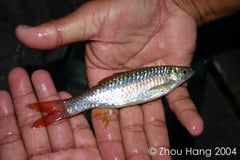
Rasbora tornieri
Ahl, 1922
Max length90mm SL3.5in SLTank120 × 30cm48 × 12inTemp20–26°C68–79°FpH4.0–7.0Rasbora tornieri is a cyprinid from Sumatra, Borneo, Peninsular Malaysia and the Mekong drainage in Cambodia. Its identity was unclear for decades before its redescription by Ng and Kottelat (2013). It is very similar to R. dusonensis, which shares the Musi river with it, but its caudal fin is carmine red, against bright yellow in R. dusonensis. It lives in flowing streams and peat swamp blackwaters alike.
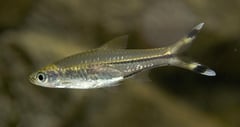
Rasbora trilineataScissortail Rasbora
authority not recorded
Max length150mm SL6in SLTank120 × 45cm48 × 18inTemp22–25°C72–77°FpHnot recordedThe scissortail rasbora, Rasbora trilineata, is a cyprinid from the Chao Phraya and lower Mekong basins, Peninsular Malaysia, Sumatra and Borneo. The name comes from the twitching of the caudal fin when the fish is at rest. It is usually sold at a much smaller size than the 15 cm it reaches, so it needs a large tank, and wild fish are increasingly hard to come by as it is produced commercially in several countries.
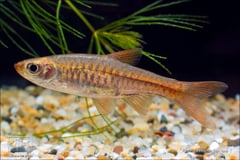
Rasbora vulcanus
authority not recorded
Max length40mm SL1.6in SLTank60 × 38cm24 × 15inTemp23–26°C73–79°FpHnot recordedRasbora vulcanus is a small rasbora from West Sumatra, Indonesia, known only from the Batang Si Joontour near the town of Painan. The name refers to the red body colouration of males. It is occasionally sold as R. reticulata or R. cf. reticulata, but the true R. reticulata is a deeper-bodied fish endemic to the island of Nias and lacks the red colouration. Females are pale yellow, and often only the more colourful males are exported.
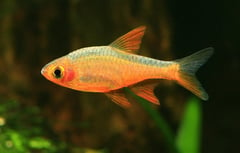
Rasboroides vateriflorisFire Rasbora
(Deraniyagala, 1930)
Max length40mm SL1.6in SLTank60 × 30cm24 × 12inTemp23–27°C73–81°FpH5.5–7.0The fire rasbora, Rasboroides vaterifloris, is a small cyprinid endemic to the Kalu, Bentota, Gin and Nilwala river basins of southwestern Sri Lanka. Colour varies with locality, and red, orange and yellow-finned forms are known. Its delicate nature causes problems in shipping, and reports suggest the more highly coloured fish are becoming scarcer in the wild, possibly because selective collection for the trade has altered the structure of wild populations.
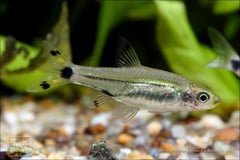
Rasbosoma spilocercaDwarf Scissortail Rasbora
authority not recorded
Max length30mm SL1.2in SLTank45 × 30cm18 × 12inTemp22–26°C72–79°FpHnot recordedThe dwarf scissortail rasbora, Rasbosoma spilocerca, is a small cyprinid from the lower Mekong basin in Laos, Thailand and Cambodia. A miniature look-alike of Rasbora trilineata, it is rarely seen in the hobby, probably because of its plain patterning and rather delicate nature. It inhabits shallow, clear waters with thick submerged vegetation, and its small size and timid behaviour suit it to a tank of other diminutive species.

Reganochromis calliurus
authority not recorded
Max length150mm SL6in SLTank120 × 45cm48 × 18inTemp24–27°C75–81°FpH8.0–9.2Reganochromis calliurus is a cichlid endemic to Lake Tanganyika, where it usually swims at 60 metres depth or more over sand or mud. Its deep-water lifestyle makes it difficult to collect, and it is rarely seen in the hobby. A peaceful biparental mouthbrooder, it should be kept in pairs and not with boisterous species such as mbuna.

Retroculus acherontos
Landim, Moreira & Figueiredo, 2015
Max length194mm SL8in SLTanknot recordedTempnot recordedpHnot recordedRetroculus acherontos is a cichlid known only from tributaries of the upper rio Tocantins basin in Goiás state, Brazil. It grows to at least 194 mm and differs from its congeners in developing a nuchal hump in both sexes above about 121 mm SL. Based on its morphology it is hypothesised to be less rheophilic than other Retroculus, and it has been collected in small to medium-sized tributaries with clear or sediment-filled water.

Retroculus lapidifer
(Castelnau, 1855)
Max length200mm SL8in SLTank210 × 60cm84 × 24inTemp26–32°C79–90°FpH6.0–8.0Retroculus lapidifer is a rheophilic cichlid from the rio Tocantins and Araguaia systems and nearby coastal drainages of northeastern Brazil. It lives in rapids and fast-flowing stretches of clear water rivers, and needs a set-up designed to resemble a flowing river, with a base of at least 210 by 60 cm and water of 26 to 32 °C. A biparental substrate-spawner, it has been bred in aquaria and is available in the trade on a sporadic basis.

Retroculus xinguensis
Gosse, 1971
Max length200mm SL8in SLTank210 × 60cm84 × 24inTemp26–32°C79–90°FpH6.0–8.0Retroculus xinguensis is a rheophilic cichlid from the rio Xingu basin in Brazil, with a handful of records from the Tapajós drainage. It occurs in rapids and fast-flowing stretches of clear water rivers, and differs from its congeners in having conspicuous dark bars on the caudal fin. It is available in the trade on a sporadic basis and needs a large set-up designed to resemble a flowing river, with water of 26 to 32 °C.
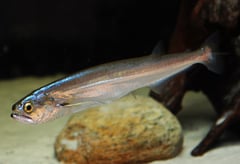
Rhaphiodon vulpinusBiara
Spix & Agassiz, 1829
Max length800mm SL31in SLTanknot recordedTemp24–28°C75–82°FpH6.0–8.0The biara, Rhaphiodon vulpinus, is a dogtooth characin found from the Orinoco and Amazon basins south to the Río de la Plata in Argentina. The only member of its genus, it grows to 600 to 800 mm and is an obligate piscivore, and it is suitable only for public installations or the very largest private aquaria. Juveniles are seen for sale quite regularly, most often without adequate information on their long-term care.
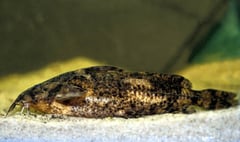
Rhinodoras boehlkeiFog Talking Catfish
authority not recorded
Max length130mm SL5in SLTank120 × 30cm48 × 12inTemp24–26°C75–79°FpH5.8–7.0The fog talking catfish, Rhinodoras boehlkei, is a doradid catfish from the upper Amazon basin in eastern Ecuador and Peru. It is usually found sheltering among roots or sunken logs in flowing rivers and tributaries. Shy and nocturnal, it is totally unaggressive but will eat smaller fish, so tankmates need to be too big to be considered food.
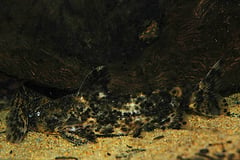
Rhinodoras dorbignyi
(Kner, 1855)
Max length300mm SL12in SLTank120 × 60cm48 × 24inTemp20–25°C68–77°FpH6.0–7.0Rhinodoras dorbignyi is a talking catfish from the Rio Paraná basin in Bolivia, Paraguay, Uruguay, Argentina and Brazil. It shelters among roots or submerged vegetation in slow-moving and standing waters. Shy and nocturnal, it grows to at least 30 cm and will eat smaller fish, although it is otherwise totally unaggressive.
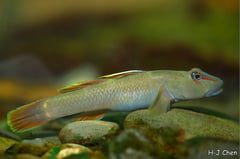
Rhinogobius candidianus
(Regan, 1908)
Max length80mm SL3.1in SLTank80 × 30cm31 × 12inTemp18–28°C64–82°FpH6.0–8.0Rhinogobius candidianus is a goby from northern and western Taiwan, where it lives in smaller tributaries and hill streams. It is normally imported alongside a smaller, near-identical congener identified as R. nantaiensis, and both are usually traded as R. candidianus. The two can be separated by snout length, noticeably longer in R. candidianus, and by adult size: R. nantaiensis reaches just 50 to 55 mm.
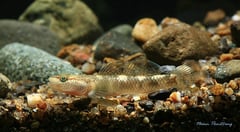
Rhinogobius chiengmaiensisChiangmai Stream Goby
Fowler, 1934
Max length50mm SL2.0in SLTank60 × 30cm24 × 12inTemp18–26°C64–79°FpH6.0–8.0The Chiangmai stream goby, Rhinogobius chiengmaiensis, is a small goby from the middle and upper Chao Phraya river system in central Thailand. It has been exported for the ornamental trade, often labelled as the congener R. mekongianus, but has five irregular dark markings on the body against seven or eight in that species. The male guards eggs laid on the ceiling of a cave or crevice, and it is among the less problematic members of the genus to breed.
Rhinogobius duospilusWhite-cheeked Goby
(Herre, 1935)
Max length50mm SL2.0in SLTank60 × 30cm24 × 12inTemp15–25°C59–77°FpH6.0–7.5The white-cheeked goby, Rhinogobius duospilus, is a small goby from Hong Kong and southern China, living in clear hill streams. It was often sold in the past as 'Rhinogobius wui', a name now listed as a valid species, so aquarium literature published under either name may refer to either fish. Adults are extremely sedentary, and populations in neighbouring streams are genetically distinct from one another.
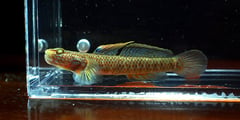
Rhinogobius filamentosus
(Wu, 1939)
Max length55mm SL2.2in SLTank60 × 30cm24 × 12inTemp18–25°C64–77°FpH6.0–8.0Rhinogobius filamentosus is a small goby from the Li River system in Guangxi, southern China, also collected in neighbouring Guangdong province. Very few details of its range exist, and its habitat is presumed to be smaller rivers and streams over gravel, rocks and boulders. The name refers to the extended primary dorsal-fin rays of males.
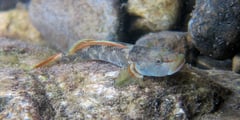
Rhinogobius flumineus
(Mizuno, 1960)
Max length60mm SL2.4in SLTank75 × 30cm30 × 12inTemp18–25°C64–77°FpH6.0–8.0Rhinogobius flumineus is a goby endemic to Japan, found in central and western Honshu and on the islands of Kyushu and Shikoku. Its entire life cycle takes place in freshwater, in smaller rivers, tributaries and streams, although it occurs alongside amphidromous congeners in places. Two colour forms appear to exist, based on the shape and patterning of the male's first dorsal fin, and its name is sometimes applied to other species.
Rhinogobius formosanus
Oshima, 1919
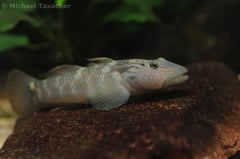
Max length100mm SL3.9in SLTank80 × 30cm31 × 12inTemp18–28°C64–82°FpH6.0–8.0Rhinogobius formosanus is a goby endemic to river systems of northern and northeastern Taiwan. Previously considered a subspecies of R. nagoyae, it has generally been accepted as distinct since 2008. Irregular, worm-like, reddish-brown lines on the cheek and opercle separate it from other Taiwanese Rhinogobius. Like many fishes from running water it needs spotless water and does best in a tank set up to simulate a flowing stream.
Rhinogobius gigas
Aonuma & Chen, 1996
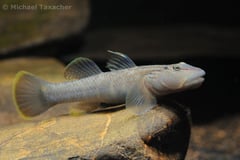
Max length85mm SL3.3in SLTank80 × 30cm31 × 12inTemp18–28°C64–82°FpH6.0–8.0Rhinogobius gigas is a goby native to eastern Taiwan, found in the middle and lower sections of rivers in Yilan, Hualien and Taitung counties. The species is uncommon in the aquarium hobby, and its name is sometimes applied to similar-looking congeners. Well-defined dark cross bands on the body, a spotted cheek and rows of spots in the second dorsal and anal fins help tell it apart from other Taiwanese Rhinogobius.
Rhinogobius lanyuensis
Chen, Miller & Fang, 1998
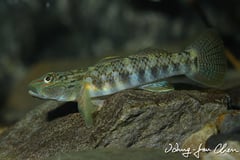
Max length67mm SL2.6in SLTank80 × 30cm31 × 12inTemp18–25°C64–77°FpH6.0–8.0Rhinogobius lanyuensis is a goby known only from Lanyu Island, better known as Orchid Island, off the southeastern coast of Taiwan. It has been available in Japan on occasion. The body carries 8 vertical blackish brown bars, and females have a discontinuous dark lateral stripe that males lack. Lanyu is a small volcanic island with no major rivers, and the species presumably inhabits small streams over gravel, rocks and bedrock.