Every species
Filters
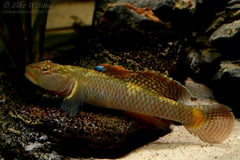
Rhinogobius leavelli
(Herre, 1935)
Max length60mm SL2.4in SLTank60 × 30cm24 × 12inTemp20–28°C68–82°FpH6.0–8.0Rhinogobius leavelli is a goby ranging from northeastern Laos through northern Vietnam to the Pearl drainage in Guangxi, southern China. It appears to exist in a number of forms that differ in colour pattern, morphology or both, although those in the aquarium trade all look similar. Fish identified as this species tend to have an orange blotch at the base of the caudal fin and a dark vertical bar at the base of the pectoral fin.
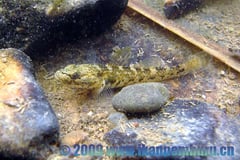
Rhinogobius lentiginis
(Wu & Zheng, 1985)
Max length32mm SL1.3in SLTank60 × 30cm24 × 12inTemp16–24°C61–75°FpH6.0–8.0Rhinogobius lentiginis is a small goby that appears endemic to Zhejiang province, eastern China, growing to around 32 mm SL. Given its natural range and the lack of commercial collecting there, it is unlikely to have been in the aquarium hobby. Irregular dark blotches and spots on the cheek and opercle separate it from its most similar congener, R. davidi, which has a single dark vertical stripe there.
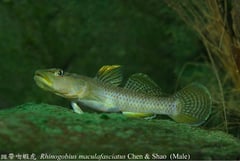
Rhinogobius maculafasciatus
Chen & Shao, 1996
Max length50mm SL2.0in SLTank60 × 30cm24 × 12inTemp18–24°C64–75°FpH6.0–8.0Rhinogobius maculafasciatus is a small goby known only from certain rivers in southern Taiwan, including the Tzengwen and Kaoping drainages. It has been collected by a few individuals. Fewer scale rows between the first dorsal-fin origin and upper pectoral-fin base than in related Taiwanese species give it a somewhat elongate appearance. Typical habitats are small brooks, tributaries and pools with slow flow over rocks and pebbles.

Rhinogobius mekongianus
(Pellegrin & Fang, 1940)
Max length50mm SL2.0in SLTank60 × 30cm24 × 12inTemp18–26°C64–79°FpH6.0–7.5Rhinogobius mekongianus is a goby from the middle and upper Mekong basin in Laos, Vietnam and Thailand. Its name has been misapplied in the aquarium trade to the congener R. chiengmaiensis, and it does not appear to have been on the market itself. It has 7-8 irregular dark markings on the body (vs. 5 in R. chiengmaiensis), and records from the Chao Phraya drainage most likely refer to that species.
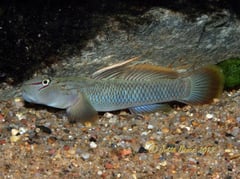
Rhinogobius nantaiensis
Aonuma & Chen, 1996
Max length55mm SL2.2in SLTank60 × 30cm24 × 12inTemp18–28°C64–82°FpH6.0–8.0Rhinogobius nantaiensis is a goby from Taiwan, officially known only from the Tzengwen and Kaoping river basins in the south of the island. It is normally imported in mixed batches with the near-identical R. candidianus, and is the commoner of the two in the aquarium trade. It does not grow as large, has a more rounded snout, and most specimens have spot-like markings on the sides of the head.
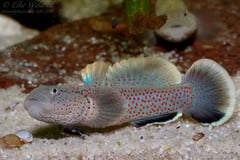
Rhinogobius rubromaculatusRed-spotted Goby
Lee & Chang, 1996
Max length55mm SL2.2in SLTank60 × 30cm24 × 12inTemp18–24°C64–75°FpH6.0–8.0The red-spotted goby, Rhinogobius rubromaculatus, is endemic to Taiwan and apparently quite common in central and western parts of the island. Fish from the Linbian river in the south are smaller, with larger and more intense red spots, and have been called R. rubromaculatus 'rot' or 'red' in the hobby, but they show only minor genetic differences. Among the less problematic members of the genus to breed, it can spawn year-round in aquaria.
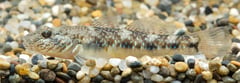
Rhinogobius similis
Gill, 1859
Max length90mm SL3.5in SLTank60 × 30cm24 × 12inTemp18–24°C64–75°FpH6.5–8.5Rhinogobius giurinus is a goby found through much of China, plus Taiwan, the Korean Peninsula, Japan and the Red and Pha river basins in Vietnam. It appears to exist in a number of forms that differ in colour pattern, morphology or both, and it is unclear whether all of them are conspecific. Newly-imported wild fish tend to be aggressive towards conspecifics, so unlike most Rhinogobius it is best kept in sexed pairs.
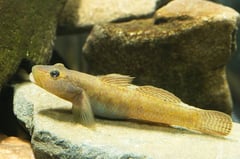
Rhinogobius sp. 'CB'
authority not recorded
Max lengthnot recordedTanknot recordedTempnot recordedpHnot recordedRhinogobius sp. 'CB' is an unidentified goby of the R. brunneus complex, found through most of Japan except Hokkaido. 'CB' is shorthand for 'cross band', after the dark bars on the body. Among the unidentified members of the grouping it is the commonest in Japan. Some wild populations are amphidromous, with the larvae washed down to the sea and the fry developing in brackish to marine estuaries.
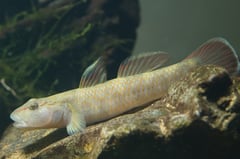
Rhinogobius sp. 'CO'
authority not recorded
Max lengthnot recordedTanknot recordedTempnot recordedpHnot recordedRhinogobius sp. 'CO' is an unidentified goby of the R. brunneus complex that certainly occurs on the island of Honshu, Japan. 'CO' is shorthand for 'cobalt', after the blue spots on the head and body. Some populations live in brackish and others in freshwater environments, and this has led them to adopt different reproductive strategies.
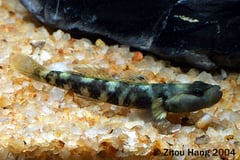
Rhinogobius yaoshanensis
(Luo, 1989)
Max length45mm SL1.8in SLTank60 × 30cm24 × 12inTemp16–24°C61–75°FpH6.0–8.0Rhinogobius yaoshanensis is a small goby recorded only from streams draining Jinxiu Yao Autonomous County in eastern Guangxi, China. Its name has appeared regularly on trade lists since the mid-2000s, but fish labelled as such do not fully match the most recent key, and whether the species itself has been exported is unclear. It is likely restricted to shallow, well-oxygenated headwaters with riffles and runs broken by pools.
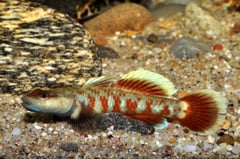
Rhinogobius zhoui
Li & Zhong, 2009
Max length36mm SL1.4in SLTank60 × 30cm24 × 12inTemp19–24°C66–75°FpH7.0–7.8Rhinogobius zhoui is a small goby restricted to a handful of streams around Lianhua Mountain in Haifeng County, Guangdong, China. In the aquarium trade since 2010, it is sold as 'Chinese vermilion goby', 'Zhou's scarlet goby', 'scarlet goby' and 'flame goby'. Adult males have 6-8 red blotches on the flank and broad white bands on the median fins. It has been bred in aquaria but not easily, because males patrol an area and do not defend a single spawning site.
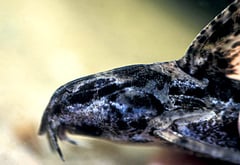
Rhynchodoras woodsiParrot Doradid
authority not recorded
Max length110mm SL4in SLTank90 × 38cm36 × 15inTemp24–26°C75–79°FpH5.8–7.0The parrot doradid, Rhynchodoras woodsi, is a doradid catfish that appears to be endemic to the Rio Marañon basin, Ecuador. Rare in the hobby, it takes its name from its inquisitive feeding habits and a bony growth extending from the upper mouthparts, whose use is not known. Very peaceful and tolerant of conspecifics, it does not compete well for food with other bottom dwellers.
Rineloricaria eigenmanniCommon Whiptail Catfish
authority not recorded
Max length150mm SL6in SLTank90 × 30cm36 × 12inTemp24–29°C75–84°FpH6.0–7.4The common whiptail catfish, Rineloricaria eigenmanni, is a peaceful loricariid from Colombia and Venezuela, found among leaf litter over sand. One of the most common species sold as 'whiptail catfish', it breeds quite easily and suits a newcomer to catfish breeding. It is often mixed up with other species: in R. eigenmanni the black bars on the caudal peduncle continue right around the fish, and the fins are barred.
Rineloricaria fallaxWhiptail Catfish
authority not recorded
Max length155mm SL6in SLTank90 × 30cm36 × 12inTemp15–25°C59–77°FpH5.8–7.8Rineloricaria fallax is a whiptail catfish from the upper Rupununi and Branco river basins in Guyana and Brazil. One of the most common species sold as 'whiptail catfish', it breeds quite easily and suits a newcomer to catfish breeding. It lives among leaf litter over sand in shallow, flowing water, and is very peaceful but easily out-competed for food.
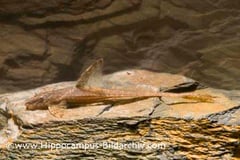
Rineloricaria lanceolataWhiptail Catfish
authority not recorded
Max length95mm SL3.7in SLTanknot recordedTemp25–28°C77–82°FpH6.0–8.0Rineloricaria lanceolata is a whiptail catfish from Peru and Brazil, usually found among leaf litter over sandy substrates. One of the most common species sold as 'whiptail catfish', it breeds quite easily in suitable conditions, although the fry can be tricky to raise. Very peaceful, it is easily out-competed for food by vigorous or aggressive tankmates.
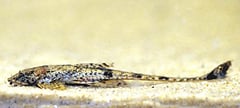
Rineloricaria morrowi
authority not recorded
Max length130mm SL5in SLTank90 × 30cm36 × 12inTemp20–24°C68–75°FpH6.0–7.0Rineloricaria morrowi is a loricariid catfish from the Ucayali River basin, Peru, found among leaf litter over sandy substrates. It is seen less often than some others in the genus. Briefly placed in the resurrected genus Hemiloricaria in 2002, it was returned to Rineloricaria within a year, but the old name is still used quite often.
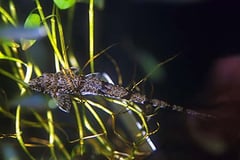
Rineloricaria parvaWhiptail Catfish
authority not recorded
Max length110mm SL4in SLTank75 × 30cm30 × 12inTemp20–25°C68–77°FpH6.0–7.5Rineloricaria parva is a whiptail catfish from Brazil, Paraguay and Argentina, found among leaf litter over sandy substrates. Commonly sold as a 'whiptail catfish', it is difficult to identify: the true R. parva has dark bands across the top of the body only and filaments on the top and bottom of the caudal fin. Some fish seen for sale may be hybrids with other species.
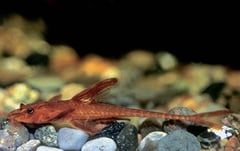
Rineloricaria sp.Red Lizard Catfish
authority not recorded
Max length110mm SL4in SLTank75 × 30cm30 × 12inTemp24–29°C75–84°FpH6.0–7.5The red lizard catfish (Rineloricaria sp., L010a) is a red whiptail catfish of unclear origin, and all fish seen for sale appear to be tank-bred. Some believe it derives from a wild fish, possibly from Paraguay, while others suggest a selectively-bred form of R. lanceolata or a hybrid with it. Very peaceful, it breeds quite easily in suitable conditions.
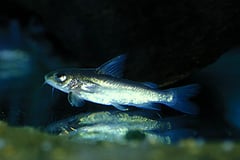
Rita kuturneeDeccan Rita
authority not recorded
Max length260mm SL10in SLTank120 × 30cm48 × 12inTemp22–27°C72–81°FpH6.0–7.0The Deccan rita, Rita kuturnee, is a bagrid catfish from large river systems in India, growing to around 260 mm SL. Rita species are not often seen in the hobby. Relatively peaceful, it suits communities of larger species such as the bigger barbs, sturdy cichlids and loricariids, although smaller fish will be eaten.

Rocio octofasciataJack Dempsey Cichlid
(Regan, 1903)
Max length200mm SL8in SLTank120 × 45cm48 × 18inTemp20–30°C68–86°FpH6.5–8.0The Jack Dempsey cichlid, Rocio octofasciata, is native to the Atlantic slope of Central America in Mexico, Belize, Guatemala and Honduras. Its name apparently comes from the American heavyweight boxer, for its 'strong facial features' and pugnacious nature. Tankmates must be too large to be viewed as prey. A bright blue strain, the 'electric blue Jack Dempsey', tends to stay smaller and may be less aggressive.