Every species
Filters

Rubricatochromis bimaculatusJewel Cichlid
(Gill, 1862)
Max length150mm SL6in SLTank120 × 30cm48 × 12inTemp22–28°C72–82°FpH6.0–7.8The jewel cichlid, Rubricatochromis bimaculatus, is a cichlid from Africa's western coast, between southern Guinea and central Liberia. Regularly seen in the trade and often sold as a community fish, it is not recommended for the beginner or the general community tank, and it becomes very aggressive when spawning. It can be told from Hemichromis lifalili by a third black spot, on the caudal peduncle. It is still often sold as Hemichromis bimaculatus.
Salminus brasiliensisDorado
authority not recorded
Max length1000mm SL39in SLTanknot recordedTemp22–28°C72–82°FpH6.0–7.5The dorado, Salminus brasiliensis, is a large characid from Brazil, Bolivia, Paraguay, Uruguay and Argentina, growing to 1000 mm SL. A highly prized game fish in some of its native waters, it turns up as juveniles in some aquatic stores, but it is not suited to captive life in any respect. Housing one for life is beyond the reach of virtually all hobbyists.
Sandelia bainsiiEastern Cape Rocky
authority not recorded
Max length325mm SL13in SLTank180 × 60cm72 × 24inTemp18–22°C64–72°FpH6.8–8.0The Eastern Cape rocky, Sandelia bainsii, is an anabantoid endemic to a handful of river systems in the southeastern Cape, South Africa. Listed as endangered by the IUCN since 1994, it occurs in short sections of only half a dozen rivers. A conservation project begun in 1991 at the Blaauwkrantz Nature Reserve has released captive-bred fish at several sites. Sandelia spp. have a less well-developed labyrinth organ than their relatives.
Sandelia capensisCape kurper
authority not recorded
Max length215mm SL8in SLTank120 × 45cm48 × 18inTemp18–22°C64–72°FpH6.5–7.2The Cape kurper, Sandelia capensis, is an anabantoid endemic to the Cape Province, South Africa, found in the middle to lower reaches of many rivers. Its habitats are being destroyed and its numbers declining through introduced predators, damming, pollution and climatic changes. Genetic studies have revealed at least two, possibly several, deep lineages, and these would appear to indicate multiple species.

Sarotherodon melanotheronBlack Chin Tilapia
Rüppell, 1852
Max length200mm SL8in SLTank120 × 38cm48 × 15inTemp23–28°C73–82°FpH7.0–8.0The black chin tilapia, Sarotherodon melanotheron, is a salt-tolerant cichlid from coastal western Africa. Its main habitat is estuarine water, especially mangrove areas. It is a paternal mouthbrooder. Introduced for aquaculture, it has thriving populations in parts of Asia, Europe and the USA.

Satanoperca acuticepsSharphead Eartheater
(Heckel, 1840)
Max length170mm SL7in SLTank180 × 60cm72 × 24inTemp20–28°C68–82°FpH5.5–7.5The sharphead eartheater, Satanoperca acuticeps, is a cichlid from the central Amazon basin in Brazil, including the lower rio Negro and rio Branco. Relatively rare in the trade, it is sometimes confused with S. daemon and S. lilith but has three dark flank blotches (vs. two in S. daemon, one in S. lilith). Unless breeding it is surprisingly peaceful, and it is very rarely bred in aquaria.

Satanoperca daemonThreespot Eartheater
(Heckel, 1840)
Max length250mm SL10in SLTank210 × 60cm84 × 24inTemp24–28°C75–82°FpH3.5–6.0The threespot eartheater, Satanoperca daemon, is a cichlid from the rio Negro, Casiquiare and upper Orinoco systems in Brazil, Venezuela and Colombia. It is mostly observed in acidic, mineral-poor blackwater. Relatively common in the aquarium trade, it is by no means easy to maintain, needing particular attention to space, diet, water quality and chemistry. Two dark blotches on the flank separate it from the similar S. lilith, which has only one.

Satanoperca jurupariDemon Eartheater
(Heckel, 1840)
Max length185mm SL7in SLTank210 × 60cm84 × 24inTemp20–28°C68–82°FpH5.5–7.5The demon eartheater, Satanoperca jurupari, is a cichlid recorded throughout much of the Amazon basin in Brazil, Bolivia, Peru, Ecuador and Colombia. In aquarium literature it is frequently confused with S. leucosticta, which has prominent white spots or vermiform markings on the sides of the head. Its precise identity is a confusing issue, and populations from the Tapajós, Xingu, Araguaia and Paraná are genetically distinct and may represent separate species.

Satanoperca leucostictaWhitespot Eartheater
(Müller & Troschel, 1849)
Max length150mm SL6in SLTank180 × 60cm72 × 24inTemp20–28°C68–82°FpH5.5–7.5The whitespot eartheater, Satanoperca leucosticta, is a cichlid from the Guiana Shield in Guyana, Suriname, eastern Venezuela and northern Brazil. Farmed in several countries, it is frequently available in the ornamental trade. It is often confused with S. jurupari but is easily recognised by the prominent white spots or vermiform markings on the sides of the head. A larvophilous maternal mouthbrooder, it has been bred in aquaria.

Satanoperca lilith
Kullander & Ferreira, 1988
Max length255mm SL10in SLTank210 × 60cm84 × 24inTemp20–28°C68–82°FpH5.0–7.5Satanoperca lilith is an eartheater cichlid known only from Brazil, where it is widely distributed along the Solimões/Amazon main channel. Despite that extensive range it is uncommon in the ornamental trade, where it is sometimes called 'one-spotted demon fish' or 'one spot eartheater'. A single dark blotch on the flank separates it from the closely similar S. daemon, which has two.

Satanoperca mapiritensis
(Fernández-Yépez, 1950)
Max length150mm SL6in SLTank180 × 60cm72 × 24inTemp22–28°C72–82°FpH5.5–7.5Satanoperca mapiritensis is an eartheater cichlid native to the lower Río Orinoco basin in northern Venezuela, including the ríos Caura and Caroní. Uncommon in the aquarium trade, its name is frequently misapplied to S. leucosticta and similar, unidentified forms. Adults have white spots and vermiculations on the head, most intense on the operculum, and pale orange lips. Genetic research suggests it may turn out to be conspecific with S. jurupari and S. rhynchitis.

Satanoperca pappaterraPantanal Eartheater
(Heckel, 1840)
Max length200mm SL8in SLTank210 × 60cm84 × 24inTemp20–28°C68–82°FpH5.5–7.5The Pantanal eartheater, Satanoperca pappaterra, is a cichlid from the rio Guaporé and upper rio Paraguai basins in Brazil, Bolivia and Paraguay. Relatively rare in the ornamental trade and much sought after, it is easily told from all known congeners by a series of prominent black blotches beneath the dorsal-fin and a well-defined dark band along the side of the body. It has been introduced to the upper rio Paraná in southeastern Brazil.

Satanoperca rhynchitis
Kullander, 2012
Max length145mm SL6in SLTank180 × 60cm72 × 24inTemp22–28°C72–82°FpHfrom 5.5Satanoperca rhynchitis is an eartheater cichlid known only from the Oyapock, Approuague and other river systems of French Guiana. Previously referred to S. jurupari, it was known in the trade as S. sp. 'red lips', and live adults have red lips. Red-lipped fish from Amapá in Brazil appear intermediate between the two, and whether they are hybrids, a distinct species or part of a cline is still unclear.

Sawbwa resplendens
Annandale, 1918
Max length35mm SL1.4in SLTank60 × 30cm24 × 12inTemp18–22°C64–72°FpH6.0–8.0Sawbwa resplendens is a small cyprinid endemic to Inlé Lake and its associated watershed in Shan State, eastern Myanmar. It is traded as 'Asian rummynose', 'rummynose rasbora' and 'naked microrasbora', and is listed as 'Endangered' on the IUCN Red List. Rival males are engaged in a continual battle for dominance, so it is not an ideal choice for the general community aquarium, and keeping more females than males helps.

Saxatilia albopunctataWhite-spotted Pike Cichlid
(Pellegrin, 1904)
Max length200mm SL8in SLTank120 × 38cm48 × 15inTemp24–27°C75–81°FpH6.0–7.0The white-spotted pike cichlid, Saxatilia albopunctata, is a pike cichlid from Guyana, Suriname and French Guiana. Its range runs from the Demerara to the Approuague, in slow-moving forest streams, tributaries and pools over sandy substrates, dimly lit by overhanging vegetation. An aggressive species, it can be kept with other large cichlids or on its own, and it grows to about 20 cm, though usually no more than 15 cm in aquaria.
Saxatilia proteusProteus Pike Cichlid
(Cope, 1872)
Max length150mm SL6in SLTank120 × 38cm48 × 15inTemp24–27°C75–81°FpH6.0–7.0The Proteus pike cichlid, Saxatilia proteus, is one of the smaller pike cichlids, known from Ecuador, Peru and Brazil. It is occasionally offered for sale and more than makes up for its size in aggression, especially towards conspecifics. It will eat any fish small enough to be considered food, so suits a tank of larger cichlids or a species-only set-up.
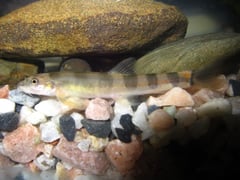
Schistura aizawlensis
Lalramliana, 2012
Max length49mm SL1.9in SLTank80 × 30cm31 × 12inTemp20–28°C68–82°FpH6.0–7.5Schistura aizawlensis is a nemacheilid loach known only from the Muthi River, a tributary of the Tuirial in Mizoram state, India. It has been collected for the aquarium hobby under an unknown trade name. Adults have 5-7 broad vertical bars on the flanks and an orange patch before the caudal-fin base. The type series came from a moderate to strongly-flowing stream with a substrate of gravel and rocks.
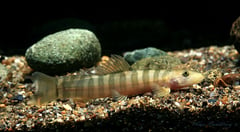
Schistura alticrista
Kottelat, 1990
Max length75mm SL3.0in SLTank90 × 30cm36 × 12inTemp21–26°C70–79°FpH6.0–7.5Schistura alticrista is a nemacheilid loach from the Nam Mae Yuan basin in Mae Hong Son Province, northwest Thailand, part of the Salween drainage. Very rare in the aquarium trade but available on occasion, it has conspicuous adipose crests on both the upper and lower midlines of the caudal peduncle and 8-9 dark brown bars about as wide as the paler interspaces. Its closest relatives appear to be S. disparizona and S. callidora.
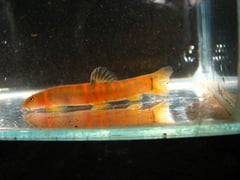
Schistura aurantiaca
Plongsesthee, Page & Beamish, 2011
Max length40mm SL1.6in SLTank75 × 30cm30 × 12inTemp20–26°C68–79°FpH6.5–8.0Schistura aurantiaca is a small nemacheilid loach known only from the Mae Khlong basin in Kanchanaburi Province, western Thailand. It is told apart from congeners solely by its colour pattern of 3-9 vertical orange bars on each flank. It inhabits riffles in clear, well-oxygenated headwater streams shaded by forest, and is possibly exported alongside similar-looking species such as S. cf. balteata.
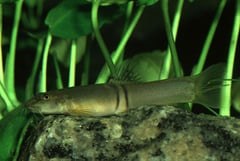
Schistura balteataSumo Loach
(Rendahl, 1948)
Max length80mm SL3.1in SLTank90 × 30cm36 × 12inTemp22–26°C72–79°FpH6.0–7.5The sumo loach, Schistura balteata, is a nemacheilid loach from the Tanintharyi river system in southern Myanmar, also recorded in western Thailand. Quite uncommon in the hobby, its name is sometimes used for the similar-looking, apparently undescribed S. cf. balteata, and both are traded as 'sumo loach'. The real S. balteata has two dark vertical bars below the dorsal-fin and no black bar at the caudal-fin base.