Every species
Filters
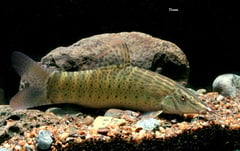
Syncrossus beaufortiChameleon Loach
(Smith, 1931)
Max length250mm SL10in SLTank150 × 45cm60 × 18inTemp22–30°C72–86°FpH6.0–7.5The chameleon loach, Syncrossus beauforti, is a botiid loach from Thailand and southern Myanmar, including the Chao Phraya and the Ataran River. It has been widely mislabelled as S. berdmorei in older aquarium literature, but has 9-10 branched dorsal-fin rays and rows of small dark markings across the body and head even when young. Adults reach 160-180 mm, and wild populations appear to have declined by at least 20-29% since 1997.
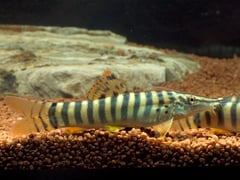
Syncrossus berdmoreiRedfin Tiger Loach
Blyth, 1860
Max length250mm SL10in SLTank180 × 45cm72 × 18inTemp21–26°C70–79°FpH6.5–7.5The redfin tiger loach, Syncrossus berdmorei, is a botiid loach from the Irrawaddy, Sittaung and Salween systems in Myanmar and Manipur, India. It looks very similar to S. beauforti but has 11-14 branched dorsal-fin rays, and in young fish its larger dark markings appear first behind the opercle. Colour and pattern vary with locality and age, and some of these forms may turn out to be separate species.
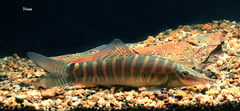
Syncrossus helodesBanded Tiger Loach
(Sauvage, 1876)
Max length300mm SL12in SLTank180 × 45cm72 × 18inTemp24–30°C75–86°FpH6.0–7.5The banded tiger loach, Syncrossus helodes, is a botiid loach from the Mekong in Laos, Cambodia, Vietnam and Thailand, and the Chao Phraya. Reaching 250-300 mm, it lives in flowing waters from headwater streams to main channels and migrates into flooded areas in the wet season to feed and spawn. It is sometimes confused with S. hymenophysa but has small dark markings on the lower body, no dark spot in the dorsal fin and 10-12 bars without bluish borders.
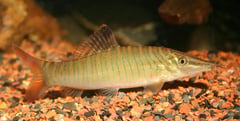
Syncrossus hymenophysaGreen Tiger Loach
(Bleeker, 1852)
Max length210mm SL8in SLTank150 × 45cm60 × 18inTemp25–30°C77–86°FpH5.0–7.5The green tiger loach, Syncrossus hymenophysa, is a botiid loach from Sumatra and Borneo, and the Pahang and Perak systems of Peninsular Malaysia. It may already have disappeared from Peninsular Malaysia, where only one confirmed specimen has been documented since 1955. Often associated with submerged branches, roots and logs, it is sometimes confused with S. helodes but has a dark spot in the dorsal fin and 12-15 body bars with bluish borders.
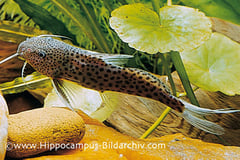
Synodontis acanthomiasBlack-spotted Synodontis
authority not recorded
Max length300mm SL12in SLTank120 × 60cm48 × 24inTemp22–24°C72–75°FpH6.5–8.0The black-spotted synodontis, Synodontis acanthomias, is a squeaker catfish from Cameroon and the Democratic Republic of Congo. Seen less frequently in the trade, it ranks alongside S. schall as one of the more aggressive members of the genus and is particularly pugnacious towards conspecifics and other Synodontis. Very hardy and growing to around 30 cm, it makes a good tankmate for large, aggressive cichlids.
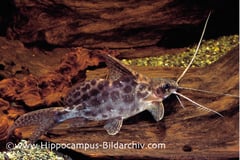
Synodontis albertiHigh-fin Synodontis
authority not recorded
Max length200mm SL8in SLTank90 × 30cm36 × 12inTemp21–25.5°C70–78°FpH6.0–8.0The high-fin synodontis, Synodontis alberti, is a squeaker catfish from the Democratic Republic of Congo, Cameroon and the Republic of Congo. Its barbels are the longest of any Synodontis, and its very large eyes reflect its nocturnal habits. Also known as the bigeye squeaker and Albert's synodontis, it is hardy, prefers cooler conditions than other members of the genus and is peaceful with tankmates over 2" long.
Synodontis albolineatusMustard Synodontis
Pellegrin, 1924
Max length100mm SL3.9in SLTank75 × 30cm30 × 12inTemp24–28°C75–82°FpH6.5–7.5The mustard synodontis, Synodontis albolineatus, is a small squeaker catfish endemic to the Majinga river system in Gabon. Also known as the mustard squeaker, it is imported infrequently but sometimes turns up in mixed boxes of Synodontis from exporters. It reaches around 10 cm and is peaceful with most species, though territorial towards its own kind in smaller systems.
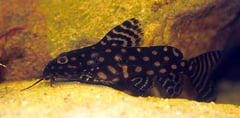
Synodontis angelicusPolka Dot Synodontis
Schilthuis, 1891
Max length250mm SL10in SLTank120 × 45cm48 × 18inTemp24–28°C75–82°FpH6.0–8.0The polka dot synodontis, Synodontis angelicus, is a squeaker catfish from the Democratic Republic of Congo, Cameroon and the Republic of Congo. Very nocturnal and long-lived, it can survive for over 20 years, and its spots vary from white to yellow on a grey to black base depending on locality. It becomes increasingly territorial as it matures, and adults are often completely intolerant of other bottom dwellers, especially other Synodontis.
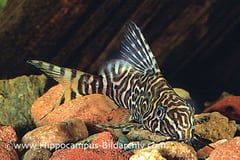
Synodontis aterrimus
Poll & Roberts, 1968
Max length115mm SL5in SLTank90 × 30cm36 × 12inTemp22–27°C72–81°FpH6.0–7.5Synodontis aterrimus is a peaceful Synodontis catfish found only in the Democratic Republic of Congo. Infrequently offered for sale, it grows to 115 mm SL and suits a medium-sized community aquarium that is dimly lit and has plenty of hiding places. Territorial, it can be kept with others of its own kind if each fish has a refuge.
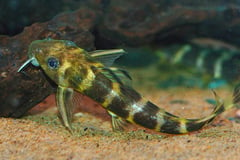
Synodontis brichardiBrichard's Synodontis
authority not recorded
Max length150mm SL6in SLTank120 × 30cm48 × 12inTemp22–26°C72–79°FpH6.2–7.5Brichard's Synodontis, Synodontis brichardi, is a catfish from the Democratic Republic of Congo and Republic of Congo. It inhabits rapids and highly oxygenated pools below waterfalls and will not thrive in aquaria with low water movement. In a biotope aquarium it moves in and out of areas of high and low current, rasping at algae on rocks. It is much more diurnal than many Synodontis, and its colours intensify with age.
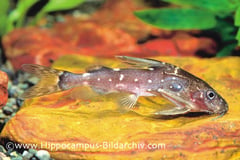
Synodontis contractusBig-nosed Upside-down Catfish
Vinciguerra, 1928
Max length75mm SL3.0in SLTank60 × 30cm24 × 12inTemp22–27°C72–81°FpH6.2–7.2The big-nosed upside-down catfish, Synodontis contractus, is a small Synodontis from the Democratic Republic of Congo and Republic of Congo. Often confused with S. nigriventris, it is easily told apart by its larger eyes and broad mouth and head, and it spends most of its time swimming inverted. It should be kept in groups of at least three or four, and can be delicate and prone to disease when first imported.
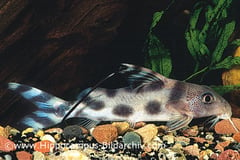
Synodontis decorusClown Synodontis
Boulenger, 1899
Max length300mm SL12in SLTank120 × 45cm48 × 18inTemp22–27°C72–81°FpH6.0–8.0The clown Synodontis, Synodontis decorus, is a large catfish from the Democratic Republic of Congo, Cameroon and the Republic of Congo. The first ray of its dorsal fin is greatly extended, and it has filamentous maxillary barbels, a feature shared with only two other members of the genus. Growing to 300 mm SL, it is secretive and nocturnal, and too large for the general community, though peaceful with fish it cannot swallow.
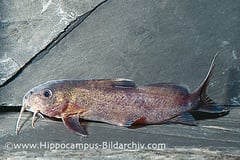
Synodontis dhonti
authority not recorded
Max length400mm SL16in SLTank120 × 45cm48 × 18inTemp24–28°C75–82°FpH7.5–8.5Synodontis dhonti is a large Synodontis catfish endemic to Lake Tanganyika, where it lives in deep water down to at least 100 metres. Its deep-water habitat and solitary lifestyle make collection difficult, so it is rarely seen for sale. Juveniles may be confused with other Tanganyikan Synos but lose their spotted patterning as they mature. It grows to 400 mm SL, though usually much smaller in aquaria, and is territorial with its own kind.
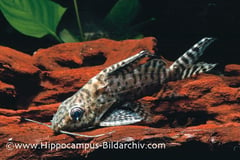
Synodontis eupterusFeatherfin Synodontis
Boulenger, 1901
Max length300mm SL12in SLTank120 × 30cm48 × 12inTemp22–27°C72–81°FpH6.0–7.5The featherfin Synodontis, Synodontis euptera, is a catfish from Nigeria, Cameroon, Mali, Ghana, Sudan, Chad and Niger. Juveniles are often sold as Synodontis 'Network' for their reticulated pattern, with no hint of an adult size of up to 300 mm SL. The pattern breaks up into simple spots with age as the long extensions of the 'feathered' dorsal fin develop. It can live for over 15 years in the aquarium.
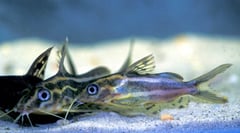
Synodontis flavitaeniatusPyjama Synodontis
Boulenger, 1919
Max length195mm SL8in SLTank90 × 30cm36 × 12inTemp23–28°C73–82°FpH6.5–8.0The pyjama Synodontis, Synodontis flavitaeniatus, is a catfish endemic to the Malebo Pool area of the River Congo in the Democratic Republic of Congo. Its patterning and colouration vary considerably, but it is difficult to misidentify. Also known as the orange striped squeaker, it has filamentous maxillary barbels like only two other members of the genus, and it is more sensitive to deteriorating water quality than many Synodontis.
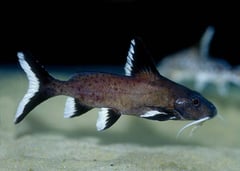
Synodontis granulosus
Boulenger, 1900
Max length270mm SL11in SLTank150 × 60cm60 × 24inTemp24–28°C75–82°FpH7.8–8.5Synodontis granulosus is a large Synodontis catfish endemic to the northern end of Lake Tanganyika, in Burundi and Tanzania. Its deep-water habitat, limited range and solitary lifestyle make collection difficult, so it is rarely seen for sale. It is territorial with its own kind and can be very aggressive in smaller aquaria, though settled fish often become tame enough to feed from the hand. Captive-bred fish from Eastern Europe have been reported to be hybrids.
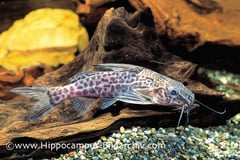
Synodontis greshoffi
authority not recorded
Max length200mm SL8in SLTank120 × 30cm48 × 12inTemp23–27°C73–81°FpH6.5–7.2Synodontis greshoffi is a Synodontis catfish from the Democratic Republic of Congo and Cameroon, growing to around 200 mm SL. Infrequently imported, it is occasionally confused with S. schoutedeni, which it superficially resembles. It becomes slightly territorial as it matures but can be kept in a small group if each fish has a refuge, and its adult size makes it unsuitable for the general community.
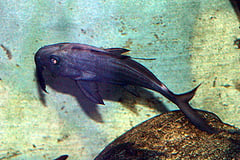
Synodontis membranaceusMoustache Catfish
(Geoffroy Saint-Hilaire, 1809)
Max length500mm SL20in SLTank120 × 60cm48 × 24inTemp22–26°C72–79°FpH6.5–7.5The moustache catfish, Synodontis membranaceus, is a large mochokid widespread in Africa, from Egypt and Sudan to Senegal and Nigeria. Its 'moustache' is a membrane along the maxillary barbels. It feeds mainly on plankton, filtered through its many gill rakers, and often feeds at the surface upside down. Often sold as a spotted juvenile, it can reach 50 cm and becomes territorial with conspecifics as it matures.
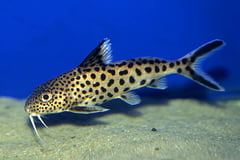
Synodontis multipunctatusCuckoo Synodontis
Boulenger, 1898
Max length150mm SL6in SLTank120 × 30cm48 × 12inTemp24–28°C75–82°FpH7.5–8.5The cuckoo Synodontis, Synodontis multipunctatus, is a Synodontis catfish endemic to Lake Tanganyika, where it swims in large shoals. One of the only fish known to practise brood parasitism, it lays its eggs among those of a mouthbrooding cichlid, and the young catfish devour the host's eggs. It is bred quite often in aquaria, with cichlids from Lake Malawi or Victoria as hosts, and should be kept in a group of four or more.
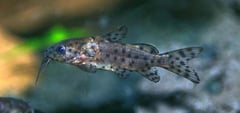
Synodontis nigritaFalse Upside-down Catfish
authority not recorded
Max length175mm SL7in SLTank90 × 30cm36 × 12inTemp21–28°C70–82°FpH6.0–7.8The false upside-down catfish, Synodontis nigrita, is a widespread Synodontis recorded from eleven African countries, among them Nigeria and Mali. Often sold as the upside-down catfish, it inverts far less often than the true one, S. nigriventris, and grows far larger, so adults returned by owners are a common sight in shops. It is also confused with the similar but smaller S. robbianus, from which its greyish base colour separates it.