Every species
Filters
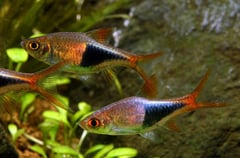
Trigonostigma heteromorphaHarlequin
(Duncker, 1904)
Max length45mm SL1.8in SLTank60 × 30cm24 × 12inTemp21–28°C70–82°FpH5.0–7.5The harlequin, Trigonostigma heteromorpha, is a small cyprinid from southern Thailand, Peninsular Malaysia, Singapore and Sumatra. First exported for aquaria in the early 1900s, it is now mass-produced, and farmed fish lack much of the colour of wild ones. The dark triangular body marking sets it apart from T. espei and T. hengeli, and two divergent lineages found in aquarium stock suggest the species as currently recognised may contain more than one taxon.
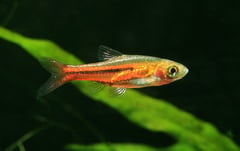
Trigonostigma somphongsi
(Meinken, 1958)
Max length30mm SL1.2in SLTank60 × 30cm24 × 12inTemp22–26°C72–79°FpH5.0–7.0Trigonostigma somphongsi is a small rasbora, probably endemic to western Thailand and reckoned to occur somewhere in the Mae Klong basin. Exceptionally rare, it was considered potentially extinct for around a dozen years before a trio arrived in Germany among Boraras urophthalmoides in 2006. Its dark flank marking is reduced to a thickish black stripe, and captive stock is being bred to establish a sustainable population.

Triportheus angulatusDusky Narrow Hatchetfish
authority not recorded
Max length165mm SL6in SLTank120 × 30cm48 × 12inTemp22–30°C72–86°FpH5.0–7.5The dusky narrow hatchetfish, Triportheus angulatus, is a characin from Ecuador, Venezuela, Peru, Brazil, Bolivia and Argentina. Common in many native habitats, where it is known as sardina, it is not often seen in the hobby. Very strong pectoral muscles let it leap several metres from the water to catch flying insects, and it should always be kept in a group.

Trochilocharax ornatusHummingbird Tetra
Zarske, 2010
Max length17mm SL0.7in SLTank45 × 30cm18 × 12inTemp20–28°C68–82°FpH4.0–6.5The hummingbird tetra, Trochilocharax ornatus, is a tiny characid from Amazonian Peru, reaching only 17 mm. Traded as 'crystal rainbow tetra' and 'orange-tailed glass tetra', it is much sought after. The type series came from an aquarium import out of Iquitos, and sources conflict over whether it comes from the río Ampiyacu or the rio Nanay.

Tropheops tropheops
(Regan, 1922)
Max length200mm SL8in SLTank120 × 38cm48 × 15inTemp24–28°C75–82°FpH7.6–8.8Tropheops tropheops is a mbuna endemic to Lake Malawi, where it occurs between the Maleri Islands and Chinyamwezi Rocks. It has many colour forms, and none of them should be mixed in aquaria since they hybridise. It browses at a characteristic angle of around 45°, and is relatively peaceable but able to stand up for itself in most mbuna communities.

Tropheus brichardi
authority not recorded
Max length115mm SL5in SLTanknot recordedTemp23–27°C73–81°FpH8.0–9.5Tropheus brichardi is a cichlid endemic to the northern end of Lake Tanganyika, found in shallow water around rocky shorelines. Not a good species for the beginner, it is very susceptible to 'bloat', so water quality is of the utmost importance. It exists in numerous colour morphs that hybridise freely and should not be mixed, and some may eventually be described as distinct species.

Tropheus duboisiWhite-Spotted Cichlid
authority not recorded
Max length120mm SL5in SLTanknot recordedTemp23–27°C73–81°FpH8.0–9.5The white-spotted cichlid, Tropheus duboisi, is endemic to Lake Tanganyika, found in rocky areas in deeper water than its congeners. Young fish have white or light blue spots on a jet black body, which fade to blue-black with a yellow or white vertical bar as they mature. Like others in the genus it is very susceptible to 'bloat' and not a good species for the beginner.

Tropheus moorii
Boulenger, 1898
Max length145mm SL6in SLTanknot recordedTemp23–27°C73–81°FpH8.0–9.5Tropheus moorii is a cichlid endemic to Lake Tanganyika, found in shallow water around rocky shores and known in over 50 geographical morphs. Despite its popularity it is not a good species for the beginner. Water quality matters above all because it is very susceptible to 'bloat', vegetable matter should form the basis of its diet, and different morphs hybridise freely and should not be mixed.

Tucanoichthys tucano
Géry & Römer, 1997
Max length17mm SL0.7in SLTank45 × 30cm18 × 12inTemp20–28°C68–82°FpH4.0–6.5Tucanoichthys tucano is a miniature characid known only from the rio Uaupés system in the upper Negro basin, Brazil. Adults are less than 17 mm SL, with a conspicuous dark lateral stripe, and the type locality is a small blackwater creek. Much sought after, it is peaceful but not an ideal community fish, given its small size and somewhat specialised requirements.

Tyrannochromis macrostomaBig-Mouth Hap
authority not recorded
Max length350mm SL14in SLTank180 × 45cm72 × 18inTemp24–28°C75–82°FpH7.6–8.8The big-mouth hap, Tyrannochromis macrostoma, is a large predatory cichlid endemic to Lake Malawi, living in shallow rocky areas. An ambush predator, it often attacks prey while swimming upside-down, and its reverse countershading (a belly darker than its back) is thought to make it harder to spot. Mbuna are its natural diet, and juveniles are easily confused with T. nigriventer.

Uaru amphiacanthoidesUaru
authority not recorded
Max length254mm SL10in SLTanknot recordedTemp27–30°C81–86°FpH6.0–7.0The uaru, Uaru amphiacanthoides, is a large cichlid from the Amazon basin in northern Brazil and Guyana, found in clear water tributaries. It occurs in the middle to lower Rio Negro and along the Solimões and main Amazon between the Japurá and Tapajós. Surprisingly peaceful for its size, it needs clean, well-filtered water at the higher end of the temperature scale.
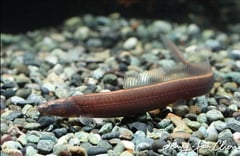
Vaillantella maassiFork-tailed Loach
Weber & de Beaufort, 1912
Max length125mm SL5in SLTank120 × 30cm48 × 12inTemp23–29°C73–84°FpH3.5–7.2The fork-tailed loach, Vaillantella maassi, is a loach from Sumatra, Borneo, Peninsular Malaysia and southern Thailand. Traded as 'chocolate scissor-tailed loach' and 'dragon loach' among other names, it has a bluish-brown body with an orange to yellow dorsal stripe. Rarely traded in numbers, it is among the more reclusive loaches and can be aggressive with its own kind and other fishes.
Variabilichromis moorii
authority not recorded
Max length100mm SL3.9in SLTanknot recordedTemp23–27°C73–81°FpH7.5–9.0Variabilichromis moorii is a lamprologine cichlid endemic to the southern part of Lake Tanganyika, living in shallow water around rocky shorelines. All adults are dark, but depending on locality the fry may be dark, yellow or orange. The only known lamprologine that eats filamentous algae, it is often sold as Neolamprologus moorii and is relatively peaceful even when spawning.

Vieja bifasciataRed-spotted Cichlid
authority not recorded
Max length300mm SL12in SLTanknot recordedTemp27–29°C81–84°FpH7.0–8.5The red-spotted cichlid, Vieja bifasciata, is a large cichlid from the River Grijalva and Usumacinta basins of Mexico and Guatemala. It is often confused with V. synspila but has two prominent horizontal lines between the eyes. It is moderately to very aggressive depending on the individual, and some fishkeepers have to keep the fish, especially males, alone.

Vieja fenestrata
authority not recorded
Max length300mm SL12in SLTank120 × 45cm48 × 18inTemp23–30°C73–86°FpH7.0Vieja fenestrata is a large cichlid endemic to Mexico, occurring in and between the rivers Papaloapán and Chachalacas. It predominantly inhabits clear lakes with sandy or muddy substrates and beds of aquatic plants. Not all that common in the UK hobby, it is often confused with the more commonly available V. synspila, and is moderately aggressive.

Vieja maculicaudaBlackbelt Cichlid
authority not recorded
Max length254mm SL10in SLTank120 × 38cm48 × 15inTemp22–27°C72–81°FpH6.0–8.0The blackbelt cichlid, Vieja maculicauda, is a large cichlid found from the Usumacinta basin in Guatemala south to the River Chagres in Panama. It takes its name from the vertical black stripe around its flank and from its toughness. It lives in slow-moving rivers and lakes, sometimes in brackish or even marine conditions, and should only be kept with similarly aggressive fish of similar size.

Vieja melanurusRedhead Cichlid
(Günther, 1862)
Max length350mm SL14in SLTanknot recordedTemp24–30°C75–86°FpH7.0The redhead cichlid, Vieja melanurus, is a large cichlid endemic to the River Usumacinta basin in Mexico, Guatemala and Belize. The most commonly available Vieja in the hobby, it is widely and incorrectly called V. synspillum. It lives in still or slow-moving lowland rivers and lakes, sometimes in mildly brackish water, and is moderately aggressive. It is still often sold as Vieja synspila.

Vieja zonataOaxaca Cichlid
authority not recorded
Max length250mm SL10in SLTanknot recordedTemp23–30°C73–86°FpH7.0–7.5The Oaxaca cichlid, Vieja zonata, is a large cichlid that appears to be endemic to the River Tehuantepec drainage in Mexico. Hardy and easy to keep, though moderately aggressive, it is only occasionally available through specialist cichlid dealers. It can be kept with similarly sized cichlids in a large enough aquarium, and will eat any fish small enough to fit into its mouth.

Wallaceochromis humilisYellow Kribensis
(Boulenger, 1916)
Max length125mm SL5in SLTanknot recordedTemp24–27°C75–81°FpH5.0–7.0The yellow kribensis, Wallaceochromis humilis, is a cichlid from Sierra Leone, Liberia and Guinea. Rare in the hobby, it is seen in several morphs including 'Guinea' and 'Liberia red', some of which may eventually be described as distinct species. It is more elongate than Pelvicachromis species, with a comparatively long snout, and is aggressive towards conspecifics, so only a single pair should be kept unless the tank is very large.

Wallaciia compressicepsCompressiceps Dwarf Pike Cichlid
(Ploeg, 1986)
Max length76mm SL3.0in SLTank90 × 38cm36 × 15inTemp24–27°C75–81°FpH5.0–6.8The compressiceps dwarf pike cichlid, Wallaciia compressiceps, is a small pike cichlid known only from the lower Rio Tocantins basin in Brazil. It swims a great deal and can be very quick and very aggressive, so it needs a larger aquarium than its size suggests, and anything half its size will be seen as food. A number of hobbyists have found it very difficult to spawn without target fish in the aquarium.