Every species
Filters
Wallago attuHelicopter Catfish
authority not recorded
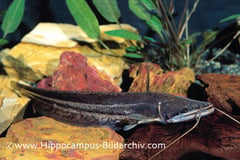
Max length2400mm SL94in SLTank360 × 120cm142 × 48inTemp19–29°C66–84°FpH6.0–7.6The helicopter catfish, Wallago attu, is a giant predatory catfish found through much of Asia, from Afghanistan and Pakistan to Indonesia. It can reach 240 cm, and its mouth is filled with needle-sharp, backward-pointing teeth. It will bite aggressively when fed or handled, and the profile treats it as a genuinely dangerous fish that is clearly not an aquarium species.
Wallagonia leeriiStriped Wallago Catfish
(Bleeker, 1851)
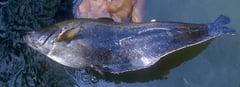
Max length2032mm SL80in SLTanknot recordedTemp22–26°C72–79°FpH6.0–7.0The striped wallago catfish, Wallago leerii, is a large predatory catfish from southeast Asia, including the Mekong basin, that can reach 2 metres. Like all Wallago it has an enormous mouth full of backward pointing teeth, and smaller fish are simply swallowed whole. This is NOT an aquarium fish, though it is imported quite regularly at a small size. In nature it is migratory and moves into inundated forest during the rainy season.

Xenentodon cancilaFreshwater Needlefish
(Hamilton, 1822)
Max length350mm SL14in SLTank180 × 60cm72 × 24inTemp18–30°C64–86°FpH6.0–8.0The freshwater needlefish, Xenentodon cancila, is a belonid from Pakistan east through India, Bangladesh, Nepal, Sri Lanka, Myanmar and Thailand. Often called 'freshwater garfish', it only superficially resembles the true gars, and most of its relatives in the Belonidae are marine or estuarine. A near-exclusive inhabitant of the upper water column, it is surprisingly peaceful with anything too large to swallow and is best kept in numbers of four or more, in a tank of 180 ∗ 60 cm or more.

Xenentodon canciloides
(Bleeker, 1854)
Max length300mm SL12in SLTank180 × 60cm72 × 24inTemp18–26°C64–79°FpH6.0–8.0Xenentodon canciloides is a freshwater needlefish from Borneo, Sumatra, Peninsular Malaysia and Thailand, and is considered to occur in the Mekong. Rarely seen in the ornamental trade, it is far less common there than its congener X. cancila, from which it differs in its slender, delicate jaws and smaller size, not exceeding 30 cm TL. A near-exclusive inhabitant of the upper water column, it is surprisingly peaceful with anything too large to swallow and is best kept in numbers of four or more.
Xenomystus nigriAfrican Knifefish
authority not recorded
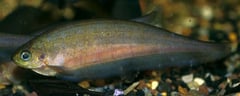
Max length300mm SL12in SLTank120 × 45cm48 × 18inTemp23–28°C73–82°FpH5.8–7.5The African knifefish, Xenomystus nigri, is a notopterid recorded from numerous African rivers, including the Nile, Congo and Niger systems. Its swim bladder acts as an accessory breathing organ, and it rises to the surface periodically to gulp air, often with a bell-like sound. Often confused with the far more aggressive Asian knifefish, Notopterus notopterus, it lacks the dorsal fin present in its Asian relative. A scaleless species, it is very sensitive to medications.

Xenotilapia flavipinnisYellow Sand Cichlid
authority not recorded
Max length90mm SL3.5in SLTank75 × 30cm30 × 12inTemp23–27°C73–81°FpH8.0–9.5The yellow sand cichlid, Xenotilapia flavipinnis, is a bi-parental mouthbrooder endemic to Lake Tanganyika, where groups swim over sandy substrates. In nature the pair bond lasts only for the breeding season. In aquaria it can last much longer, with the pair remaining in their territory and defending it even when not spawning. A gentle substrate-sifter, it needs sand, a group of 6-10 and peaceful Tanganyikan tankmates, and it is very sensitive to deteriorating water conditions.
Xenotilapia melanogenysBlack-Chinned Xenotilapia
authority not recorded
Max length160mm SL6in SLTank120 × 38cm48 × 15inTemp24–27°C75–81°FpH7.5–9.0The black-chinned xenotilapia, Xenotilapia melanogenys, is a cichlid endemic to Lake Tanganyika, where it lives in huge shoals over sandy substrates. Much of the literature still places it in the genus Enatiopus. The shoals in nature appear to be fixed, with an individual remaining in the same group for life. A skittish fish, it may react very nervously to rapid movements outside the tank and should not be kept with boisterous fish such as mbuna.

Xenotilapia simaBig-Eyed Xenotilapia
authority not recorded
Max length165mm SL6in SLTank120 × 38cm48 × 15inTemp23–27°C73–81°FpH8.0–9.5The big-eyed xenotilapia, Xenotilapia sima, is a cichlid endemic to Lake Tanganyika, where it is found in large groups over sandy substrates. Rarely seen in the hobby, it feeds like the South American Geophagus species, sifting sand through its gills for invertebrates, so a sand substrate is essential. A peaceful and skittish maternal mouthbrooder, it should be kept in a group of 6-10 with peaceful Tanganyikan species and never with mbuna.
Xenotoca eiseniRedtail Goodeid
authority not recorded
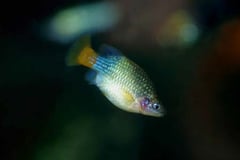
Max length60mm SL2.4in SLTank60 × 30cm24 × 12inTemp15–30°C59–86°FpH6.0–8.0The redtail goodeid, Xenotoca eiseni, is a livebearer from Mexico, found in habitats from clear mountain streams to polluted roadside ditches. Very hardy and adaptable, it is less popular in the hobby than it once was, probably because of its often aggressive nature. Some specimens attack and kill other fish, catfish in particular, so a species tank is best. As in other goodeids, the developing young are nourished by a structure known as the trophotaenia.
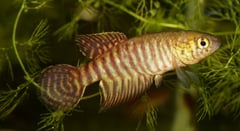
Xenurolebias myersi
(Carvalho, 1971)
Max length40mm SL1.6in SLTank45 × 30cm18 × 12inTemp20–27°C68–81°FpH5.5–7.0Xenurolebias myersi is an annual killifish from minor coastal river basins in eastern Brazil, in Bahia and Espírito Santo states. Its range lies between the rio Jucuruçu and the rio Doce. It inhabits rain-fed pools and swamps that dry out each year, when the adults die and the eggs wait in diapause until the rains return. Whether it is conspecific with X. izecksohni remains unclear.
Xiphophorus helleriiGreen Swordtail
Heckel, 1848
Max length140mm SL6in SLTank120 × 30cm48 × 12inTemp16–28°C61–82°FpH7.0–8.0The green swordtail, Xiphophorus hellerii, is a livebearer native to southeastern Mexico, Guatemala, Belize and Honduras. Among the world's most recognisable aquarium fishes, it is ubiquitous in the trade, where selective breeding and hybridisation with X. maculatus and X. variatus have produced a bewildering array of ornamental forms. The name is often misspelled X. helleri.
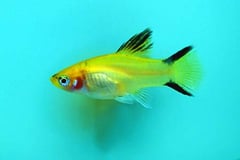
Xiphophorus maculatusPlaty
(Gunther, 1866)
Max length50mm SL2.0in SLTank60 × 30cm24 × 12inTemp20–26°C68–79°FpH7.0–8.2The platy, Xiphophorus maculatus, is a livebearer from the Atlantic coastal plain of Mexico, Guatemala, Belize and Nicaragua. Wild fish are almost never seen in the hobby, where dozens of selectively bred varieties are available, some produced by crossing with other Xiphophorus species. Many commercially bred platies are not very hardy because of inbreeding and over-production. Very peaceful, it suits the beginner as long as the water is moderately hard or harder.
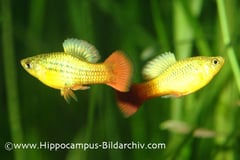
Xiphophorus variatusVariable Platy
(Meek, 1904)
Max length50mm SL2.0in SLTank60 × 30cm24 × 12inTemp20–26°C68–79°FpH7.0–8.2The variable platy, Xiphophorus variatus, is a livebearer native to the Atlantic slope of Mexico, with feral populations in several other countries. Most on sale are mass-produced in the Far East and Eastern Europe, and many commercially bred platies are not very hardy because of inbreeding. Wild fish are slimmer than X. maculatus with a slightly longer dorsal fin, and should be kept from crossbreeding with domestic forms. It lives in shallow, heavily vegetated streams, ponds, swamps and ditches.
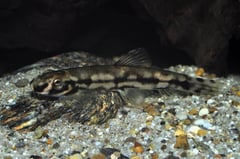
Yaoshania pachychilusPanda Loach
(Chen, 1980)
Max length60mm SL2.4in SLTank60 × 30cm24 × 12inTemp15.5–24°C60–75°FpH6.5–7.5The panda loach, Yaoshania pachychilus, is a balitorid loach from headwater streams draining the Dayao Mountain in Guangxi, southern China. The name comes from the black-and-white-striped juvenile pattern, which fades in older fish, so only young fish tend to be traded, sometimes labelled 'panda goby'. It needs clean, well-oxygenated, fast-flowing water, and though often marketed for them it is not suitable for tiny 'nano' aquaria.
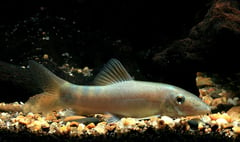
Yasuhikotakia caudipunctataSpeckle-tailed Loach
(Taki & Doi, 1995)
Max length100mm SL3.9in SLTank120 × 30cm48 × 12inTemp23–30°C73–86°FpH6.0–7.5The speckle-tailed loach, Yasuhikotakia caudipunctata, is a botiid loach described from the Mekong drainage in Laos, near Pakse and Vientiane. Relatively rare in the aquarium trade and much sought after, it looks similar to Y. splendida but has numerous small blackish spots in the dorsal and caudal fins. SF members report it milder in temperament than some congeners, and it needs an aquarium with a base of at least 120 ∗ 30 cm.
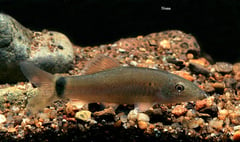
Yasuhikotakia eosSun Loach
(Taki, 1972)
Max length110mm SL4in SLTank120 × 30cm48 × 12inTemp23–28°C73–82°FpH6.0–7.5The sun loach, Yasuhikotakia eos, is a botiid loach from the middle and lower Mekong in Laos, Cambodia and Thailand, and the Dong Nai in Vietnam. Its yellow to reddish brown body with a metallic sheen and a large dark marking on each side of the caudal peduncle make it difficult to confuse with any congener. It has a reputation for aggression and can be fiercely territorial where space or shelter is limited, so it suits only larger, well-structured aquaria with other sturdy fishes.
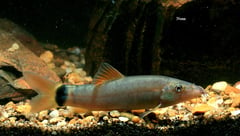
Yasuhikotakia leconteiSilver Loach
(Fowler, 1937)
Max length150mm SL6in SLTank120 × 45cm48 × 18inTemp23–28°C73–82°FpH6.0–8.0The silver loach, Yasuhikotakia lecontei, is a botiid loach from the middle and lower Mekong and the Chao Phraya and Mae Klong drainages of Thailand. Sometimes confused with Y. modesta, it is a slimmer, more elongate fish, usually brownish with a gold/green sheen, and its roundish caudal peduncle markings do not meet on the ventral surface. It forages under cover of dusk and darkness, and SF members report it milder in temperament than Y. eos and Y. morleti.
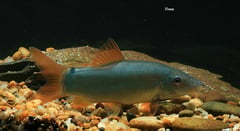
Yasuhikotakia modestaRedtail Loach
(Bleeker, 1864)
Max length250mm SL10in SLTank150 × 45cm60 × 18inTemp23–28°C73–82°FpH6.0–8.0The redtail loach, Yasuhikotakia modesta, is a botiid loach from the middle and lower Mekong and the Chao Phraya and Mae Klong drainages of Thailand. One of the more commonly encountered botiids in the hobby, it is also sold as 'blue', 'orange-finned' or 'red-finned' botia. Some fish are dyed and sold as 'blueberry' or 'raspberry' loach, and their health is normally compromised by the process. Deeper-bodied than the similar Y. lecontei, it grows to 250 mm and needs an aquarium with a base of at least 150 ∗ 45 cm.
Yasuhikotakia morletiSkunk Loach
(Tirant, 1885)
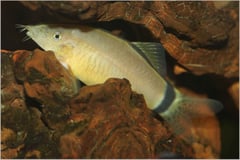
Max length85mm SL3.3in SLTank120 × 30cm48 × 12inTemp23–28°C73–82°FpH6.0–7.5The skunk loach, Yasuhikotakia morleti, is a botiid loach from the middle and lower Mekong and the Chao Phraya and Mae Klong drainages of Thailand. Common in the hobby, where most fish are farmed commercially, it is also sold as 'skunk botia' or 'Hora's loach'. The dark stripe over its dorsal surface separates it from the similar Y. longidorsalis. It can be combative, nipping fins and harassing tankmates, especially when kept in smaller groups.
Yasuhikotakia splendida
(Roberts, 1995)
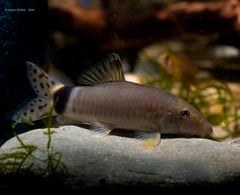
Max length100mm SL3.9in SLTank120 × 30cm48 × 12inTemp20–28°C68–82°FpH6.0–7.5Sold as the 'jaguar loach' among other names, Yasuhikotakia splendida is a botiid loach from the Xe Pian river system in southern Laos. It is known from small, swiftly-running headwater streams draining the Bolaven Plateau, with clear water over rocks and cobbles. An unbroken dark ring around the caudal peduncle and large dark spots in the yellow caudal-fin separate it from the similar Y. caudipunctata, Y. longidorsalis and Y. morleti. SF members report it milder in temperament than some congeners.