Every species
Filters
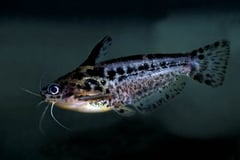
Trachelyichthys exilisPygmy Driftwood Catfish
authority not recorded
Max length80mm SL3.1in SLTank60 × 38cm24 × 15inTemp22–25°C72–77°FpH6.5–7.0The pygmy driftwood catfish, Trachelyichthys exilis, is a small auchenipterid catfish from the Nanay river basin in Peru. It is very similar to T. decaradiatus but has the eye set further forward and a longer, thinner humeral process. Unlike most auchenipterids it usually feeds by day. It is totally unaggressive towards conspecifics and does best in a group.
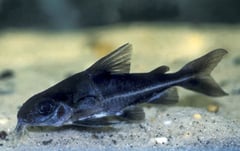
Trachydoras steindachneri
authority not recorded
Max length86mm SL3.4in SLTank90 × 38cm36 × 15inTemp24–26°C75–79°FpH6.0–7.0Trachydoras steindachneri is a doradid catfish from the Amazon basin in Ecuador, Colombia, Peru, Bolivia and Brazil. Rare in the hobby, it is seldom offered for sale. Primarily nocturnal, it is a bottom feeder that suits a peaceful community with tetras, barbs and dwarf cichlids.

Tramitichromis intermedius
authority not recorded
Max length160mm SL6in SLTank120 × 38cm48 × 15inTemp24–28°C75–82°FpH7.6–8.8Tramitichromis intermedius is a sand-dwelling cichlid endemic to Lake Malawi, widespread in the south of the lake. It sifts sediment-rich sand or mud for food, so a soft sandy substrate is essential. Species like this can be delicate, and small, regular water changes are a necessity. The genus differs from Lethrinops only in part of the lower jaw dentition, and this species is likely to be moved to another genus.

Trematocranus placodonSnail-Crusher Hap
authority not recorded
Max length250mm SL10in SLTank150 × 38cm60 × 15inTemp24–28°C75–82°FpH7.6–8.8The snail-crusher hap, Trematocranus placodon, is a large cichlid endemic to Lake Malawi, where it inhabits shallow water. A molluscivore, it feeds mainly on snails, crushing their shells with specially developed pharyngeal teeth. It suits the larger Malawian community but is not often seen for sale. Males are territorial and aggressive towards one another.

Trichogaster chunaHoney Gourami
(Hamilton, 1822)
Max length55mm SL2.2in SLTank60 × 30cm24 × 12inTemp22–27°C72–81°FpH6.0–7.5The honey gourami, Trichogaster chuna, is a labyrinth fish from the Ganges and Brahmaputra systems of India and Bangladesh, with records from Nepal. Virtually all fish on sale are commercially produced, and ornamental strains such as 'red', 'sunset' and 'golden' exist. Slow-moving and easily outcompeted, it needs peaceful tankmates and does best in a group of four to six.

Trichogaster fasciataBanded Gourami
authority not recorded
Max length100mm SL3.9in SLTanknot recordedTemp21–28°C70–82°FpH6.0–7.5The banded gourami, Trichogaster fasciata, is a labyrinth fish from Pakistan, India, Nepal, Bangladesh and Myanmar, found in sluggish, weedy waters. The largest species in its genus, it is a popular food fish in its native countries. Peaceful, it suits most quiet community tanks, but should not be kept with the thick-lipped gourami because the two can hybridise.

Trichogaster labiosaThick-lipped Gourami
authority not recorded
Max length100mm SL3.9in SLTank74 × 30cm29 × 12inTemp22–27°C72–81°FpH6.0–7.5The thick-lipped gourami, Trichogaster labiosa, is a labyrinth fish known only from southern Myanmar, found in shady, weedy rivers and ponds. Easy to keep and peaceful, it is one of the best gouramis for a community tank. A gold or 'sunset' strain has been selectively bred for the trade. It should not be kept with the banded gourami because the two can hybridise freely.

Trichogaster laliusDwarf Gourami
authority not recorded
Max length88mm SL3.5in SLTanknot recordedTemp22–27°C72–81°FpH6.0–7.5The dwarf gourami, Trichogaster lalius, is a labyrinth fish from Pakistan, northern India and Bangladesh. All the fish in the trade are mass-produced, and several line-bred colour forms are sold, including 'Sunset' and 'Neon'. Stock quality has fallen badly, and mass-breeding may have spread dwarf gourami iridovirus (DGIV), which appears to be very infectious and can pass to other species sharing the water.

Trichopodus leeriiPearl Gourami
authority not recorded
Max length120mm SL5in SLTank90 × 30cm36 × 12inTemp24–30°C75–86°FpH5.5–8.0The pearl gourami, Trichopodus leerii, is a labyrinth fish from Thailand, Malaysia, Borneo and Sumatra, where it inhabits lowland swamps. One of the most peaceful gouramis, it is hardy and fairly long-lived, surviving 8 years or more in the aquarium. Wild fish are rare in the hobby, and most on sale are mass-produced in the Far East and Eastern Europe.

Trichopodus microlepisMoonlight Gourami
authority not recorded
Max length150mm SL6in SLTank90 × 30cm36 × 12inTemp25–30°C77–86°FpH6.0–7.5The moonlight gourami, Trichopodus microlepis, is a labyrinth fish from Vietnam, Cambodia and Thailand. It inhabits lowland ponds, bogs and swamps where vegetation grows densely, and its modified ventral fins are considerably longer than in other gouramis. It is often used as a food fish in its native countries, and most fish on sale are mass-produced.

Trichopodus pectoralisSnakeskin Gourami
authority not recorded
Max length300mm SL12in SLTank120 × 30cm48 × 12inTemp22–30°C72–86°FpH5.8–8.5The snakeskin gourami, Trichopodus pectoralis, is a large labyrinth fish from the Mekong and Chao Phraya drainages of Indochina and Myanmar. Growing to 30 cm, it is farmed as a food fish, and feral populations are established in several countries as a result. A very peaceful species for the larger community tank, it can produce 'cracking' noises during breeding or territorial exchanges.

Trichopodus trichopterusThree-spot Gourami
authority not recorded
Max length150mm SL6in SLTank90 × 30cm36 × 12inTemp24–30°C75–86°FpH5.5–8.5The three-spot gourami, Trichopodus trichopterus, is a labyrinth fish found mostly in the Mekong basin of Southeast Asia and southern China. The natural form is blue-grey with three spots, but gold, opaline, cosby, marbled and silver forms bred for the trade are seen far more often. One of the hardiest fish in the trade, it is recommended for community tanks with reservations, since some individuals become very spiteful as they mature.

Trichopsis pumilaSparkling Gourami
(Arnold, 1936)
Max length40mm SL1.6in SLTank45 × 30cm18 × 12inTemp22–28°C72–82°FpH5.0–7.5The sparkling gourami, Trichopsis pumila, is a small labyrinth fish from the lower Mekong basin and central and southern Thailand. Also known as the pygmy gourami, it has a solid dark midlateral stripe topped by a row of dark blotches, which with its small size separates it from T. schalleri. Both sexes produce audible 'croaking' sounds with a specialised pectoral mechanism, and most traded fish are produced commercially.

Trichopsis schalleri
Ladiges, 1962
Max length50mm SL2.0in SLTank60 × 30cm24 × 12inTemp22–28°C72–82°FpH5.0–7.5Trichopsis schalleri is a croaking gourami from the lower Mekong basin and the Chao Phraya watershed in Thailand, Laos, Cambodia and Vietnam. Sometimes called the Mekong croaking gourami or three-stripe gourami, it is larger than the similar T. pumila, and its upper body stripe varies with mood and sometimes fades entirely. Peaceful unless breeding, it can be kept in a pair or a group.

Trichopsis vittataCroaking gourami
(Cuvier, in Cuvier & Valenciennes, 1831)
Max length70mm SL2.8in SLTank60 × 30cm24 × 12inTemp22–28°C72–82°FpH5.0–7.5The croaking gourami, Trichopsis vittata, is a labyrinth fish found through much of Indochina, Peninsular Malaysia and Singapore. The largest of its genus, it produces audible sounds with a specialised pectoral mechanism unique within the Osphronemidae. Wild populations vary in colour pattern, and records from Borneo, Sumatra and Java might refer to a distinct species.

Trichromis salviniSalvini
(Günther, 1862)
Max length152mm SL6in SLTank90 × 30cm36 × 12inTemp22–26°C72–79°FpH6.5–8.0Salvin's cichlid, Trichromis salvini, is a Central American cichlid native to eastern parts of southern Mexico, Guatemala and Belize. It has a well-deserved reputation for aggression, especially when breeding, and will prey on any fish it can fit in its mouth. It does not need a huge tank, with males reaching around 6 inches and females 4.5, and a true pair is best obtained by growing on six juveniles. It is still often sold as Cichlasoma salvini.
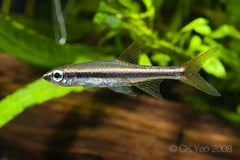
Trigonopoma gracile
(Kottelat, 1991)
Max length55mm SL2.2in SLTank75 × 30cm30 × 12inTemp21–26°C70–79°FpH4.0–7.0Trigonopoma gracile is a small rasbora from the blackwater peat swamps of Peninsular Malaysia, Borneo and Sumatra. Its colour forms vary with collection locality. The name Rasbora agilis has been applied to it since a 1971 book pictured it under that name, but R. agilis is a junior synonym of T. pauciperforatum, the fish it is said to resemble.
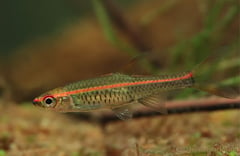
Trigonopoma pauciperforatumGlowlight Rasbora
(Weber & de Beaufort, 1916)
Max length60mm SL2.4in SLTank90 × 30cm36 × 12inTemp21–26°C70–79°FpH4.0–7.5The glowlight rasbora, Trigonopoma pauciperforatum, is a small cyprinid from Peninsular Malaysia, Singapore, Borneo and Sumatra. Also sold as the 'redline' rasbora, its lateral stripe varies from deep orange to golden with locality, diet, condition and mood. It inhabits blackwater streams associated with peat swamps, where the pH can drop as low as 3.0 or 4.0, and the name R. agilis is a junior synonym of it.
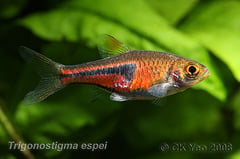
Trigonostigma espeiLambchop Rasbora
(Meinken, 1967)
Max length30mm SL1.2in SLTank60 × 30cm24 × 12inTemp23–28°C73–82°FpH5.5–7.5The lambchop rasbora, Trigonostigma espei, is a small cyprinid from southwestern and southeastern Thailand, reaching into southwestern Cambodia. It can be confused with T. heteromorpha and T. hengeli but is generally bright copper to reddish, with a thinner 'lambchop'-shaped body marking. Very peaceful, it inhabits gently flowing forest streams where submerged plants grow thickly.
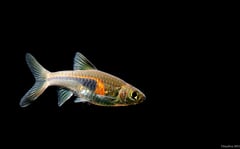
Trigonostigma hengeli
(Meinken, 1956)
Max length30mm SL1.2in SLTank60 × 30cm24 × 12inTemp23–28°C73–82°FpH5.0–7.5Trigonostigma hengeli is a small rasbora from the Greater Sunda Islands, collected in Jambi province, Sumatra and apparently West Kalimantan, Borneo. It is sometimes sold as the 'glowlight rasbora', a name also applied to Trigonopoma pauciperforatum. Slightly smaller than T. espei and T. heteromorpha, it has a greyish body with bright orange along the upper and anterior edges of the 'lambchop' marking.