Wallago attu
Helicopter Catfish
Last revised 2012Edit this page
On this page11 sections
Quick factsEdit
Difficulty4 of 8 measures
Rated difficult because it needs a tank at least 2 m long.
- Space
- very large tank
- Water
- flexible
- Temp
- flexible
- Diet
- unknown
- Temperament
- eats smaller fish
- Social
- unknown
- Compatibility
- unknown
Other demands
Each of these can raise the rating on its own, whatever the measures above say.
- Hardiness
- unknown
- Needs a tank at least 2 m long
Before you buy
Needs a tight-fitting lid as this species is known to jump
The tank should have a very heavy, tightly fitting cover to prevent the fish escaping.
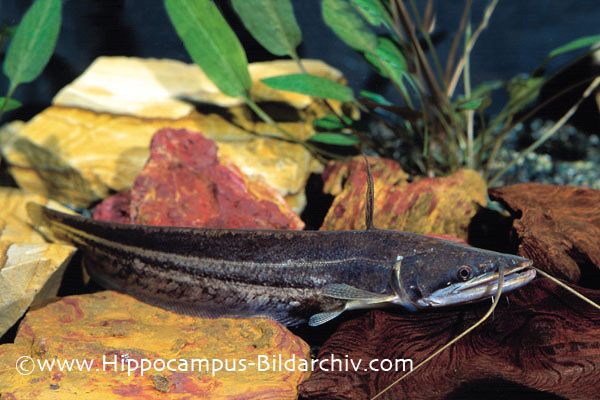
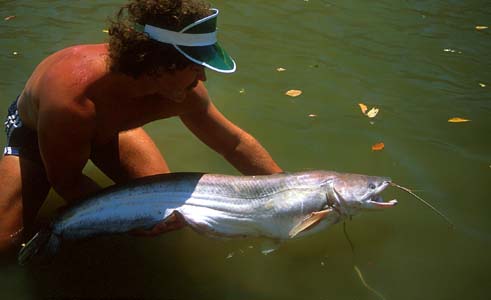
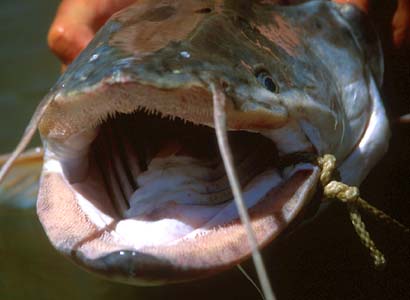
The helicopter catfish, Wallago attu, is a giant predatory catfish found through much of Asia, from Afghanistan and Pakistan to Indonesia. It can reach 240 cm, and its mouth is filled with needle-sharp, backward-pointing teeth. It will bite aggressively when fed or handled, and the profile treats it as a genuinely dangerous fish that is clearly not an aquarium species.
Distribution
EditWidely distributed throughout much of Asia. It has been recorded in Afghanistan, Pakistan, India, Nepal, Bangladesh, Sri Lanka, Myanmar, China, Thailand, Laos, Cambodia, Vietnam, Indonesia and Malaysia.
Habitat
Write a noteEditPrefers turbid, deep slow-moving or still bodies of water such as large lakes and rivers. It tends to hide in muddy areas, often hiding around river banks. It breeds in shallow water just prior to the wet season, before migrating to flooded areas to feed.
Aquarium size
Write a noteEditAn adult fish would require a truly enormous aquarium or better still, pond. Minimum size would be something in the region of 360 ∗ 120 ∗ 120 cm142 ∗ 48 ∗ 48 in - ~5184 litres~1369 US gal. Even this may not be large enough for an old fish.
Maintenance
Write a noteEditDecor is not critical, and would most likely be destroyed or continually buffeted around at any rate, so a bare tank, perhaps with a gravel substrate is probably best. This kind of fish requires a massive, highly efficient filtration system to deal with the large amounts of waste it produces. Regular partial water changes are also needed. The tank should have a very heavy, tightly fitting cover to prevent the fish escaping.
Water conditions
EditTemperature: 19 – 29 °C66 – 84 °F.
pH: 6.0-7.6
Hardness: 1-20°H
Diet
Write a noteEditHighly piscivorous, although wild specimens have been found with amphibians, birds, small mammals and even human remains in their stomachs! In the aquarium small specimens can be offered white fish such as lancefish, earthworms, and prawns. Larger specimens will accept whole trout and the like, but do not need to be fed as often. Once or twice a week is more than adequate. Extreme caution must be exercised when feeding this fish, as it will often launch itself from the water, and is more than capable of causing injury (see below).
Behaviour and compatibility
Write a noteEditShould be kept alone as a single specimen as it will consume any fish it can fit in its capacious mouth, and will usually kill anything it can't.
Sexual dimorphism
Write a noteEditUnknown.
Reproduction
Write a noteEditNot achieved in aquaria for obvious reasons, but has been bred commercially in ponds in Malaysia.
Notes
EditThis species is clearly not an aquarium fish, and thankfully is not imported with any great regularity. Young specimens are occasionally seen for sale however and no matter how cute they look, don't be tempted to buy one. The gigantic adult size is not the only problem with W. attu, as the mouth is filled with needle sharp, backward-pointing teeth. The fish will bite aggressively when being fed, especially when handled and larger individuals could easily sever a hand or worse. It is a genuinely dangerous fish to own, and should only be considered by the most experienced aquarist with the resources required to house it properly.
Species images · 3
These photographs are used with each photographer's permission.
Send a photographProfile completeness18 of 24
75% complete
Also missing: a recorded distribution, taxonomic authority, etymology.
Community
Questions about Wallago attu?
Ask on Discord