Wallagonia leerii
Striped Wallago Catfish
Formerly Wallago leerii
Last revised 2026Edit this page
On this page11 sections
Quick factsEdit
Difficulty3 of 8 measures
Rated difficult because it needs a tank at least 2 m long.
- Space
- very large tank
- Water
- needs a steady pH
- Temp
- needs a steady temperature
- Diet
- unknown
- Temperament
- unknown
- Social
- unknown
- Compatibility
- unknown
Other demands
Each of these can raise the rating on its own, whatever the measures above say.
- Hardiness
- unknown
- Needs a tank at least 2 m long
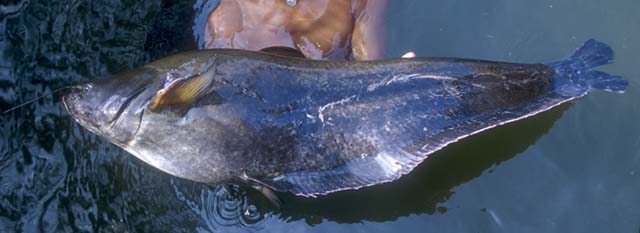
The striped wallago catfish, Wallago leerii, is a large predatory catfish from southeast Asia, including the Mekong basin, that can reach 2 metres. Like all Wallago it has an enormous mouth full of backward pointing teeth, and smaller fish are simply swallowed whole. This is NOT an aquarium fish, though it is imported quite regularly at a small size. In nature it is migratory and moves into inundated forest during the rainy season.
Distribution
EditHabitat
Write a noteEditThis species is migratory and in nature is known to move over large distances according to the season. It's primarily a riverine species but is also known to move into areas of inundated forest during the rainy season. Some populations are known to enter smaller tributaries when spawning.
Aquarium size
Write a noteEditIt's really suitable only for the largest of public aquaria.
Maintenance
Write a noteEditHypothetically speaking, decor is not likely to be critical and would in all likelihood be destroyed or continually buffeted around at any rate. A bare tank, perhaps with a gravel substrate would probably be best. A predatory fish of this size would also require a massive, highly efficient filtration system to deal with the large amounts of organic waste. The species has been known to cross small areas of land to find new waters in nature, so a tightly-fitting, heavy cover would seem to be another prequisite.
Water conditions
EditTemperature: 22 – 26 °C72 – 79 °F
pH: 6.0 - 7.0
Hardness: Up to 20°H
Diet
Write a noteEditLike others in the genus, W. leerii is highly predatory. Stomach analyses of wild specimens have revealed the remains of smaller fish including Puntius sp. and bagrid catfish as well as freshwater prawns. It is likely to require a similarly meaty diet in captivity. This species should not be fed the meat of mammals such as beef heart or chicken. The fats contained in these meats cannot be properly metabolised by the fish, and can cause excess deposits of fat and even organ degeneration. When first imported some specimens refuse to accept anything other than live fish, although most can be trained to take dead alternatives over time. As a juvenile it can be fed on a daily basis, but as its growth slows a single meal per week should be sufficient.
Behaviour and compatibility
Write a noteEditIt would surely be a bad idea to attempt to keep one of these with anything else. While larger tankmates may escape predation initially, they will inevitably end up on the menu at some point.
Sexual dimorphism
Write a noteEditCan be sexed by examining the genital papilla, which is noticeably slimmer in males.
Reproduction
Write a noteEditCaptive breeding has unsurprisingly not occured in an aquarium, although its cousin W. attu has been bred in oudoor ponds in Malaysia.
Notes
EditWallago are fearsome predatory catfish that are fairly widespread in southeast Asia. There are currently five recognised species, W. attu, W. leerii, W. hexanema, W. maculatus and W. micropogon. The latter was described to science in 2004 by renowned catfish expert Heok Hee Ng and was previously considered to be a geographic variant of W. leerii. All members of the genus possess an enormous mouth full of backward pointing teeth, which are used to rip chunks from their prey. Smaller fish or amphibians are simply swallowed whole.
We cannot emphasise strongly enough that this is NOT an aquarium fish. Unfortunately it is imported quite regularly at a small (ie. saleable) size.
Species images · 3
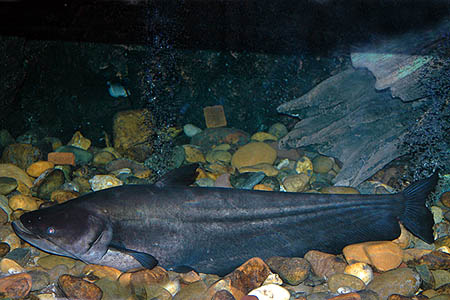
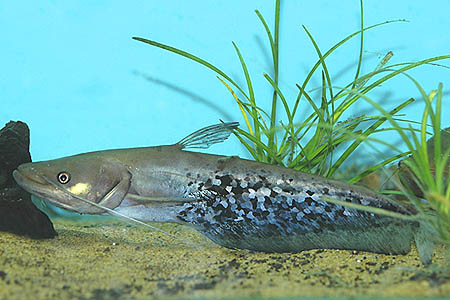
These photographs are used with each photographer's permission.
Send a photographHow the name has changed
Moved from Wallago leerii to Wallagonia leerii.
Distribution
Profile completeness18 of 24
75% complete
Also missing: aquarium size, etymology.
Community
Questions about Wallagonia leerii?
Ask on Discord