Basin
Yangtze basin
Only species with a profile on Seriously Fish are counted.
- Species
- 16
- Rivers
- 8
- Photographed
- 16 of 16
- Difficulty rated
- 15 of 16
Rivers in this basinspecies recorded from each
Runs through
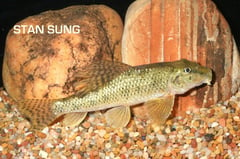
Abbottina rivularisChinese False Gudgeon
Cyprinidae · Basilewsky, 1855
The Chinese false gudgeon, Abbottina rivularis, is a small bottom-dwelling cyprinid native to China, the Korean peninsula and southern Japan. It has been widely introduced elsewhere, including the Mekong and Salween basins, Taiwan, Turkmenistan and Kyrgyzstan, and is considered invasive. It has started to appear in the aquarium trade and should never be released into natural waters outside its native range.
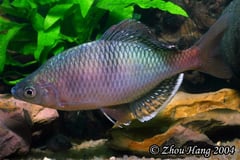
Acheilognathus macropterusGiant Chinese Bitterling
Cyprinidae · Bleeker, 1871
The giant Chinese bitterling, Acheilognathus macropterus, is a bitterling from China, the Korean peninsula, northern Vietnam and southeastern Russia. It has been introduced to Japan and is considered invasive there. Typical adults are 100 to 150 mm, and it appears in the trade only irregularly. Like all bitterlings it spawns in living unionid mussels, and its wide range suggests it may be a group of closely-related species.
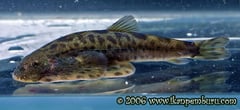
Beaufortia szechuanensis
Gastromyzontidae · Fang, 1930
Beaufortia szechuanensis is a hillstream loach from the upper Yangtze River basin in Sichuan province, southwestern China. It has been recorded from several tributary systems including the Qing, Wu and Da Ning He. Its flattened head and body and horizontal paired fins form a sucking cup that lets it cling to rocks in shallow, fast-flowing, highly-oxygenated headwaters.
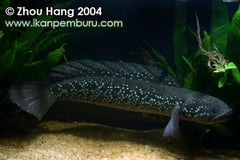
Channa asiaticaChinese Snakehead
Channidae · Linnaeus, 1758
The Chinese snakehead, Channa asiatica, is a snakehead native to central and southern China and northern Vietnam. One of several Channa lacking pelvic fins, it is told apart from them by vertical black bars on a brownish body and numerous white spots on the body and fins. It is best kept in a species tank. Pairs build no bubble nest, and both parents defend several thousand floating eggs and the fry.
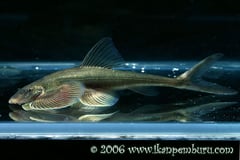
Jinshaia sinensis
Balitoridae · Sauvage & Dabry de Thiersant, 1874
Jinshaia sinensis is a balitorid loach known only from the Jinsha river basin, the westernmost headwater tributary of the Yangtze in China. Like other balitorids it has a flattened head and body and horizontally extended paired fins that form a powerful sucking cup. It lives only in riffles, runs and cascades of swift, clear, oxygen-saturated water, and the aquarium must be set up to resemble such a habitat.
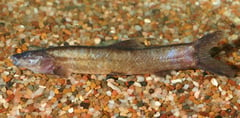
Leptobotia microphthalma
Botiidae · Fu & Ye, 1983
Leptobotia microphthalma is a botiid loach from the upper Yangtze basin in southwestern China, known from the Min and Jialing rivers. Its near-vestigial eyes and the variable hypopigmentation seen in many individuals suggest a deep water or even subterranean existence. Poorly known in the hobby, it is superficially similar to L. tientainensis and differs in a more deeply forked caudal-fin and a smaller eye, although eye size varies considerably between individuals.

Macropodus ocellatusRoundtail Paradise Fish
Osphronemidae · Cantor, 1842
The roundtail paradise fish, Macropodus ocellatus, is a labyrinth fish with an enormous range in China, Korea and Japan, north to the Amur River. It lives in ditches, rice paddies, marshes and river backwaters, where winter can freeze the surface and drop the water to 3 °C. It is sometimes referred to as M. chinensis in older literature, a name now considered a synonym of M. opercularis. Males are territorial when breeding and build bubble nests.

Macropodus opercularisParadise Fish
Osphronemidae · Linnaeus, 1758
The paradise fish, Macropodus opercularis, is a labyrinth fish from China south of the Yangtze, including Taiwan and Hainan, plus Vietnam and Laos. Imported to France in 1869, it was among the very first ornamental fish brought to Europe. Wild examples are uncommon in the hobby since it is farmed extensively, and xanthic, albino, red, blue and stripeless strains exist. Males are territorially aggressive, especially when breeding, and should not be housed together unless the aquarium is very large.
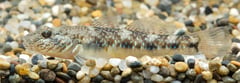
Rhinogobius giurinus
Gobiidae · Rutter, 1897
Rhinogobius giurinus is a goby found through much of China, plus Taiwan, the Korean Peninsula, Japan and the Red and Pha river basins in Vietnam. It appears to exist in a number of forms that differ in colour pattern, morphology or both, and it is unclear whether all of them are conspecific. Newly-imported wild fish tend to be aggressive towards conspecifics, so unlike most Rhinogobius it is best kept in sexed pairs.
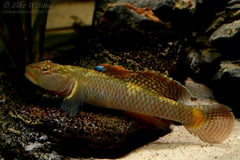
Rhinogobius leavelli
Gobiidae · (Herre, 1935)
Rhinogobius leavelli is a goby ranging from northeastern Laos through northern Vietnam to the Pearl drainage in Guangxi, southern China. It appears to exist in a number of forms that differ in colour pattern, morphology or both, although those in the aquarium trade all look similar. Fish identified as this species tend to have an orange blotch at the base of the caudal fin and a dark vertical bar at the base of the pectoral fin.
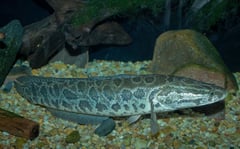
Channa argusNorthern Snakehead
Channidae · Cantor, 1842
The northern snakehead, Channa argus, is a large snakehead native to eastern China, southeastern Russia and the Korean peninsula. Growing to 850 mm, it is largely unsuitable for the home aquarium given its size and natural behaviour. Introduced populations, first intended for aquaculture, are now established in Japan, the United States, central Asia and parts of eastern Europe.
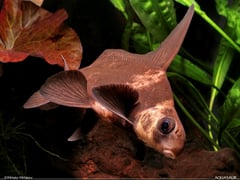
Myxocyprinus asiaticusChinese Sailfin Sucker
Catostomidae · Bleeker, 1864
The Chinese sailfin sucker, Myxocyprinus asiaticus, is a catostomid endemic to the upper and middle Yangtze River system in China, including the Min. The only Asian member of its family, it is traded as juveniles under names such as 'Chinese banded shark', almost always without mention of an adult size of almost a metre or a lifespan of 25 years or more. Wild populations are threatened by dams, pollution, overfishing and introduced species.
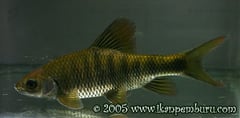
Acrossocheilus monticola
Cyprinidae · Günther, 1888
Acrossocheilus monticola is a barred cyprinid that is apparently endemic to the upper Yangtze River basin in China. It alone in the genus has seven or eight dark vertical bars on each flank, each one to three scales wide. The type locality is a mountain stream flowing into the Ichang gorge, and wild fish feed on small benthic invertebrates and graze biofilm from rocks and other solid surfaces.

Garra imberba
Cyprinidae · Garman, 1912
Garra imberba is a cyprinid without barbels from the upper Yangtze, Mekong and Red River basins in southern China, and the upper Red in Vietnam. Records from the Salween system result from confusion with the similarly-named G. imberbis. With G. micropulvinus it is placed in the Semilabeoina, for which the name Ageneiogarra has been suggested. It tends to inhabit swiftly-flowing headwaters and tributaries.
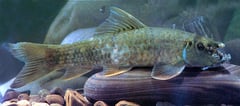
Garra orientalis
Cyprinidae · Nichols, 1925
Garra orientalis is a cyprinid widely distributed in southern China, with records from the Pearl River (Zhu Jiang) and Min Jiang watersheds. Earlier records from the Salween and upper Irrawaddy are now known to represent other species. It shares a forward-projecting, trilobed proboscis with G. salweenica and G. fuliginosa but lacks their dark blotch on the caudal peduncle. It tends to inhabit rocky, swiftly-flowing headwaters.
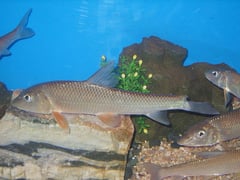
Hemibarbus labeoBarbel Steed
Cyprinidae · Pallas, 1776
The barbel steed, Hemibarbus labeo, is a cyprinid widespread in eastern Asia between the Yangtze and Amur river basins. A predominantly riverine fish of clear, well-oxygenated running water, it forms schools just above the substrate as an adult, and some populations make annual spawning migrations. Adults lack dark spots on the body and have a long snout and well-developed lips.