Country · Asia
Bhutan
Only species with a profile on Seriously Fish are counted, whether native or introduced.
- Species
- 11
- Families
- 4
- Genera
- 10
- Found only here
- 0
- Photographed
- 10 of 11
Shares its fishes withspecies recorded in both

Barilius bendelisis
Cyprinidae · Hamilton, 1807
Barilius bendelisis is a large, fast-swimming cyprinid from India, Bangladesh, Nepal and probably Bhutan. Occasionally sold as 'Indian hill trout' or 'Hamilton's baril', it has 8 to 12 bluish vertical bars and, in adults, a blue-black spot on each scale. It grows to around 200 mm SL and inhabits well-oxygenated, fast-flowing rivers and streams, and its speed and vigorous feeding make it unsuitable for the general community.
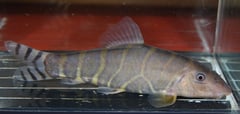
Botia darioBengal Loach
Botiidae · Hamilton, 1822
The Bengal loach, Botia dario, is a botiid loach from the middle to lower Ganges and Brahmaputra drainages in northern India, Bangladesh and Bhutan. Its yellow to golden body carries 7-9 dark bars with thinner, lighter bars between, and its particularly curved head makes it among the most easily recognisable in the genus. Botia macrolineata, described from aquarium fish shipped via Bombay, represents the same species. It is among the botiids produced commercially using hormones.

Channa gachuaDwarf Snakehead
Channidae · Hamilton, 1822
The dwarf snakehead, Channa gachua, is a snakehead recorded across an enormous range from Iran to Taiwan and Bali. There is significant evidence that C. gachua as currently understood is a complex of similar-looking species in need of taxonomic review. A mouthbrooder bred regularly in captivity, it can share a well-chosen community with peaceful fishes too large to be prey, but populations should not be mixed as some may hybridise.
Channa stewartiiAssamese Snakehead
Channidae · (Playfair, 1867)
The Assamese snakehead, Channa stewartii, is a snakehead of the C. gachua group from the Brahmaputra and Ganges basins of India, Bangladesh and Nepal. It is also listed from Bhutan and Myanmar and grows to about 30 cm TL. Keepers give it a cooler winter of about 16-18 °C, it is aggressive towards its own kind, and the male broods the eggs in his mouth.
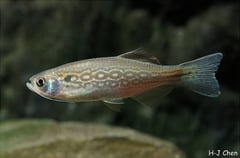
Danio dangilaMoustached Danio
Cyprinidae · (Hamilton, 1822)
The moustached danio, Danio dangila, is a cyprinid from the Ganges and Brahmaputra drainages, with most records from Nepal, India and Bangladesh. The common name refers to its exceptionally long barbels, and despite its apparent abundance in nature it remains uncommon in the hobby. Its constant activity can upset slow-moving or timid tankmates, so it suits larger tanks with similarly-sized fishes, and adult size appears to vary by population from 60 to 130 mm.

Devario assamensis
Cyprinidae · (Barman, 1984)
Devario assamensis is a deep-bodied devario from Assam and West Bengal in northeastern India, in tributaries of the lower Brahmaputra. It has been traded as Devario sp. 'Mirik red', D. sp. 'redline' and D. sp. 'blood stripe', but is very rare in the hobby. If the distribution records are correct, it occurs from around 250 m AMSL in Darrang to 1767 m at Mirik, and possibly higher in Bhutan.

Opsarius barna
Cyprinidae · Hamilton, 1822
Traded as 'striped hill trout' or 'banded hill trout', Opsarius barna is a cyprinid from the Ganges and Brahmaputra basins in northern India. It is thought to also occur in the Mahanadi and in river systems in Nepal, Bhutan, Bangladesh and Rakhine State, Myanmar, in well-oxygenated, fast-flowing rivers over gravel, cobbles and boulders. An extremely fast swimmer and vigorous feeder, it is unsuitable for the general community.

Pethia tictoTicto Barb
Cyprinidae · Hamilton, 1822
The ticto barb, Pethia ticto, is a small cyprinid widely distributed through most of the Indian subcontinent, from Pakistan and Nepal to Bangladesh. Its name is frequently misapplied to P. padamya in aquarium literature, though P. ticto is much the less colourful fish and males lack reddish-orange pigmentation on the body. Morphology and colour pattern vary by population, and some populations have already been described as distinct species.

Puntius cholaSwamp Barb
Cyprinidae · (Hamilton, 1822)
The swamp barb, Puntius chola, is a cyprinid from much of Pakistan, India, Nepal, Bhutan, Bangladesh, Sri Lanka, Myanmar and western Thailand. Sometimes called the 'chola' or 'green' barb, it has a single pair of barbels and dark blotches behind the operculum and near the caudal-fin base. It apparently prefers stiller waters over mud or silt, and makes an ideal addition to a peaceful community of riverine fishes.

Anabas testudineusClimbing Perch
Anabantidae · Bloch, 1792
The climbing perch, Anabas testudineus, is a labyrinth fish found from Pakistan and Sri Lanka east to southern China, Indonesia and Singapore. It lives in almost every kind of lowland water from rice paddies to main river channels, and can cross several hundred metres of land provided it stays moist. Its taxonomy is confused, and additional taxa probably exist. Its size and predatory nature make it unsuitable for the general community.

Ctenopharyngodon idellaGrass Carp
Cyprinidae · Valenciennes, 1844
The grass carp, Ctenopharyngodon idella, is a large cyprinid native to the Amur River system in eastern Russia and northeastern China. Adults typically reach 800 to 1200 mm, making it a wholly unsuitable aquarium subject, though an albino form is traded. Widely introduced for aquaculture and weed control, it has caused serious damage to natural waters, and unwanted fish should never be released.