Country · Asia
Hong Kong
Only species with a profile on Seriously Fish are counted, whether native or introduced.
- Species
- 14
- Families
- 10
- Genera
- 14
- Found only here
- 0
- Photographed
- 12 of 14
Shares its fishes withspecies recorded in both
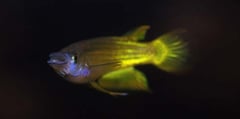
Aplocheilus lineatusStriped Panchax
Aplocheilidae · (Valenciennes, 1846)
The striped panchax, Aplocheilus lineatus, is a predatory killifish from peninsular India and northern Sri Lanka, growing to 10 cm TL. It lives in permanent water from mountain streams and lakes to swamps and rice paddies, and is not an annual species. The golden wonder panchax sold in the trade is a golden form selectively bred in the hobby that does not occur in the wild.
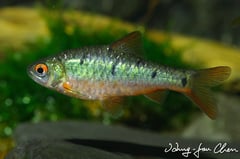
Barbodes semifasciolatusGolden Barb*
Cyprinidae · Günther, 1868
Barbodes semifasciolatus, the green or Chinese barb, is a cyprinid from Vietnam, Taiwan, southwestern China and northern Laos. The natural green form is an infrequent find in the trade, but the selectively-bred golden variant, first produced in the 1960s, is farmed in huge numbers. Commercial fish are largely inbred, with reduced fins and other deformities not uncommon. The name 'Puntius schuberti' often given to the golden form is not an official scientific name.

Butis butisCrazy Fish
Butidae · Hamilton, 1822
The crazy fish, Butis butis, is a flathead gudgeon of coastal and brackish waters across the Indo-Pacific, from eastern Africa to Fiji. The most commonly traded member of the genus, it has many other names, including crocodile fish, duckbill sleeper and upside-down sleeper. A nocturnal ambush predator, it often swims upside-down, and it is territorial and not sociable with conspecifics, so is best kept singly.
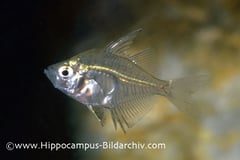
Chanda rangaIndian Glass Fish
Ambassidae · Hamilton, 1822
The Indian glass fish, Chanda ranga, is a small ambassid from South and Southeast Asia, with translucent skin that shows its bones and organs. For many years it was injected with luminous dyes on Asian fish farms and sold as 'painted' glass fish, and most injected fish do not survive more than a few months. It is found most often in freshwater, frequently soft and acidic, and needs no added salt. Parambassis lala and C. siamensis are often imported under its name.

Folifer brevifilis
Cyprinidae · Peters, 1881
Folifer brevifilis is a large cyprinid from the Mekong, Salween and Ayeyarwady systems of southern China, Myanmar, Thailand, Laos and Vietnam. It has also been recorded from Hainan and Hong Kong. Growing to 300 mm SL, it is unsuitable for the majority of home aquaria and extremely rare in the ornamental trade. It inhabits flowing middle and lower sections of major rivers and may migrate seasonally to spawn.
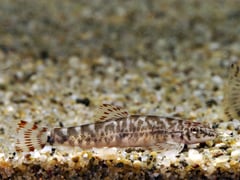
Liniparhomaloptera disparisBroken-band Hillstream Loach
Gastromyzontidae · Lin, 1934
The broken-band hillstream loach, Liniparhomaloptera disparis, is a gastromyzontid from the Pearl River system of southern China and from Hong Kong. It is restricted to shallow, fast-flowing, highly oxygenated headwaters with riffles and runs. Sometimes available as bycatch among shipments of Rhinogobius duospilus, it also appears on trade lists under the fictitious name 'Homaloptera hoffmani'. It has been bred in aquaria and buries its eggs within the substrate.

Macropodus hongkongensis
Osphronemidae · Freyhof & Herder, 2002
Macropodus hongkongensis is a paradisefish from Hong Kong and the neighbouring Chinese provinces of Guangdong and Fujian. In Hong Kong it is now known only from Tai Po and Sai Kung districts. It lives in hill streams and lowland, sometimes agricultural, habitats, apparently preferring shallow, densely vegetated water with slow flow. Males are territorially aggressive, especially when breeding, and the species is a bubble nester that is occasionally available in the trade.
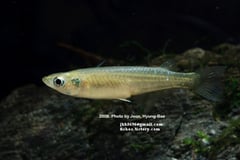
Oryzias latipesMedaka
Adrianichthyidae · Temminck & Schlegel, 1846
The medaka, Oryzias latipes, is a ricefish from Japan, Korea, Taiwan, eastern China, Laos and Vietnam. Long used as a model organism in genomic and experimental biology, it was the first vertebrate animal to mate in space, in the mid-1990s. The ornamental 'golden' variant is more often seen than the natural form, and a transgenic 'glowing' form is illegal to buy, sell or own within the European Union.
Rhinogobius duospilusWhite-cheeked Goby
Gobiidae · (Herre, 1935)
The white-cheeked goby, Rhinogobius duospilus, is a small goby from Hong Kong and southern China, living in clear hill streams. It was often sold in the past as 'Rhinogobius wui', a name now listed as a valid species, so aquarium literature published under either name may refer to either fish. Adults are extremely sedentary, and populations in neighbouring streams are genetically distinct from one another.
Xiphophorus helleriiGreen Swordtail
Poeciliidae · Heckel, 1848
The green swordtail, Xiphophorus hellerii, is a livebearer native to southeastern Mexico, Guatemala, Belize and Honduras. Among the world's most recognisable aquarium fishes, it is ubiquitous in the trade, where selective breeding and hybridisation with X. maculatus and X. variatus have produced a bewildering array of ornamental forms. The name is often misspelled X. helleri.

Ctenopharyngodon idellaGrass Carp
Cyprinidae · Valenciennes, 1844
The grass carp, Ctenopharyngodon idella, is a large cyprinid native to the Amur River system in eastern Russia and northeastern China. Adults typically reach 800 to 1200 mm, making it a wholly unsuitable aquarium subject, though an albino form is traded. Widely introduced for aquaculture and weed control, it has caused serious damage to natural waters, and unwanted fish should never be released.
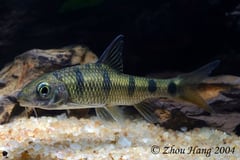
Acrossocheilus beijiangensis
Cyprinidae · Wu & Lin, 1977
Acrossocheilus beijiangensis is a barred cyprinid from Fujian, Guangdong and Guangxi in southern China, plus the islands of Hainan and Hong Kong. With A. clivosius it is one of only two species in the genus always to have five dark vertical bars on each flank. Wild fish feed on small benthic invertebrates and graze biofilm from rocks and other solid surfaces.
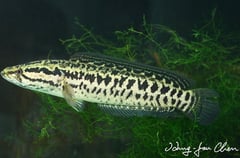
Channa maculataBlotched Snakehead
Channidae · Lacepède, 1801
The blotched snakehead, Channa maculata, is a snakehead from coastal drainages of southeastern China, including Hong Kong, and northern Vietnam. It is frequently confused with C. argus but has fewer fin rays and lateral line scales and carries 2-3 rounded blotches on the caudal peduncle. An important food fish, it has become established in Japan, Taiwan, the Philippines, Madagascar and Hawaii, and hybrids with C. argus appear to be quite common in aquaculture.
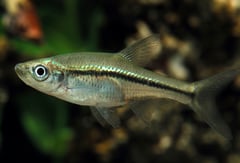
Metzia formosae
Cyprinidae · Oshima, 1920
Metzia formosae is a small cyprinid from northern Taiwan, Hainan, Hong Kong, southern China and northern Vietnam. It is identified by its upturned mouth and a black stripe along the flank from the gill opening to the caudal-fin base. It inhabits slow-moving to still, well-vegetated waters, including streams, rice paddies, ditches and canals. The genus remains unresolved in taxonomic terms.