Country · Africa
Mauritania
Only species with a profile on Seriously Fish are counted, whether native or introduced.
- Species
- 3
- Families
- 3
- Genera
- 3
- Found only here
- 0
- Photographed
- 3 of 3
The country
These figures are from Wikidata, checked on 24 October 2026.
Shares its fishes withspecies recorded in both
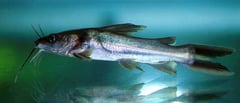
Clarotes laticepsWidehead Catfish
Bagridae · authority not recorded
The widehead catfish, Clarotes laticeps, is a large predatory catfish recorded across much of Africa, from Senegal and Guinea east to Egypt and Kenya. It inhabits large lakes and rivers and grows to 80 cm, though it is unlikely to reach this in captivity. Uncommon in the trade, it is capable of swallowing surprisingly large prey and is unsuitable for all but the biggest aquaria.
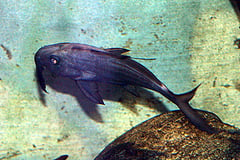
Synodontis membranaceusMoustache Catfish
Mochokidae · (Geoffroy Saint-Hilaire, 1809)
The moustache catfish, Synodontis membranaceus, is a large mochokid widespread in Africa, from Egypt and Sudan to Senegal and Nigeria. Its 'moustache' is a membrane along the maxillary barbels. It feeds mainly on plankton, filtered through its many gill rakers, and often feeds at the surface upside down. Often sold as a spotted juvenile, it can reach 50 cm and becomes territorial with conspecifics as it matures.
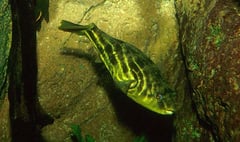
Tetraodon lineatusFahaka Puffer
Tetraodontidae · authority not recorded
The fahaka puffer, Tetraodon lineatus, is a large freshwater puffer from lakes and rivers across northern and West Africa, reaching 43 cm. Also known as the Nile puffer, it was previously named T. fahaka. One of the most aggressive puffers available, it learns to interact with its owner, but should be kept alone and needs no salt in its water.