Country · Asia
North Korea
Only species with a profile on Seriously Fish are counted, whether native or introduced.
- Species
- 9
- Families
- 3
- Genera
- 6
- Found only here
- 0
- Photographed
- 9 of 9
Shares its fishes withspecies recorded in both
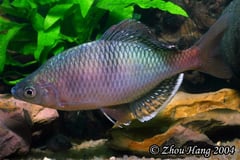
Acheilognathus macropterusGiant Chinese Bitterling
Cyprinidae · Bleeker, 1871
The giant Chinese bitterling, Acheilognathus macropterus, is a bitterling from China, the Korean peninsula, northern Vietnam and southeastern Russia. It has been introduced to Japan and is considered invasive there. Typical adults are 100 to 150 mm, and it appears in the trade only irregularly. Like all bitterlings it spawns in living unionid mussels, and its wide range suggests it may be a group of closely-related species.

Macropodus ocellatusRoundtail Paradise Fish
Osphronemidae · Cantor, 1842
The roundtail paradise fish, Macropodus ocellatus, is a labyrinth fish with an enormous range in China, Korea and Japan, north to the Amur River. It lives in ditches, rice paddies, marshes and river backwaters, where winter can freeze the surface and drop the water to 3 °C. It is sometimes referred to as M. chinensis in older literature, a name now considered a synonym of M. opercularis. Males are territorial when breeding and build bubble nests.
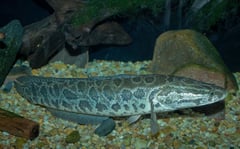
Channa argusNorthern Snakehead
Channidae · Cantor, 1842
The northern snakehead, Channa argus, is a large snakehead native to eastern China, southeastern Russia and the Korean peninsula. Growing to 850 mm, it is largely unsuitable for the home aquarium given its size and natural behaviour. Introduced populations, first intended for aquaculture, are now established in Japan, the United States, central Asia and parts of eastern Europe.

Ctenopharyngodon idellaGrass Carp
Cyprinidae · Valenciennes, 1844
The grass carp, Ctenopharyngodon idella, is a large cyprinid native to the Amur River system in eastern Russia and northeastern China. Adults typically reach 800 to 1200 mm, making it a wholly unsuitable aquarium subject, though an albino form is traded. Widely introduced for aquaculture and weed control, it has caused serious damage to natural waters, and unwanted fish should never be released.
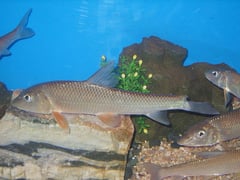
Hemibarbus labeoBarbel Steed
Cyprinidae · Pallas, 1776
The barbel steed, Hemibarbus labeo, is a cyprinid widespread in eastern Asia between the Yangtze and Amur river basins. A predominantly riverine fish of clear, well-oxygenated running water, it forms schools just above the substrate as an adult, and some populations make annual spawning migrations. Adults lack dark spots on the body and have a long snout and well-developed lips.
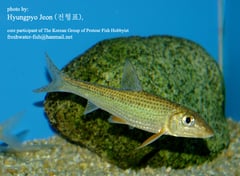
Hemibarbus longirostris
Cyprinidae · Regan, 1908
Hemibarbus longirostris is a cyprinid native to far eastern Asia, including northeastern China, southeastern Russia, the Korean peninsula and Japan. A predominantly riverine fish, it lives in clear, well-oxygenated running water over sand, gravel, rock or mud, and adults tend to form schools just above the substrate in slower-moving sections.
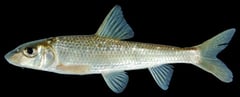
Hemibarbus maculatusSpotted Steed
Cyprinidae · Bleeker, 1871
The spotted steed, Hemibarbus maculatus, is a cyprinid widespread in eastern Asia between the Yangtze and Amur basins, including Taiwan and Hainan. It has 7–11 large blackish spots on each flank and a deep body with a clearly convex dorsal profile. A riverine fish of clear, well-oxygenated running water, it breeds in May and June, depositing its eggs among aquatic vegetation. It has probably been introduced to Vietnam and Laos, or records from there represent another species.
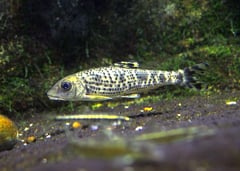
Hemibarbus mylodon
Cyprinidae · Berg, 1907
Hemibarbus mylodon is a cyprinid endemic to the Korean peninsula, where it occurs throughout North Korea and South Korea. A predominantly riverine fish, it lives in clear, well-oxygenated running water over sand, gravel, rock or mud, and adults tend to form schools just above the substrate in faster-flowing sections.
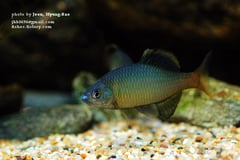
Tanakia signiferKorean Bitterling
Cyprinidae · Berg, 1907
The Korean bitterling, Tanakia signifer, is endemic to the Korean peninsula, where it occurs in southern North Korea and northern South Korea. It is considered endangered in South Korea, where it lives only in the Han river system and many populations have been extirpated. It inhabits cool, clean, shallow water over coarse sand or gravel, and like all bitterlings it spawns in living unionid mussels.