Hobbyist group · Characiformes
Other characiforms
Other characiforms spans 7 families.
- Species
- 23
- Families
- 7
- Genera
- 11
- Photographed
- 23 of 23
- Difficulty rated
- 23 of 23
Families
Where they come fromnative records only
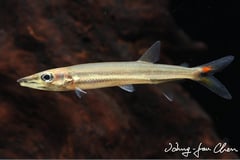
Acestrorhynchus isalineaeStriped Barracuda Tetra
Acestrorhynchidae · Menezes & Géry, 1983
The striped barracuda tetra, Acestrorhynchus isalineae, is a small predatory acestrorhynchid from the rio Madeira basin in the Brazilian Amazon. Most records come from the type locality, a tributary of the rio dos Marmelos. Like others in the A. nasutus group it keeps two dark longitudinal stripes into adulthood and stays around 100 mm. Acestrorhynchids are cannibalistic given the opportunity, so a group must be of comparable size.
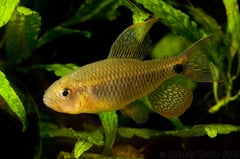
Crenuchus spilurusSailfin Characin
Crenuchidae · Günther, 1863
The sailfin characin, Crenuchus spilurus, is a crenuchid from much of the Amazon and Orinoco drainages and coastal rivers of the Guianas. The only described member of its genus, it varies considerably in colour pattern and morphology across that range. It lives in tea-stained forest streams, and its timid, predominantly benthic nature means it does not always make an ideal community fish. Males guard eggs laid on the roof of a small cave, often formed from leaf litter.
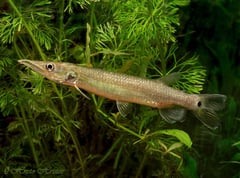
Ctenolucius hujetaGar Characin
Ctenoluciidae · (Valenciennes, 1850)
The gar characin, Ctenolucius hujeta, is a predatory pike characid from the Lake Maracaibo basin in Venezuela west to the Río Sinú in Colombia. Also traded as 'freshwater barracuda' and 'hujeta gar', it is surprisingly peaceful with anything too large to swallow. Juveniles school readily, and it is best kept in numbers of four or more with placid fishes that feed from the substrate. It is much the commoner of the two Ctenolucius in the hobby.
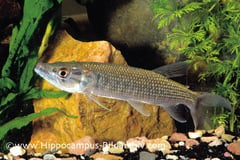
Hepsetus odoeAfrican Pike Characin
Hepsetidae · authority not recorded
The African pike characin, Hepsetus odoe, is a predatory characin of West and Central Africa, found from the Sassandra in Ivory Coast to Kribi in Cameroon and in the Niger, Volta and Chad basins. It is an ambush predator with a fearsome set of teeth that superficially resembles the European pike. Juveniles appear in the trade, but it reaches 70 cm in nature and is strictly for the specialist with a very large aquarium.
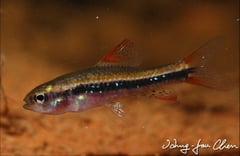
Poecilocharax weitzmaniBlack Darter Tetra
Crenuchidae · Géry, 1965
The black darter tetra, Poecilocharax weitzmani, is a crenuchid recorded from Brazil, Colombia, Peru and Venezuela. It has been collected from the upper Río Negro, Río Orinoco and Río Solimões drainages. Also traded as 'Black Morpho' tetra, it requires specialist care and is notoriously reluctant to accept dried foods. Unlike most small characids it does not form schools, and males are aggressively territorial towards one another. The Peruvian populations may apparently represent an undescribed species.
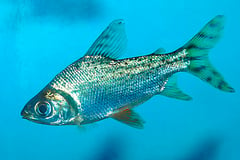
Semaprochilodus insignisFlagtail Prochilodus
Prochilodontidae · authority not recorded
The flagtail prochilodus, Semaprochilodus insignis, is a large shoaling characin from Ecuador, Peru, Colombia, Guyana and Brazil. Known with some congeners as the jaraqui in Brazil, it migrates over large distances in huge shoals and feeds on organic detritus, using one of its two stomachs, filled with mud, to aid digestion. It is aggressive towards its own kind in small numbers but can be kept in groups of six or more in larger tanks.
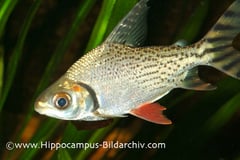
Semaprochilodus taeniurusFlagtail Characin
Prochilodontidae · authority not recorded
The flagtail characin, Semaprochilodus taeniurus, is a large shoaling fish from the central Amazon basin in Brazil, growing to around 30 cm. Also sold as the silver prochilodus or fei feng, it migrates twice a year in huge shoals, moving into white waters to spawn at the start of the wet season and feeding mostly in the floodplains. It is aggressive towards its own kind in small numbers but can be kept in groups of six or more in larger tanks.
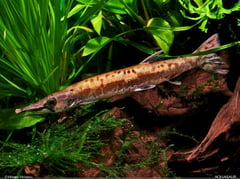
Boulengerella lucius
Ctenoluciidae · (Cuvier, 1816)
Boulengerella lucius is a large, pelagic ctenoluciid from the central Amazon region in Brazil and the Río Orinoco in Venezuela. Named for its resemblance to the northern pike, it grows to 420 mm and is largely unsuitable for the home aquarium. Juveniles and subadults are sometimes available in the trade, often misidentified as B. maculata. Dark patches between the median caudal-fin rays and random dark spots on the lower flanks separate it from B. cuvieri and B. xyrekes.
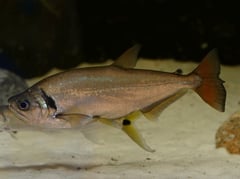
Hydrolycus tatauaia
Cynodontidae · Toledo-Piza, Menezes & Santos, 1999
Hydrolycus tatauaia is a large, predatory dogtooth characin from the lower and central Amazon, the upper Orinoco and coastal drainages of Guyana. A pelagic species of flowing main river channels, it performs long upstream migrations to spawn. Its adult size and natural behaviour mean only a handful of private aquarists have the facilities to house it long-term.
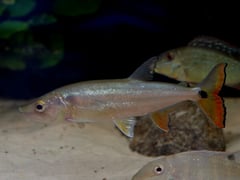
Acestrorhynchus altusRed Barracuda Tetra
Acestrorhynchidae · Menezes, 1969
The red barracuda tetra, Acestrorhynchus altus, is a predatory acestrorhynchid that may be restricted to the lower Amazon in Brazil. A member of the A. lacustris group, it has a round humeral spot and is virtually impossible to tell from its relatives in the trade unless collection data is known. An obligate piscivore of open water, it is best kept in a group of four or more of comparable size, since acestrorhynchids are cannibalistic.
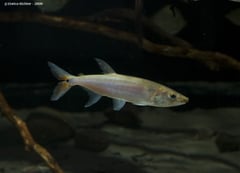
Acestrorhynchus falcatusRed-Tailed Freshwater Barracuda
Acestrorhynchidae · (Bloch, 1794)
The red-tailed freshwater barracuda, Acestrorhynchus falcatus, is a predatory acestrorhynchid from the northern Amazon and Orinoco basins. It also occurs in coastal rivers of Guyana, Suriname and French Guiana. Its large humeral spot, shaped like an inverted tear drop, separates it from other Acestrorhynchus. Reaching 250 to 275 mm, it needs plenty of open water, and a group must be of comparable size because acestrorhynchids are cannibalistic.
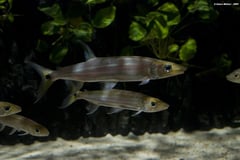
Acestrorhynchus falcirostrisBig-Eyed Cachorro
Acestrorhynchidae · (Cuvier, 1819)
The big-eyed cachorro, Acestrorhynchus falcirostris, is a large predatory acestrorhynchid from northern Amazon drainages and the Orinoco. The two dark body stripes of the A. nasutus group appear only in its juveniles, and at 320 to 350 mm SL it grows far larger than the other members. A black fringe to the rear of the operculum gives it a 'collared' look. It needs open water, and a group must be of comparable size because acestrorhynchids are cannibalistic.
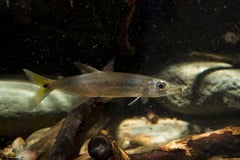
Acestrorhynchus microlepisPike Tetra
Acestrorhynchidae · (Jardine, 1841)
The pike tetra, Acestrorhynchus microlepis, is a predatory acestrorhynchid from northern Amazon drainages and the Orinoco. It also occurs in coastal rivers of Guyana, Suriname and French Guiana. A member of the A. microlepis group, it has a small blackish spot behind the gill cover and is separable from the very similar A. grandoculis only by counts. It tends to take smaller prey such as tetras, and acestrorhynchids are cannibalistic, so a group must be of comparable size.
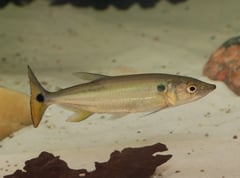
Acestrorhynchus pantaneiroPantanal Barracuda Tetra
Acestrorhynchidae · Menezes, 1992
The Pantanal barracuda tetra, Acestrorhynchus pantaneiro, is a predatory acestrorhynchid from the Paraná, Uruguay and de la Plata basins. It also occurs in the rio Mamoré in Bolivia. A member of the A. lacustris group with a round humeral spot, it is virtually impossible to tell from its relatives in the trade unless collection data is known. It lives in open water, and a group must be of comparable size because acestrorhynchids are cannibalistic.
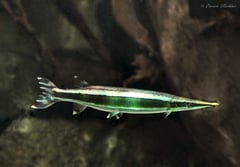
Boulengerella lateristrigaStriped Pike 'Characin'
Ctenoluciidae · (Boulenger, 1895)
The striped pike 'characin', Boulengerella lateristriga, is a ctenoluciid from the rio Negro basin and parts of the upper Río Orinoco. It appears limited to black water rivers and tributaries, where the water is stained darkly with humic acids and the pH can be as low as 3.0 or 4.0. A thin dark stripe from the rear of the eye to the caudal peduncle and dark crossbars on the caudal-fin lobes separate it from the similar B. maculata. It grows to 258 mm SL.
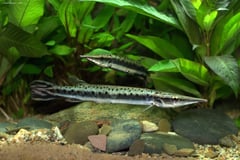
Boulengerella maculata
Ctenoluciidae · (Valenciennes, 1850)
Boulengerella maculata is a pelagic ctenoluciid found throughout much of the Amazon, Orinoco and Tocantins river systems. Colour pattern varies considerably, with some specimens much paler than others, and this may be correlated with water type. Random dark spots on the upper body, and a dark stripe only behind the eye when one is present, separate it from the similar B. lateristriga. It reaches 329 mm SL and needs an aquarium with base dimensions of 240 by 90 cm or more.
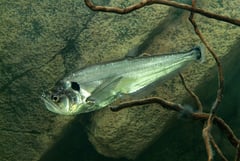
Cynodon gibbus
Cynodontidae · (Agassiz, 1829)
Cynodon gibbus is a cynodontid from much of the Amazon basin, the middle and lower Orinoco, and the Rupununi River in Guyana. A pelagic fish of main river channels and larger tributaries, it grows to around 280 mm SL. It is rare in the trade but arguably more suitable for the home aquarium than some of its better-known relatives, given its size and relatively docile behaviour. Being easily dominated, it is best kept alone or with similarly sized, non-aggressive fishes.
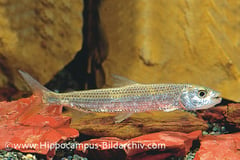
Hydrocynus vittatusAfrican Tiger Fish
Alestidae · authority not recorded
The African tiger fish, Hydrocynus vittatus, is a large predatory alestid found throughout Africa, from Egypt to South Africa. A voracious piscivore with dagger-shaped, interlocking teeth, it hunts in large shoals in the wild and is a popular game fish. Small specimens show up quite frequently in dealers' tanks, but even an aquarium of 300 by 90 cm is too small for an adult.
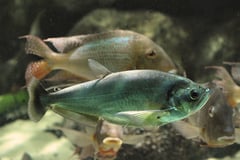
Hydrolycus scomberoidesVampire Tetra
Cynodontidae · (Cuvier, 1819)
The vampire tetra, Hydrolycus scomberoides, is a predatory dogtooth characin from the central and upper Amazon in Brazil, Bolivia, Peru and Ecuador. Also sold as 'scomb' and 'sabre tooth tetra', it is regularly confused with the much larger payara, H. armatus. At up to 300 mm it still needs a huge tank and specialist care, and newly-imported specimens often refuse anything but live food.
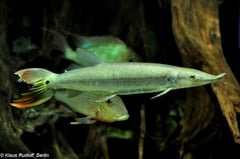
Boulengerella cuvieri
Ctenoluciidae · (Spix & Agassiz, 1829)
Boulengerella cuvieri is a pelagic ctenoluciid characin from much of the Amazon basin, the Río Orinoco and coastal drainages of the Guianas. The largest officially recorded specimen measured 675 mm, but it appears to grow larger, possibly beyond 800 mm. Given that size and its natural behaviour it is largely unsuitable for the home aquarium. Its entire dorsal-fin base lies ahead of the anal-fin origin, a character shared only with B. lucius and B. xyrekes among ctenoluciids.
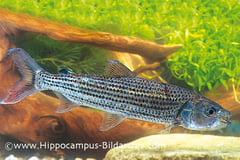
Hydrocynus goliathGiant Tigerfish
Alestidae · authority not recorded
The giant tigerfish, Hydrocynus goliath, is a huge predatory alestid from large rivers and lakes of Tanzania and the Democratic Republic of Congo. A voracious piscivore with dagger-shaped, interlocking teeth, it is one of the world's most infamous game fish. Small specimens are becoming easier to acquire, but its enormous adult size and the danger of maintaining it make it totally unsuited to aquarium life.
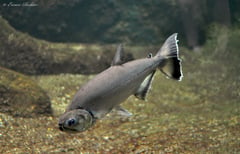
Hydrolycus armatusPayara
Cynodontidae · (Jardine, 1841)
The payara, Hydrolycus armatus, is a large, predatory dogtooth characin from the eastern Amazon, the Orinoco and the Essequibo in Guyana. Given its eventual size and natural behaviour it probably should not be considered a home aquarium subject at all, though juveniles are sometimes sold. It is regularly confused with the smaller H. scomberoides, and no other member of the genus has white margins to the anal and caudal fins.
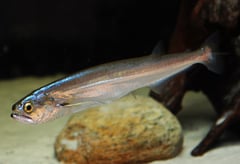
Rhaphiodon vulpinusBiara
Cynodontidae · Spix & Agassiz, 1829
The biara, Rhaphiodon vulpinus, is a dogtooth characin found from the Orinoco and Amazon basins south to the Río de la Plata in Argentina. The only member of its genus, it grows to 600 to 800 mm and is an obligate piscivore, and it is suitable only for public installations or the very largest private aquaria. Juveniles are seen for sale quite regularly, most often without adequate information on their long-term care.