Hobbyist group · Cypriniformes
Rasboras & relatives
- Species
- 38
- Families
- 1
- Genera
- 9
- Photographed
- 38 of 38
- Difficulty rated
- 38 of 38
Families
Where they come fromnative records only
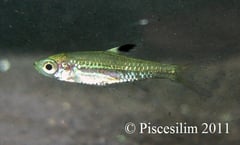
Brevibora cheeya
Cyprinidae · Liao & Tan, 2011
Brevibora cheeya is a small cyprinid from Peninsular Malaysia, Sumatra and the island of Bangka. The type locality is a slow-flowing, acidic stream in coastal heath forest over sand and peat. Very rare in the trade, it is normally imported only as bycatch among other fishes. A complete lateral line, more scales in the lateral row and a larger adult size separate it from the better-known B. dorsiocellata.
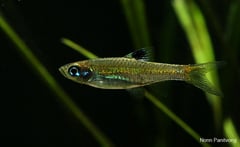
Brevibora dorsiocellataEyespot Rasbora
Cyprinidae · Duncker, 1904
The eyespot rasbora, Brevibora dorsiocellata, is a small cyprinid from southern Thailand, Peninsular Malaysia, Borneo and Sumatra. It is also traded as the 'green-eyed', 'emerald-eyed' or 'hi-spot' rasbora. The common, commercially produced form is plain-coloured with a greenish-blue reflective patch in the eye, while a probably wild-caught form seen from time to time has russet red at the base of the tail. Some Bornean records may refer to B. cheeya.
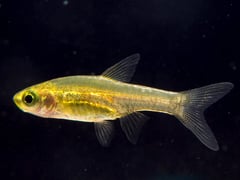
Horadandia atukorali
Cyprinidae · Deraniyagala, 1943
Horadandia atukorali is a miniature cyprinid from Sri Lanka and southern India, where it is restricted to Kerala, Tamil Nadu and Puducherry. Its small adult size evolved through miniaturisation, and it shows a preference for sluggish and still waters such as rice paddies, swamps and weedy ponds. Very peaceful but timid, it does best alone or with other diminutive species in a densely-planted tank.
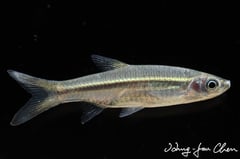
Rasbora argyrotaeniaSilver Rasbora
Cyprinidae · (Bleeker, 1849)
The silver rasbora, Rasbora argyrotaenia, is a cyprinid from Peninsular Malaysia, Singapore, Sumatra, Java, Borneo and the Palawan islands. One of the larger rasboras at up to 140 mm TL, it is a plain, silvery fish with a faint dark stripe, and fish pictured under this name with a bold black stripe are probably a regional variant of R. daniconius. A DNA barcode study found two mitochondrial lineages under the name, and the species as currently recognised is likely to be split.
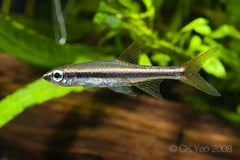
Trigonopoma gracile
Cyprinidae · Kottelat, 1991
Trigonopoma gracile is a small rasbora from the blackwater peat swamps of Peninsular Malaysia, Borneo and Sumatra. Its colour forms vary with collection locality. The name Rasbora agilis has been applied to it since a 1971 book pictured it under that name, but R. agilis is a junior synonym of T. pauciperforatum, the fish it is said to resemble.
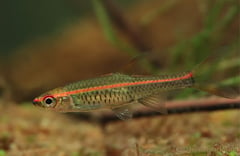
Trigonopoma pauciperforatumGlowlight Rasbora
Cyprinidae · Weber & de Beaufort, 1916
The glowlight rasbora, Trigonopoma pauciperforatum, is a small cyprinid from Peninsular Malaysia, Singapore, Borneo and Sumatra. Also sold as the 'redline' rasbora, its lateral stripe varies from deep orange to golden with locality, diet, condition and mood. It inhabits blackwater streams associated with peat swamps, where the pH can drop as low as 3.0 or 4.0, and the name R. agilis is a junior synonym of it.
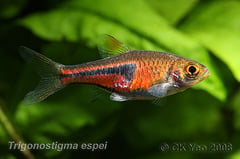
Trigonostigma espeiLambchop Rasbora
Cyprinidae · Meinken, 1967
The lambchop rasbora, Trigonostigma espei, is a small cyprinid from southwestern and southeastern Thailand, reaching into southwestern Cambodia. It can be confused with T. heteromorpha and T. hengeli but is generally bright copper to reddish, with a thinner 'lambchop'-shaped body marking. Very peaceful, it inhabits gently flowing forest streams where submerged plants grow thickly.
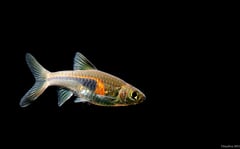
Trigonostigma hengeli
Cyprinidae · Meinken, 1956
Trigonostigma hengeli is a small rasbora from the Greater Sunda Islands, collected in Jambi province, Sumatra and apparently West Kalimantan, Borneo. It is sometimes sold as the 'glowlight rasbora', a name also applied to Trigonopoma pauciperforatum. Slightly smaller than T. espei and T. heteromorpha, it has a greyish body with bright orange along the upper and anterior edges of the 'lambchop' marking.
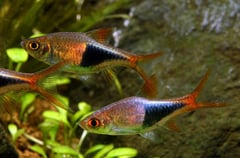
Trigonostigma heteromorphaHarlequin
Cyprinidae · Duncker, 1904
The harlequin, Trigonostigma heteromorpha, is a small cyprinid from southern Thailand, Peninsular Malaysia, Singapore and Sumatra. First exported for aquaria in the early 1900s, it is now mass-produced, and farmed fish lack much of the colour of wild ones. The dark triangular body marking sets it apart from T. espei and T. hengeli, and two divergent lineages found in aquarium stock suggest the species as currently recognised may contain more than one taxon.
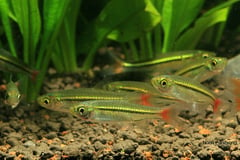
Rasbora borapetensisRed-tailed Rasbora
Cyprinidae · authority not recorded
The red-tailed rasbora, Rasbora borapetensis, is a small cyprinid from the Mekong and Chao Phraya drainages and the Mae Klong in western Thailand. One of the more commonly encountered rasboras in stores, it is also sold as the black-line or magnificent rasbora. The similar R. rubrodorsalis has a bright red blotch in the dorsal fin, whereas in R. borapetensis the dorsal is colourless and only the base of the caudal fin is red. Very peaceful, it often schools quite closely.
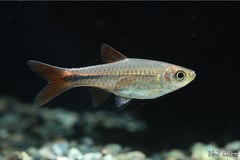
Rasbora lacrimulaRed Cherry Rasbora
Cyprinidae · authority not recorded
The red cherry rasbora, Rasbora lacrimula, is a small cyprinid confirmed only from the Belayan drainage in east Kalimantan, Indonesian Borneo. Also traded as 'Bornean redfin rasbora', 'sunshine rasbora' and 'dwarf volcano rasbora', it first appeared in the hobby in late 2010. Larger fish carry small tubercules on the back behind the dorsal fin, and a faint dark midlateral stripe ends in a teardrop-shaped blotch at the caudal peduncle.
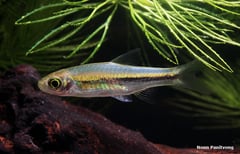
Rasbora paucisqualis
Cyprinidae · authority not recorded
Rasbora paucisqualis is a small rasbora from Peninsular Malaysia, recorded from the states of Johor, Pahang, Selangor, Kelantan and Terengganu. It was described from a single specimen from the aquarium trade, supposedly imported from the Malay Peninsula. Despite reports to the contrary it does not occur in the Mekong drainage, and the fish from there once thought to be conspecific was described as R. amplistriga by Kottelat (2000).
Rasbora rubrodorsalis
Cyprinidae · authority not recorded
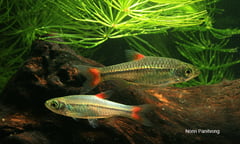
Rasbora rubrodorsalis is a small rasbora from Thailand, found most abundantly in the lower Mekong river basin in the northeast of the country. It lives in the shallow margins of still or gently flowing waters such as swamps, marshes and floodplains. The bright red blotch in its dorsal fin separates it from R. borapetensis, a similar fish that shares part of its range and is much commoner in the hobby. It is sometimes sold as R. beauforti or R. sp. cf. beauforti.
Boraras brigittaeMosquito Rasbora
Cyprinidae · Vogt, 1978
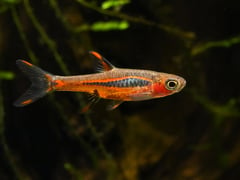
The mosquito rasbora, Boraras brigittae, is a miniature cyprinid that appears to be endemic to southwestern Borneo. It inhabits blackwater streams and pools associated with forest peat swamps, where the water is very soft and acidic. The congener B. urophthalmoides is often traded under its name, but B. brigittae is larger, lacks a distinct dark blotch at the caudal peduncle and has brighter, more uniformly red patterning. Striped males of B. merah have led to speculation that the two are the same species.
Boraras maculatusDwarf Rasbora
Cyprinidae · Duncker, 1904
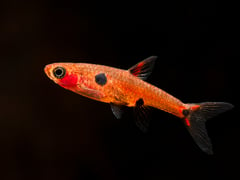
The dwarf rasbora, Boraras maculatus, is a miniature cyprinid from Peninsular Malaysia, southern Thailand, eastern Sumatra, Singapore and Bintan. It inhabits blackwater streams and rivers associated with forest peat swamps, where the water is very soft and acidic. Colour pattern varies between populations, some forms showing more intense red than others. It is most similar to B. naevus, in which the red body colouration does not extend into the head.
Boraras merah
Cyprinidae · Kottelat, 1991
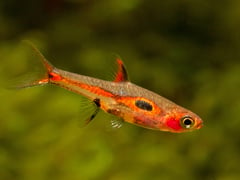
Boraras merah is a miniature cyprinid from southern Borneo, described from the Jelai Bila river basin near Sukamara in Central Kalimantan, Indonesia. Sometimes sold as the 'phoenix rasbora', it lacks colour in much of the body, with the red pigmentation concentrated around dark markings that tend to form spots or blotches. Fully-striped males have led to speculation that it is the same species as B. brigittae, though Kottelat (2013) argued for two species.

Boraras micros
Cyprinidae · Kottelat & Vidthayanon, 1993
Boraras micros is a tiny cyprinid from the Mekong basin in northeastern Thailand, recorded in Nong Khai, Udon Thani and Sakon Nakhon provinces. Growing to only 13 mm SL, it inhabits shallow, clear, densely vegetated swamps, marshes, floodplains and rice paddies. Poorly documented and rarely seen in the trade, it has a rather plain pattern, and fish sold as B. micros var. 'red' or 'strawberry rasbora' are always B. maculatus, B. brigittae or B. naevus.
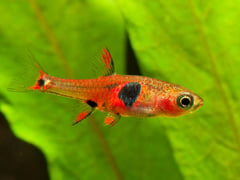
Boraras naevus
Cyprinidae · Conway & Kottelat, 2011
Boraras naevus is a miniature cyprinid known only from the lower Tapi river drainage in Surat Thani province, southern (peninsular) Thailand. Before its description it was traded as B. sp. 'micros', 'red micros', 'Petch Noi' and 'strawberry rasbora', and it is exported only sporadically. It lives in shallow, clear swamps and marshes. Males have an anterior flank blotch much larger than that of females, a feature unique to this species within the genus.
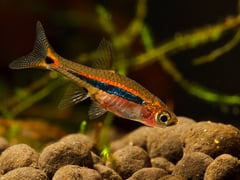
Boraras urophthalmoides
Cyprinidae · Kottelat, 1991
Boraras urophthalmoides is a miniature cyprinid from southern and central Thailand, Cambodia and Vietnam, including the moats of Angkor Wat. It inhabits shallow, clear, vegetated swamps, marshes, floodplains and rice paddies. Some populations develop an orange-red stripe that leads to confusion with B. brigittae, but B. urophthalmoides is smaller, with a distinct round, dark blotch on the caudal peduncle and a long, unbroken lateral stripe. It is sometimes sold as the 'exclamation-point rasbora'.
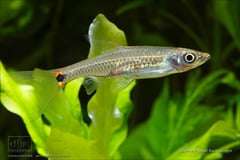
Kottelatia brittani
Cyprinidae · Axelrod, 1976
Kottelatia brittani is a small rasborin cyprinid described from southern Peninsular Malaysia and recorded from the Batang Hari river in Sumatra. Its distribution is unclear, since the type specimens came via a Singapore wholesaler, and there appears to be a possibility that it is endemic to Sumatra. Sold as the 'head and tail light rasbora', it has been confused with Rasbora kalbarensis but is larger, with a more pointed head and intense orange to red blotches on the caudal peduncle.
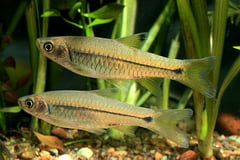
Rasbora dorsinotata
Cyprinidae · Kottelat, 1987
Rasbora dorsinotata is a small rasbora from the Mekong and upper Chao Phraya river basins in northern Thailand and northern Laos. It shows a preference for smaller tributaries containing clear, flowing water and is apparently abundant in such habitats. Poorly documented in the aquarium literature, it can be told from similar species by the black tip to its dorsal fin and a black lateral stripe ending in a rounded spot on the caudal peduncle.
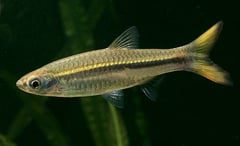
Rasbora dusonensis
Cyprinidae · Bleeker, 1850
Rasbora dusonensis is a cyprinid from Sumatra, Peninsular Malaysia and Borneo, found in larger river channels and peat swamp blackwaters. Its identity was unclear for decades before its redescription by Ng and Kottelat (2013). It is very similar to R. tornieri, which shares the Musi river with it, but has a bright yellow caudal fin with a broad dark margin, against carmine red in R. tornieri. One specimen measured 162 mm SL, although 95 to 105 mm is a more commonly reported adult size.
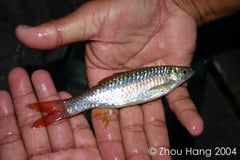
Rasbora tornieri
Cyprinidae · Ahl, 1922
Rasbora tornieri is a cyprinid from Sumatra, Borneo, Peninsular Malaysia and the Mekong drainage in Cambodia. Its identity was unclear for decades before its redescription by Ng and Kottelat (2013). It is very similar to R. dusonensis, which shares the Musi river with it, but its caudal fin is carmine red, against bright yellow in R. dusonensis. It lives in flowing streams and peat swamp blackwaters alike.
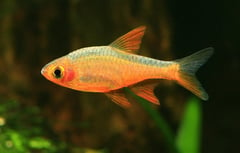
Rasboroides vateriflorisFire Rasbora
Cyprinidae · Deraniyagala, 1930
The fire rasbora, Rasboroides vaterifloris, is a small cyprinid endemic to the Kalu, Bentota, Gin and Nilwala river basins of southwestern Sri Lanka. Colour varies with locality, and red, orange and yellow-finned forms are known. Its delicate nature causes problems in shipping, and reports suggest the more highly coloured fish are becoming scarcer in the wild, possibly because selective collection for the trade has altered the structure of wild populations.
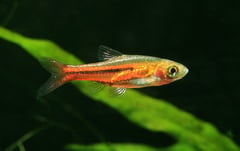
Trigonostigma somphongsi
Cyprinidae · Meinken, 1958
Trigonostigma somphongsi is a small rasbora, probably endemic to western Thailand and reckoned to occur somewhere in the Mae Klong basin. Exceptionally rare, it was considered potentially extinct for around a dozen years before a trio arrived in Germany among Boraras urophthalmoides in 2006. Its dark flank marking is reduced to a thickish black stripe, and captive stock is being bred to establish a sustainable population.
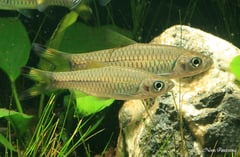
Rasbora caudimaculataGreater Scissortail Rasbora
Cyprinidae · authority not recorded
The greater scissortail rasbora, Rasbora caudimaculata, is a cyprinid probably restricted to Peninsular Malaysia, Borneo and Sumatra. Also sold as the 'red scissortail', it is told from the similar R. trilineata by orange-red colour in the caudal fin, with black tips to the lobes. It has been collected from swift forest streams and sluggish peat swamp blackwaters, and its size, to 150 mm SL, suits it only to larger tanks with sufficiently bold companions.
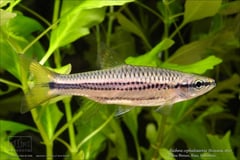
Rasbora cephalotaeniaPorthole Rasbora
Cyprinidae · authority not recorded
The porthole rasbora, Rasbora cephalotaenia, is a cyprinid from Peninsular Malaysia, Borneo, Sumatra and southern Thailand. It inhabits black water streams and rivers in ancient peat swamp forest, where the water is very soft and acidic. The dark lateral stripe is broken into a series of spots, while in the similar R. einthovenii and R. jacobsoni it forms a solid line. Not often exported, it makes an elegant, peaceful resident of the larger community tank.
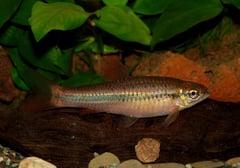
Rasbora cf. dandia
Cyprinidae · authority not recorded
Rasbora cf. dandia is a cyprinid from Sri Lanka and southern India that may well be a form of R. dandia itself. It appears to be widely available in the trade but is often misidentified as R. wilpita, a species confirmed as endemic to a small number of Sri Lankan streams and probably much rarer in the hobby than previously thought. It inhabits virtually all kinds of lowland freshwater habitat, from rivers and streams to rice paddies and reservoirs.
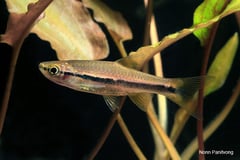
Rasbora einthoveniiBrilliant Rasbora
Cyprinidae · authority not recorded
The brilliant rasbora, Rasbora einthovenii, is a cyprinid from southern Thailand, Peninsular Malaysia, Singapore, Borneo and Sumatra. It mostly inhabits black water streams and rivers associated with peat swamp forest. One of the more commonly seen rasboras in the hobby, it resembles R. jacobsoni but lacks dark reticulated scales above the lateral stripe, and the stripe itself has noticeably uneven or 'crinkly' edges. Most fish in the trade are captive-bred.
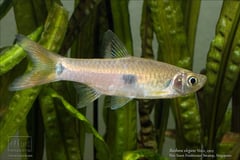
Rasbora elegansElegant Rasbora
Cyprinidae · authority not recorded
The elegant rasbora, Rasbora elegans, is a cyprinid from Peninsular Malaysia, Singapore and the Greater Sunda Islands of Borneo and Sumatra. It lacks the dark lateral stripe of similar members of the genus and carries two spot-like markings on each flank, one below the dorsal-fin origin and one at the caudal peduncle. It has been collected from swift forest streams and peat swamp blackwaters alike, and it needs space to swim: it can act nervously in smaller quarters.
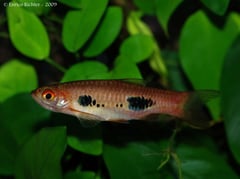
Rasbora kalochromaClown Rasbora
Cyprinidae · authority not recorded
The clown rasbora, Rasbora kalochroma, is a cyprinid from the peat swamp blackwaters of Peninsular Malaysia, Borneo and Sumatra. Its patterning varies with locality. Adults are sometimes confused with R. elegans, a silver fish, while this one is pinkish to reddish. The only congener it may genuinely be mistaken for is the almost identical R. kottelati of northern Sarawak and Brunei, which has an additional dark blotch on the caudal peduncle.
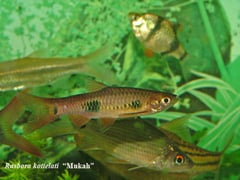
Rasbora kottelati
Cyprinidae · authority not recorded
Rasbora kottelati is a blackwater rasbora endemic to Borneo, restricted to Brunei Darussalam and northern parts of the Malaysian state of Sarawak. It is almost identical to its closest relative R. kalochroma but has an additional oval-shaped dark blotch on the caudal peduncle and lacks the stripe in the middle of the caudal fin. Collections from its native waters occur only sporadically, and its care is largely based on experience with R. kalochroma.
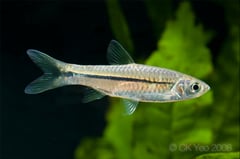
Rasbora paviana
Cyprinidae · authority not recorded
Rasbora paviana is a striped rasbora from the Mekong, Chao Phraya and Mae Klong basins in Thailand, Laos, Cambodia and Vietnam. Much of the literature pictures it under the invalid name R. paviei. It can be hard to separate from R. sumatrana, R. hobelmani and R. laticlavia, but it is the only one of the group found in Indochina, so a known collection locality makes identification easier. It has been collected from hill streams and sluggish lowland waters alike.
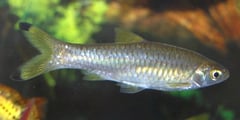
Rasbora rasboraGangetic Scissortail Rasbora
Cyprinidae · authority not recorded
The Gangetic scissortail rasbora, Rasbora rasbora, is a cyprinid apparently native to Pakistan, India, Bangladesh, Myanmar and Thailand. Many older records are probably cases of mistaken identity, and recent ones come mostly from the Brahmaputra basin and Myanmar, while records from the Ganges basin are conspicuously absent. The species is rarely seen in the trade and little has been written about its captive care.
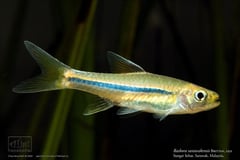
Rasbora sarawakensis
Cyprinidae · authority not recorded
Rasbora sarawakensis is a small rasbora endemic to Borneo, found in Sarawak and the neighbouring Indonesian province of West Kalimantan. It mostly inhabits slow-moving forest streams with thick marginal vegetation, where the water is clear but weakly stained by tannins. Poorly documented in the aquarium literature, it is a very peaceful little fish and apparently quite common across its natural range.
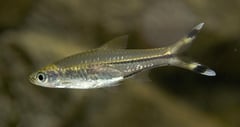
Rasbora trilineataScissortail Rasbora
Cyprinidae · authority not recorded
The scissortail rasbora, Rasbora trilineata, is a cyprinid from the Chao Phraya and lower Mekong basins, Peninsular Malaysia, Sumatra and Borneo. The name comes from the twitching of the caudal fin when the fish is at rest. It is usually sold at a much smaller size than the 15 cm it reaches, so it needs a large tank, and wild fish are increasingly hard to come by as it is produced commercially in several countries.
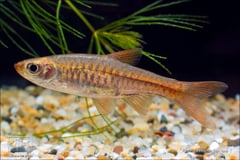
Rasbora vulcanus
Cyprinidae · authority not recorded
Rasbora vulcanus is a small rasbora from West Sumatra, Indonesia, known only from the Batang Si Joontour near the town of Painan. The name refers to the red body colouration of males. It is occasionally sold as R. reticulata or R. cf. reticulata, but the true R. reticulata is a deeper-bodied fish endemic to the island of Nias and lacks the red colouration. Females are pale yellow, and often only the more colourful males are exported.
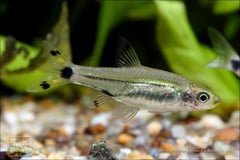
Rasbosoma spilocercaDwarf Scissortail Rasbora
Cyprinidae · authority not recorded
The dwarf scissortail rasbora, Rasbosoma spilocerca, is a small cyprinid from the lower Mekong basin in Laos, Thailand and Cambodia. A miniature look-alike of Rasbora trilineata, it is rarely seen in the hobby, probably because of its plain patterning and rather delicate nature. It inhabits shallow, clear waters with thick submerged vegetation, and its small size and timid behaviour suit it to a tank of other diminutive species.