River
Ampiyacu
Only species with a profile on Seriously Fish are counted.
- Species
- 17
- Families
- 11
- Photographed
- 17 of 17
- Difficulty rated
- 17 of 17
Shares fishes withspecies recorded from both
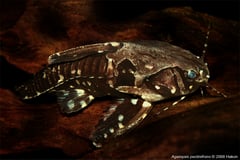
Agamyxis pectinifronsSpotted Talking Catfish
Doradidae · Cope, 1870
The spotted talking catfish, Agamyxis pectinifrons, is a doradid catfish from the Amazon basin in Bolivia, Brazil, Colombia and Peru. Very common in the trade, it is hardy and relatively long-lived, and recommended to beginners and experienced aquarists alike despite its adult size. It closely resembles A. albomaculatus, known only from the Río Orinoco drainage in Venezuela, and the two are probably sold under the same trade names.

Apistogramma cacatuoidesCockatoo Cichlid
Cichlidae · Hoedeman, 1951
The cockatoo cichlid, Apistogramma cacatuoides, is a small cichlid from the upper Amazon basin, from the Ucayali in Peru to the Solimões in Brazil. It lives in slow tributaries, backwaters and creeks where leaf litter collects. Numerous line-bred forms such as 'double red' and 'orange flash' are traded, and captive-raised fish suit a community aquarium, while wild fish are best kept alone or with small dither fishes.

Apistogramma eunotus
Cichlidae · Kullander, 1981
Apistogramma eunotus is a dwarf cichlid from the Río Ucayali in Peru and the Solimões/Amazon in Colombia and Brazil, as far east as the Japurá. Coded A73 under the DATZ system, it has similar-looking, possibly conspecific populations referred to as A74 to A77 depending on locality. It inhabits slow-moving streams, creeks and tributaries, and captive-raised fish are the recommended choice for the community aquarium.
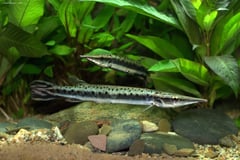
Boulengerella maculata
Ctenoluciidae · Valenciennes, 1850
Boulengerella maculata is a pelagic ctenoluciid found throughout much of the Amazon, Orinoco and Tocantins river systems. Colour pattern varies considerably, with some specimens much paler than others, and this may be correlated with water type. Random dark spots on the upper body, and a dark stripe only behind the eye when one is present, separate it from the similar B. lateristriga. It reaches 329 mm SL and needs an aquarium with base dimensions of 240 by 90 cm or more.
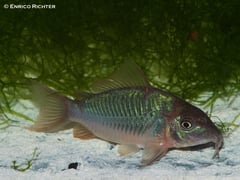
Brochis splendensEmerald 'Brochis'
Callichthyidae · (Castelnau, 1855)
The emerald 'brochis', Brochis splendens, long known as Corydoras splendens, is an armoured catfish recorded throughout much of the Amazon basin in Brazil, Peru, Ecuador and Colombia. It is sometimes called the 'common brochis', and juveniles are sometimes traded as 'hi-fin cory' for their enlarged dorsal fin. Its 10 to 12 dorsal-fin rays separate it from B. britskii and B. multiradiata, the other two species long kept in Brochis, and certain populations are thought likely to represent distinct species.

Colomesus asellusAmazon Puffer
Tetraodontidae · Müller & Troschel, 1849
The Amazon puffer, Colomesus asellus, is a freshwater puffer found throughout much of the Amazon basin, with records north to Guyana and Venezuela. Also traded as the South American puffer or 'SAP', it is told from congeners by a transverse row of dermal flaps across the chin. It lives mostly in well-oxygenated river habitats, is intolerant of organic waste, and forms loose aggregations, so a group of 6 or more is best, away from the general community.
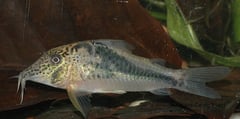
Corydoras fowleriFowler's Cory
Callichthyidae · Böhlke, 1950
Fowler's cory, Corydoras fowleri, is a long-snouted armoured catfish from the Amazon basin in Peru. Also known as the 'huanta cory' and 'milegros cory', it is often confused with C. coriatae and C. semiaquilus, and aquarium fish are regularly misidentified. Most long-snouted cories grow larger and are more aggressive than other Corydoras, and this one is suitable only for larger community aquaria.
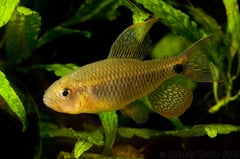
Crenuchus spilurusSailfin Characin
Crenuchidae · Günther, 1863
The sailfin characin, Crenuchus spilurus, is a crenuchid from much of the Amazon and Orinoco drainages and coastal rivers of the Guianas. The only described member of its genus, it varies considerably in colour pattern and morphology across that range. It lives in tea-stained forest streams, and its timid, predominantly benthic nature means it does not always make an ideal community fish. Males guard eggs laid on the roof of a small cave, often formed from leaf litter.
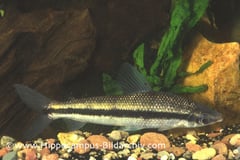
Laemolyta taeniataStriped Headstander
Anostomidae · Kner, 1858
The striped headstander, Laemolyta taeniata, is an anostomid from the central Amazon basin, also recorded from the Orinoco system in Venezuela. The largest-growing member of the genus, to 288 mm SL, it is rarely seen in the aquarium trade. Something of a habitat generalist, it migrates into flooded forest in the wet season and has been seen in large migratory shoals with Leporinus fasciatus and L. agassizii. Water quality is of the utmost importance, and anostomids are prodigious jumpers.
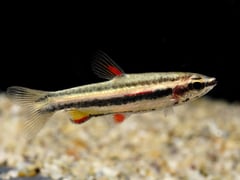
Nannostomus marginatusDwarf Pencilfish
Lebiasinidae · Eigenmann, 1909
The dwarf pencilfish, Nannostomus marginatus, is a lebiasinid of Guyana, Suriname and the middle-to-lower Amazon in Peru, Colombia and Brazil. Enduringly popular, it lacks the red body colour of males of the related N. mortenthaleri and N. rubrocaudatus, showing three dark lateral stripes with no red or purple between them. Colour varies between populations, and its small size and timid nature make it a poor community fish.
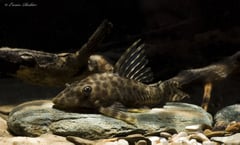
Peckoltichthys bachiL146
Loricariidae · (Boulenger, 1898)
The bola pleco, Peckoltichthys bachi, is a loricariid catfish from the upper Amazon region in Brazil, Colombia, Ecuador and Peru. It has been assigned several L-numbers, including L146 from Colombia and L232 from the Río Putumayo/Içá, and has been exported under other generic names including Hemiancistrus and Sophiancistrus. Its mottled colour pattern separates it from most Peckoltia species, and it lives among submerged grasses and branches in flowing water along the margins of medium to large rivers.

Satanoperca jurupariDemon Eartheater
Cichlidae · Heckel, 1840
The demon eartheater, Satanoperca jurupari, is a cichlid recorded throughout much of the Amazon basin in Brazil, Bolivia, Peru, Ecuador and Colombia. In aquarium literature it is frequently confused with S. leucosticta, which has prominent white spots or vermiform markings on the sides of the head. Its precise identity is a confusing issue, and populations from the Tapajós, Xingu, Araguaia and Paraná are genetically distinct and may represent separate species.

Trochilocharax ornatusHummingbird Tetra
Characidae · Zarske, 2010
The hummingbird tetra, Trochilocharax ornatus, is a tiny characid from Amazonian Peru, reaching only 17 mm. Traded as 'crystal rainbow tetra' and 'orange-tailed glass tetra', it is much sought after. The type series came from an aquarium import out of Iquitos, and sources conflict over whether it comes from the río Ampiyacu or the rio Nanay.
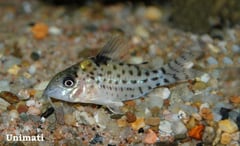
Brochis ambiacus
Callichthyidae · (Cope, 1872)
Brochis ambiacus, long known as Corydoras ambiacus, is an armoured catfish from the upper Amazon tributaries of Peru, Brazil, Colombia and Ecuador, described from the Río Ampiyacu. Its name is commonly misapplied to similar-looking fishes, particularly B. agassizii, and the colour pattern is variable. Cope described a large black spot covering the front half of the dorsal fin, and fish matching this are far more common in the trade than those matching B. agassizii.
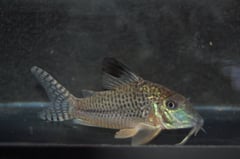
Corydoras acutusBlacktop Cory
Callichthyidae · Cope, 1872
The blacktop cory, Corydoras acutus, is an armoured catfish from the upper Amazon basin in Brazil, Peru, Ecuador and possibly Bolivia. It can be confused with three similar fishes known as C024, C077 and C109. C024 and C109 occur thousands of kilometres outside its range, but C077 lives alongside it in the rio Abunã and is only known to differ in growing smaller. Some specimens lack the dark marking in the dorsal fin.
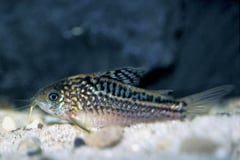
Gastrodermus elegansElegant Cory
Callichthyidae · (Steindachner, 1876)
The elegant cory, Gastrodermus elegans, long known as Corydoras elegans, is an armoured catfish from the western Amazon basin in Peru, Ecuador and Brazil. Unlike most congeners it spends a fair amount of time away from the substrate, often forming groups in midwater. It gives its name to the unofficial 'C. elegans group' of similar species, which includes G. nanus and G. undulatus plus many C- and CW-numbered fishes of uncertain status.
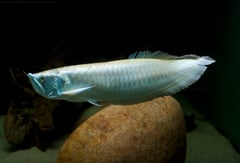
Osteoglossum bicirrhosumSilver Arowana
Osteoglossidae · Cuvier, 1829
The silver arowana, Osteoglossum bicirrhosum, is a large predator from the Amazon basin, plus river systems in Guyana and French Guiana. Reaching 80 cm, it is largely unsuitable for the home aquarium, and although juveniles are readily available, few private aquarists can house an adult long-term. Juveniles have a single dark lateral stripe, while in those of its only congener, O. ferreirai, most of the body and fins are dark.