River
Capim
Only species with a profile on Seriously Fish are counted.
- Species
- 6
- Families
- 5
- Photographed
- 6 of 6
- Difficulty rated
- 6 of 6
Shares fishes withspecies recorded from both
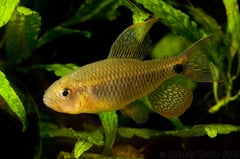
Crenuchus spilurusSailfin Characin
Crenuchidae · Günther, 1863
The sailfin characin, Crenuchus spilurus, is a crenuchid from much of the Amazon and Orinoco drainages and coastal rivers of the Guianas. The only described member of its genus, it varies considerably in colour pattern and morphology across that range. It lives in tea-stained forest streams, and its timid, predominantly benthic nature means it does not always make an ideal community fish. Males guard eggs laid on the roof of a small cave, often formed from leaf litter.
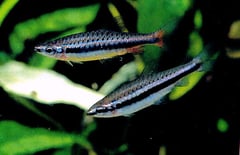
Nannostomus nitidusShining Pencilfish
Lebiasinidae · Weitzman, 1978
The shining pencilfish, Nannostomus nitidus, was described from the Rio Capim, a short river draining into the rio Pará near Belém, Brazil. Poorly known in the hobby, it is rarely traded in numbers and is more often seen as bycatch. Males have a brightly coloured stripe above the primary dark lateral stripe, and some captive-raised fry lacking an adipose-fin have raised questions about the validity of the similar N. limatus.
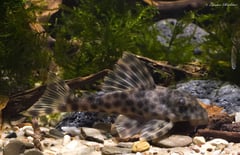
Peckoltia oligospilaL006
Loricariidae · Günther, 1864
The brown dot peckoltia (Peckoltia oligospila), also known as L006, is a suckermouth catfish from the rios Tocantins and Capim in Brazil. Only faint spots and saddles mark its body, a pattern it shares among congeners with P. bachi and some specimens of P. furcata alone. Relatively peaceful but territorial with conspecifics, it is a cave-spawner and does best in a tank designed to simulate a flowing stream.

Retroculus lapidifer
Cichlidae · Castelnau, 1855
Retroculus lapidifer is a rheophilic cichlid from the rio Tocantins and Araguaia systems and nearby coastal drainages of northeastern Brazil. It lives in rapids and fast-flowing stretches of clear water rivers, and needs a set-up designed to resemble a flowing river, with a base of at least 210 by 60 cm and water of 26 to 32 °C. A biparental substrate-spawner, it has been bred in aquaria and is available in the trade on a sporadic basis.
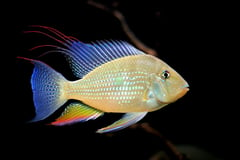
Acarichthys heckeliiThreadfin Acara
Cichlidae · Müller & Troschel, 1849
The threadfin acara, Acarichthys heckelii, is a cichlid from the northern Amazon basin in Colombia, Peru and Brazil and the Essequibo in Guyana. The only member of its genus, it grows to around 200 mm and digs incessantly, and it is susceptible to deteriorating water quality. Some adults show sudden, extreme aggression towards conspecifics that can kill weaker fish, and the problem decreases as tank and group size increase.
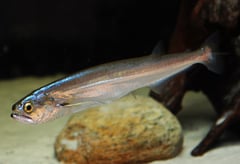
Rhaphiodon vulpinusBiara
Cynodontidae · Spix & Agassiz, 1829
The biara, Rhaphiodon vulpinus, is a dogtooth characin found from the Orinoco and Amazon basins south to the Río de la Plata in Argentina. The only member of its genus, it grows to 600 to 800 mm and is an obligate piscivore, and it is suitable only for public installations or the very largest private aquaria. Juveniles are seen for sale quite regularly, most often without adequate information on their long-term care.