River
Tocantins
Only species with a profile on Seriously Fish are counted.
- Species
- 46
- Families
- 18
- Photographed
- 45 of 46
- Difficulty rated
- 46 of 46
Shares fishes withspecies recorded from both
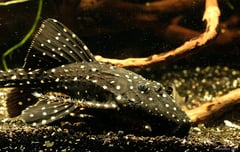
Acanthicus adonisPolka Dot Lyre Tail Pleco
Loricariidae · Isbrücker & Nijssen, 1988
The polka dot lyre tail pleco, Acanthicus adonis, is a very large loricariid catfish from the rio Tocantins in Brazil. Thought to range across much of the Amazon basin, it is traded as spotted juveniles in quite large numbers despite its patent unsuitability for aquaria. It reaches 600 mm or more, loses its spotted patterning as it matures and becomes increasingly belligerent with age, so it can only be recommended to owners of the largest private aquaria or tropical ponds.
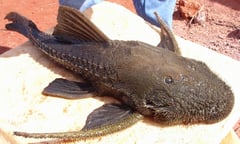
Acanthicus hystrixL155
Loricariidae · Spix & Agassiz, 1829
The lyre tail pleco, Acanthicus hystrix, is a very large loricariid catfish from the Amazon region of Brazil and Peru. A handful of records come from the Orinoco in Venezuela. Juveniles are traded in quite large numbers, but it can reach at least 1000 mm in nature and 500 to 600 mm in captivity, and becomes increasingly belligerent with age. Young fish are easily told from A. adonis by lacking its white to yellowish body spots.
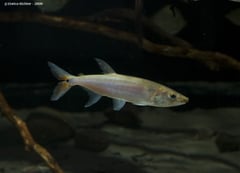
Acestrorhynchus falcatusRed-Tailed Freshwater Barracuda
Acestrorhynchidae · (Bloch, 1794)
The red-tailed freshwater barracuda, Acestrorhynchus falcatus, is a predatory acestrorhynchid from the northern Amazon and Orinoco basins. It also occurs in coastal rivers of Guyana, Suriname and French Guiana. Its large humeral spot, shaped like an inverted tear drop, separates it from other Acestrorhynchus. Reaching 250 to 275 mm, it needs plenty of open water, and a group must be of comparable size because acestrorhynchids are cannibalistic.
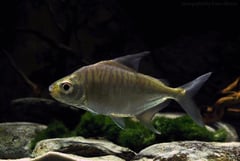
Acnodon normaniSheep Pacu
Serrasalmidae · Gosline, 1951
The sheep pacu, Acnodon normani, is a serrasalmid from Brazil, possibly restricted to the Xingu and Tocantins watersheds of the Amazon basin. Also known in the trade as 'tiger pacu', it is often said to be a frugivore or herbivore, but aquarium observations suggest it also feeds on the scales of other fishes. That makes it unsuitable for the community aquarium, although it does not seem to target much smaller species.
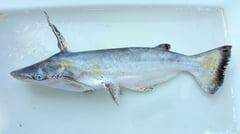
Ageneiosus inermisManduba
Auchenipteridae · (Linnaeus, 1766)
The manduba, Ageneiosus inermis, is a large auchenipterid catfish found throughout much of South America east of the Andes. At around 470 mm SL it would need an aquarium in excess of 400 x 120 cm as an adult and is largely unsuitable for private aquaria. An obligate carnivore, it can take surprisingly large prey, and the larger Ageneiosus species are often used as food fishes in their native countries.
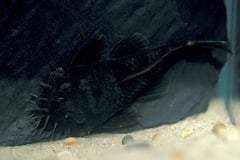
Ancistrus ranunculusL034
Loricariidae · Muller, Rapp Py-Daniel & Zuanon, 1994
Ancistrus ranunculus, the medusa pleco (L034), is a wide-headed, flattened suckermouth catfish from the rio Xingu and rio Tocantins basins in Brazil. It lives among rocks in shallow, fast-flowing water, needs well-oxygenated water with plenty of movement and a protein-rich diet, and is often in poor condition after import. Juveniles carry light spots like the similarly shaped L255, but in A. ranunculus these fade as the fish matures.

Astronotus ocellatusOscar
Cichlidae · (Agassiz, 1831)
The oscar, Astronotus ocellatus, is a large cichlid widely distributed in the Amazon region, recorded from Colombia and Venezuela south to Argentina. It grows to 350 mm SL and typically lives 10 to 20 years, both of which need taking into account before purchase. Most fish on sale come from commercial breeders in Eastern Europe or the Far East, in numerous ornamental strains, and genetic analyses suggest the genus contains additional, morphologically cryptic species.

Astyanax bimaculatusTwo Spot Astyanax
Characidae · (Linnaeus, 1758)
The two spot astyanax, Astyanax bimaculatus, is a characid ranging from Panama through most of the Amazon and Orinoco basins. It lives in a wide variety of biotopes, from swiftly-flowing rivers and streams to ponds, ditches and reservoirs. The name is currently applied to what is considered a species complex of at least four taxa, and aquarium fish most often arrive as contaminants among shipments of other species.
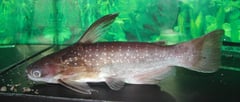
Auchenipterichthys coracoideusMidnight Catfish
Auchenipteridae · (Eigenmann & Allen, 1942)
The midnight catfish, Auchenipterichthys coracoideus, is an auchenipterid catfish from the Peruvian and Brazilian Amazon and the Essequibo drainage. Also known as the 'Zamora woodcat', it has often been misidentified as A. thoracatus, and the two differ principally in anal-fin ray count. By day it shelters among submerged roots, tree stumps or vegetation in turbid rivers and flooded areas, emerging to feed in open water at night.
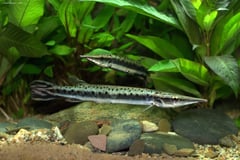
Boulengerella maculata
Ctenoluciidae · (Valenciennes, 1850)
Boulengerella maculata is a pelagic ctenoluciid found throughout much of the Amazon, Orinoco and Tocantins river systems. Colour pattern varies considerably, with some specimens much paler than others, and this may be correlated with water type. Random dark spots on the upper body, and a dark stripe only behind the eye when one is present, separate it from the similar B. lateristriga. It reaches 329 mm SL and needs an aquarium with base dimensions of 240 by 90 cm or more.
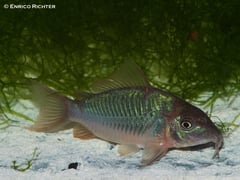
Brochis splendensEmerald 'Brochis'
Callichthyidae · (Castelnau, 1855)
The emerald 'brochis', Brochis splendens, long known as Corydoras splendens, is an armoured catfish recorded throughout much of the Amazon basin in Brazil, Peru, Ecuador and Colombia. It is sometimes called the 'common brochis', and juveniles are sometimes traded as 'hi-fin cory' for their enlarged dorsal fin. Its 10 to 12 dorsal-fin rays separate it from B. britskii and B. multiradiata, the other two species long kept in Brochis, and certain populations are thought likely to represent distinct species.
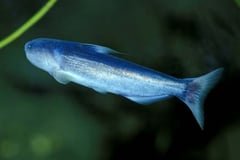
Cetopsis coecutiensBlue Whale Catfish
Cetopsidae · authority not recorded
The blue whale catfish, Cetopsis coecutiens, is a cetopsid catfish from the Amazon, Tocantins and Orinoco river basins. In the wild it swims in voracious feeding groups, homing in on weakened fish by smell and burrowing into prey. It will bite chunks out of tankmates much bigger than itself, so it is best kept alone, and at up to 26.5 cm it needs a large tank with strong water flow and dim lighting.

Colomesus asellusAmazon Puffer
Tetraodontidae · (Müller & Troschel, 1849)
The Amazon puffer, Colomesus asellus, is a freshwater puffer found throughout much of the Amazon basin, with records north to Guyana and Venezuela. Also traded as the South American puffer or 'SAP', it is told from congeners by a transverse row of dermal flaps across the chin. It lives mostly in well-oxygenated river habitats, is intolerant of organic waste, and forms loose aggregations, so a group of 6 or more is best, away from the general community.
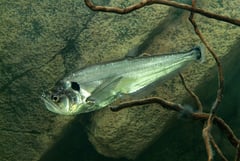
Cynodon gibbus
Cynodontidae · (Agassiz, 1829)
Cynodon gibbus is a cynodontid from much of the Amazon basin, the middle and lower Orinoco, and the Rupununi River in Guyana. A pelagic fish of main river channels and larger tributaries, it grows to around 280 mm SL. It is rare in the trade but arguably more suitable for the home aquarium than some of its better-known relatives, given its size and relatively docile behaviour. Being easily dominated, it is best kept alone or with similarly sized, non-aggressive fishes.
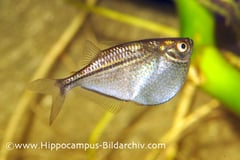
Gasteropelecus levisSilver Hatchetfish
Gasteropelecidae · (Eigenmann, 1909)
The silver hatchetfish (Gasteropelecus levis) is a freshwater hatchetfish found only in the lower Amazon basin in the state of Pará, Brazil. It spends almost all of its time at or just below the surface, and can leap from the water and glide for several metres to catch flying insects or escape predators. It lives in open water of larger igarapés, streams and floodplain lakes.

Geophagus neambi
Cichlidae · Lucinda, Lucena & Assis, 2010
Geophagus neambi is a cichlid from the mid-to-upper rio Tocantins in Brazil, to which it may be endemic. It was in the hobby several years before it was described, traded as G. sp. aff. altifrons 'Tocantins', G. sp. 'Tocantins' or G. sp. 'rio Areoes', and aquarium fish are apparently collected in the rio Das Mortes basin. The 8-9 flank bars are normally visible only when the fish are stressed or spawning.
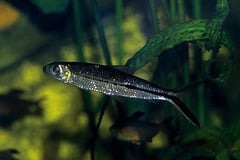
Hemiodus ternetzi
Hemiodontidae · authority not recorded
Hemiodus ternetzi is a shoaling hemiodontid characin known only from the Rio Tocantins basin in Brazil. It can be identified by its black lateral stripe, which extends to behind the eye, and a dorsal fin with no pigmentation. Like other Hemiodus it can be skittish when first introduced but usually settles, especially in a large group.
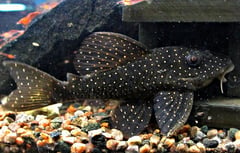
Hypancistrus sp.L004
Loricariidae · authority not recorded
L004, the angelicus pleco, is an undescribed Hypancistrus from tributaries of the lower Amazon near its mouth in Pará state, northern Brazil. It is sometimes traded under the false name 'Peckoltia angelicus', and the codes L004, L005, L028 and L073 represent distinct populations from the Tocantins, Guamá and Pará rivers. Peaceful but territorial towards its own kind, it has been bred in aquaria many times.

Hyphessobrycon amandaeEmber Tetra
Characidae · Géry & Uj, 1987
The ember tetra, Hyphessobrycon amandae, is a tiny characid from the rio das Mortes, a tributary of the Araguaia in Mato Grosso, Brazil. Also traded as the 'Amanda's', 'dwarf red', 'red' and 'fire' tetra, it grows to around 20 mm SL. Very peaceful and gregarious, it makes a good dither fish for Apistogramma and other dwarf cichlids and spawns often in a mature aquarium.

Hyphessobrycon heterorhabdusFlag Tetra
Characidae · (Ulrey, 1894)
The flag tetra, Hyphessobrycon heterorhabdus, is a characid from Pará and Maranhão states in eastern Brazil, also known as 'Belgian flag tetra'. Its name has been misapplied to similar fishes across much of the Amazon, the Orinoco and the Guianas, and the true species may reach no further upstream than the rio Tapajós. It lives almost exclusively in small, shaded forest streams called igarapés.

Hyphessobrycon stegemanniSavanna Tetra
Characidae · Géry, 1961
The savanna tetra, Hyphessobrycon stegemanni, is a characid from the middle rio Tocantins and rio Araguaia basins in central Brazil. In the hobby its name has often been misapplied to Hemigrammus ataktos, since both occur in the Tocantins and have a dark lateral stripe. Its range lies almost entirely in the cerrado, the tropical wooded grassland of central Brazil.

Iguanodectes spilurusGreen Line Lizard Tetra
Iguanodectidae · (Günther, 1864)
The green line lizard tetra, Iguanodectes spilurus, is a characin found throughout the Amazon, Orinoco, Essequibo and Tocantins river systems. The most widespread Iguanodectes species, it has also been called the 'slender', 'spindle' or 'iguana' tetra, and differs from its congeners in its translucent dorsal and anal fins, lack of a red lateral stripe and prominent dark caudal-fin marking. It is sensitive to poor water conditions.
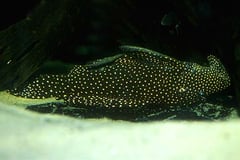
Leporacanthicus galaxiasGalaxy Plec
Loricariidae · authority not recorded
The galaxy plec, Leporacanthicus galaxias (L029), is a suckermouth catfish from the Amazon, Tocantins and other river basins in Brazil. Also sold as the vampire or tusken plec, it lives in rapids and other fast-flowing waters. Four similar undescribed variants, L007, L240, L241 and L294, are known as L. cf. galaxias and are best referred to by their L numbers.

Megalamphodus haraldschultziCrystal Red Tetra
Characidae · (Travassos, 1960)
The crystal red tetra, Megalamphodus haraldschultzi, is a small characid endemic to the rio Araguaia system in Brazil. It is occasionally available, usually as bycatch among shipments of other fishes, and is sometimes traded as 'Araguaia red' or 'Schultz's tetra'. It is most easily separated from the similar Megalamphodus eques by the dorsal-fin marking, which is less extensive and bordered above by a white blotch and below by a yellowish band.
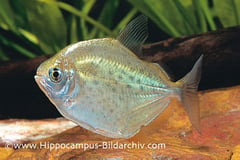
Metynnis lippincottianus
Serrasalmidae · (Cope, 1870)
Metynnis lippincottianus is a spotted silver dollar from Brazil and French Guiana, found in the lower and middle Amazon and the Oyapock system. It is occasionally seen for sale, sometimes as 'silver dollar', and its spotted pattern tells it apart from M. argenteus and M. hypsauchen. The spots are less pronounced than in M. maculatus, with which it shares a common name. The precise extent of its range is unclear.
Peckoltia oligospilaL006
Loricariidae · (Günther, 1864)
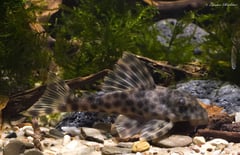
The brown dot peckoltia (Peckoltia oligospila), also known as L006, is a suckermouth catfish from the rios Tocantins and Capim in Brazil. Only faint spots and saddles mark its body, a pattern it shares among congeners with P. bachi and some specimens of P. furcata alone. Relatively peaceful but territorial with conspecifics, it is a cave-spawner and does best in a tank designed to simulate a flowing stream.
Peckoltia sp.L038
Loricariidae · authority not recorded
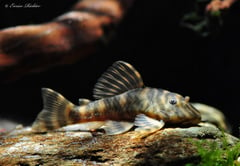
L038 is an unidentified Peckoltia, a suckermouth catfish collected near Mocajuba on the lower rio Tocantins in Pará state, Brazil. It is relatively peaceful but territorial with conspecifics and similarly-shaped species, and spawns in caves with the male responsible for brood care.
Potamotrygon scobinaMosaic Stingray
Potamotrygonidae · authority not recorded
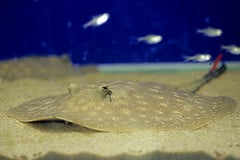
The mosaic stingray, Potamotrygon scobina, is a freshwater stingray found only in the middle and lower Amazon drainage in Brazil. Most captive fish stay below 35 cm across the disc, and it is usually recommended as a good beginners' ray. Other rays, almost always Peruvian, are often mislabelled as scobina. Apparently only the real P. scobina has five rows of spines on the tail.

Retroculus lapidifer
Cichlidae · (Castelnau, 1855)
Retroculus lapidifer is a rheophilic cichlid from the rio Tocantins and Araguaia systems and nearby coastal drainages of northeastern Brazil. It lives in rapids and fast-flowing stretches of clear water rivers, and needs a set-up designed to resemble a flowing river, with a base of at least 210 by 60 cm and water of 26 to 32 °C. A biparental substrate-spawner, it has been bred in aquaria and is available in the trade on a sporadic basis.

Satanoperca jurupariDemon Eartheater
Cichlidae · (Heckel, 1840)
The demon eartheater, Satanoperca jurupari, is a cichlid recorded throughout much of the Amazon basin in Brazil, Bolivia, Peru, Ecuador and Colombia. In aquarium literature it is frequently confused with S. leucosticta, which has prominent white spots or vermiform markings on the sides of the head. Its precise identity is a confusing issue, and populations from the Tapajós, Xingu, Araguaia and Paraná are genetically distinct and may represent separate species.
Thoracocharax stellatusSpotfin Hatchetfish
Gasteropelecidae · (Kner, 1858)
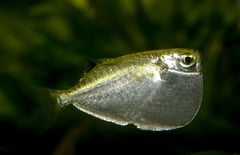
The spotfin hatchetfish, Thoracocharax stellatus, is the most widespread neotropical hatchetfish, recorded from much of South America. It is told from its only congener, T. securis, by a prominent dark spot in the dorsal fin, and is sometimes traded as 'platinum hatchetfish'. It feeds almost entirely on insects, and a tightly fitting cover is needed because it can clear several metres in one jump.

Wallaciia compressicepsCompressiceps Dwarf Pike Cichlid
Cichlidae · (Ploeg, 1986)
The compressiceps dwarf pike cichlid, Wallaciia compressiceps, is a small pike cichlid known only from the lower Rio Tocantins basin in Brazil. It swims a great deal and can be very quick and very aggressive, so it needs a larger aquarium than its size suggests, and anything half its size will be seen as food. A number of hobbyists have found it very difficult to spawn without target fish in the aquarium.
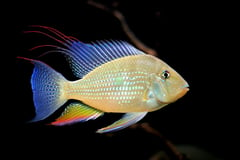
Acarichthys heckeliiThreadfin Acara
Cichlidae · (Müller & Troschel, 1849)
The threadfin acara, Acarichthys heckelii, is a cichlid from the northern Amazon basin in Colombia, Peru and Brazil and the Essequibo in Guyana. The only member of its genus, it grows to around 200 mm and digs incessantly, and it is susceptible to deteriorating water quality. Some adults show sudden, extreme aggression towards conspecifics that can kill weaker fish, and the problem decreases as tank and group size increase.

Aequidens tetramerusSaddle Cichlid
Cichlidae · (Heckel, 1840)
The saddle cichlid, Aequidens tetramerus, is a cichlid found across much of northern South America, from the Amazon and Orinoco basins to the Guianas. The type species of its genus, it occurs in several colour forms, and fish from Ecuador and Peru are sought after for the red or orange colouration on the lower head and belly. As currently recognised it is likely to represent a group of related fishes, some of which may be described as distinct species.
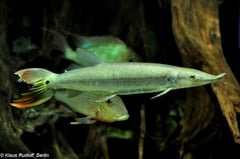
Boulengerella cuvieri
Ctenoluciidae · (Spix & Agassiz, 1829)
Boulengerella cuvieri is a pelagic ctenoluciid characin from much of the Amazon basin, the Río Orinoco and coastal drainages of the Guianas. The largest officially recorded specimen measured 675 mm, but it appears to grow larger, possibly beyond 800 mm. Given that size and its natural behaviour it is largely unsuitable for the home aquarium. Its entire dorsal-fin base lies ahead of the anal-fin origin, a character shared only with B. lucius and B. xyrekes among ctenoluciids.
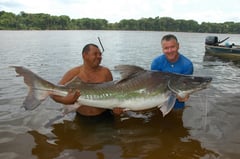
Brachyplatystoma filamentosumPiraíba
Pimelodidae · (Lichtenstein, 1819)
The piraíba, Brachyplatystoma filamentosum, is the largest catfish of the Amazon basin, also found in the Orinoco and river systems of the Guianas. Adults typically measure 2 to 2.5 m and weigh over 150 kg. In the Amazon only fish over around 160 cm are called 'Piraíba', and smaller ones 'filhote'. It is suitable only for public aquaria and a very small minority of private aquarists.

Laetacara araguaiae
Cichlidae · Ottoni & Costa, 2009
Laetacara araguaiae is a small cichlid from Brazil, known from the rios Tapajós, Xingu and Tocantins, right-bank tributaries of the lower Amazon. Known in the hobby as L. sp. 'Buckelkopf' before it was described, it grows to around 35 mm SL and is a biparental substrate-spawner. Some populations differ from one another in colour pattern, and 7-8 dorsal-fin rays separate it from all congeners.
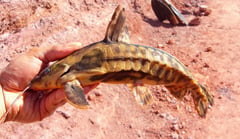
Megalodoras uranoscopusGiant Raphael Catfish
Doradidae · authority not recorded
The giant Raphael catfish, Megalodoras uranoscopus, is a large doradid recorded from the Essequibo, Tocantins and Amazon river systems. It is also known in the US as the 'ripsaw catfish', and older literature often refers to it as M. irwini, now a junior synonym. Growing to 600 to 700 mm, it is very peaceful and can be combined with many other species in suitably sized systems.
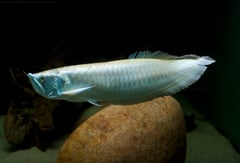
Osteoglossum bicirrhosumSilver Arowana
Osteoglossidae · (Cuvier, 1829)
The silver arowana, Osteoglossum bicirrhosum, is a large predator from the Amazon basin, plus river systems in Guyana and French Guiana. Reaching 80 cm, it is largely unsuitable for the home aquarium, and although juveniles are readily available, few private aquarists can house an adult long-term. Juveniles have a single dark lateral stripe, while in those of its only congener, O. ferreirai, most of the body and fins are dark.
Potamotrygon henleiBlack Stingray
Potamotrygonidae · authority not recorded
The black stingray (P12), Potamotrygon henlei, is a freshwater stingray probably endemic to the Rio Tocantins basin in Brazil. It reaches 60 cm across the disc and occurs in several colour forms, with white or yellow spots on a black to dark brown background. It is often confused with P. leopoldi and P14, and is told apart by spots on the underside of the disc, although some P. leopoldi have shown this patterning too.
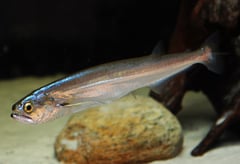
Rhaphiodon vulpinusBiara
Cynodontidae · Spix & Agassiz, 1829
The biara, Rhaphiodon vulpinus, is a dogtooth characin found from the Orinoco and Amazon basins south to the Río de la Plata in Argentina. The only member of its genus, it grows to 600 to 800 mm and is an obligate piscivore, and it is suitable only for public installations or the very largest private aquaria. Juveniles are seen for sale quite regularly, most often without adequate information on their long-term care.
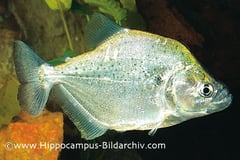
Serrasalmus geryiGéry's Pirambeba
Serrasalmidae · authority not recorded
Géry's pirambeba, Serrasalmus geryi, is a piranha from the Rio Araguaia and Rio Tocantins drainages in Brazil. Sometimes sold as the 'violet-line piranha', it is one of the easiest Serrasalmus to identify because the purple stripe from the lower jaw over the top of the body is unique to it. S. compressus has been sold as S. geryi, and reports of it living in groups are considered tenuous, so it is kept as a specimen fish.

Symphysodon aequifasciatusDiscus
Cichlidae · Pellegrin, 1904
The discus, Symphysodon aequifasciatus, is a cichlid from the Amazon in Colombia, Peru and Brazil. It ranges down the Rio Solimões and the main Amazon from the Rio Putumayo to the Tocantins drainage, keeping to slow-moving tributaries and forest pools where it schools in deep, sheltered water around tree roots and rocks. Wild fish reach around 14 cm, and discus are very shy, skittish fish that need plenty of cover.

Thayeria obliquaPenguin Tetra
Characidae · authority not recorded
The penguin tetra, Thayeria obliqua, is a characin from the central Amazon and Rio Tocantins basins and the Rio Guaporé in Brazil. The type species of the genus, it was the original penguin tetra, though T. boehlkei is now usually sold under that name. In T. obliqua the black caudal stripe tapers upwards and fades before reaching the dorsal fin. It should be kept in a group of at least six.
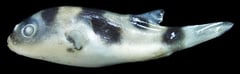
Colomesus tocantinensis
Tetraodontidae · Amaral, Brito, Silva & Carvalho, 2013
Colomesus tocantinensis is a small freshwater pufferfish from Brazil, known only from the Tocantins River near Porto Nacional in Tocantins state. The type series measured up to 34.9 mm, though it should grow larger. It is distinguished from C. asellus and C. psittacus by fewer anal and dorsal-fin rays, a ventrally notched opercle, no dermal flaps on the chin, and a pale yellow back with five dark bands.

Retroculus acherontos
Cichlidae · Landin, Mareira & Figueiredo, 2015
Retroculus acherontos is a cichlid known only from tributaries of the upper rio Tocantins basin in Goiás state, Brazil. It grows to at least 194 mm and differs from its congeners in developing a nuchal hump in both sexes above about 121 mm SL. Based on its morphology it is hypothesised to be less rheophilic than other Retroculus, and it has been collected in small to medium-sized tributaries with clear or sediment-filled water.