River
Dibru
Only species with a profile on Seriously Fish are counted.
- Species
- 6
- Families
- 3
- Photographed
- 6 of 6
- Difficulty rated
- 6 of 6
Shares fishes withspecies recorded from both
Runs through

Badis assamensis
Badidae · Ahl, 1937
Badis assamensis is a badid from the Brahmaputra River basin in Assam state, northeast India, and the largest species in its genus. Like most badids it is poorly documented. Its body patterning is almost identical to that of B. blosyrus, but it grows slightly larger, to 65 to 75 mm, and has a noticeably shorter jaw profile. The neotype was collected from a slow-moving forest stream in the Dibru River drainage, and it is a slow-moving, retiring fish that more boisterous tankmates can outcompete for food.

Badis badisBadis
Badidae · (Hamilton, 1822)
The badis, Badis badis, is a small badid from the Ganges river system in India, Nepal and Bangladesh, with further records in Assam and the Mahanadi. Sometimes sold as the 'chameleon fish' for its ability to change colour rapidly, especially when breeding or stressed, it was one of only two badids popular in the hobby before 2002. Several congeners share its dark cleithral spot and can be hard to tell apart. It is sluggish and retiring, and rival males can be quite aggressive towards one another in confined spaces.

Chela cachiusNeon Hatchet Fish
Cyprinidae · (Hamilton, 1822)
The neon hatchet fish, Chela cachius, is a deep-bodied cyprinid mostly recorded from the Ganges and Brahmaputra systems of India and Bangladesh. Its extremely deep body means it is unlikely to be confused with any related species, and it is the only valid member of the genus. A habitat generalist, it is an active schooling fish that is best kept in a group of at least 8-10 in a tank with a tightly-fitting cover, since it is an accomplished jumper.
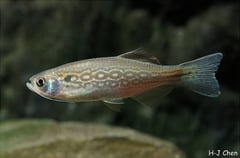
Danio dangilaMoustached Danio
Cyprinidae · (Hamilton, 1822)
The moustached danio, Danio dangila, is a cyprinid from the Ganges and Brahmaputra drainages, with most records from Nepal, India and Bangladesh. The common name refers to its exceptionally long barbels, and despite its apparent abundance in nature it remains uncommon in the hobby. Its constant activity can upset slow-moving or timid tankmates, so it suits larger tanks with similarly-sized fishes, and adult size appears to vary by population from 60 to 130 mm.
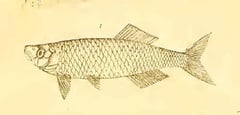
Devario aequipinnatus
Cyprinidae · (McClelland, 1839)
Devario aequipinnatus is a striped devario from hill streams in northeastern India, Bangladesh and Nepal. It is recognised by three straight dark stripes along each side, of which the middle one is widest. The name was long applied to almost any striped Devario, including the commercially bred giant danio, which is covered here under D. malabaricus.

Notopterus notopterusBronze Featherback
Notopteridae · (Pallas, 1769)
The bronze featherback, Notopterus notopterus, is an air-breathing notopterid from the Indian subcontinent and Southeast Asia. Also called 'Asian knifefish' or 'ghost knifefish' in the trade, it grows to 600 mm and arguably has no place in the ornamental hobby given its adult size and specialised requirements. The single species in Notopterus is likely to represent a complex of closely-related species.