River
Yamuna
Only species with a profile on Seriously Fish are counted.
- Species
- 7
- Families
- 4
- Photographed
- 7 of 7
- Difficulty rated
- 7 of 7
Basin
Also in the Ganges basinspecies recorded from both
Shares fishes with rivers elsewherespecies recorded from both
Runs through

Badis badisBadis
Badidae · Hamilton, 1822
The badis, Badis badis, is a small badid from the Ganges river system in India, Nepal and Bangladesh, with further records in Assam and the Mahanadi. Sometimes sold as the 'chameleon fish' for its ability to change colour rapidly, especially when breeding or stressed, it was one of only two badids popular in the hobby before 2002. Several congeners share its dark cleithral spot and can be hard to tell apart. It is sluggish and retiring, and rival males can be quite aggressive towards one another in confined spaces.

Barilius vagra
Cyprinidae · Hamilton, 1822
Barilius vagra is a cyprinid widely distributed in the Ganges and Brahmaputra river systems of northern India, Nepal and Bangladesh. Poorly known in the hobby but exported on occasion, it has 10 to 14 vertical bars on each flank that do not extend below the lateral line. It inhabits well-oxygenated, fast-flowing rivers and tributaries with gravel, cobble and boulder substrates, and its speed and vigorous feeding make it unsuitable for the general community.
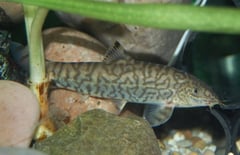
Botia almorhaeYo-Yo Loach
Botiidae · Gray, 1831
The yo-yo loach, Botia almorhae, is a botiid loach from parts of the Ganges River drainage in northern India and possibly Nepal. It is often called the 'Pakistani' loach, but that name is a misnomer. B. almorhae sensu stricto appears to belong to a group of closely-related species and has possibly never been seen in the aquarium trade, where the most commonly available members seem to be B. lohachata, B. sp. 'Kosi' and B. sp. 'Teesta', plus assorted hybrids.

Chagunius chagunio
Cyprinidae · Hamilton, 1822
Chagunius chagunio is a large cyprinid endemic to the Ganges and Brahmaputra river basins in northern India, Nepal and Bangladesh. Growing to 400-450 mm, it can only be considered suitable for public aquaria and a very small minority of private aquarists. Rarely seen in the trade, it looks almost identical to C. baileyi and C. nicholsi but has more circumferential and circumpeduncular scales.

Opsarius barna
Cyprinidae · Hamilton, 1822
Traded as 'striped hill trout' or 'banded hill trout', Opsarius barna is a cyprinid from the Ganges and Brahmaputra basins in northern India. It is thought to also occur in the Mahanadi and in river systems in Nepal, Bhutan, Bangladesh and Rakhine State, Myanmar, in well-oxygenated, fast-flowing rivers over gravel, cobbles and boulders. An extremely fast swimmer and vigorous feeder, it is unsuitable for the general community.

'Puntius' guganioGlass Barb
Cyprinidae · Hamilton, 1822
The glass barb, Puntius guganio, is a small cyprinid widespread in the Ganges and Brahmaputra river systems of Bangladesh, Nepal and northern India. It lives in slow-moving or standing waters such as pools, ditches and minor rivers. Poorly known in the hobby, it is of uncertain taxonomic placement, and its stiff, serrated last dorsal-fin ray, incomplete lateral line and 36-39 lateral scales are shared only with 'P.' nangalensis.

Notopterus notopterusBronze Featherback
Notopteridae · Pallas, 1769
The bronze featherback, Notopterus notopterus, is an air-breathing notopterid from the Indian subcontinent and Southeast Asia. Also called 'Asian knifefish' or 'ghost knifefish' in the trade, it grows to 600 mm and arguably has no place in the ornamental hobby given its adult size and specialised requirements. The single species in Notopterus is likely to represent a complex of closely-related species.