River
Guaporé
Only species with a profile on Seriously Fish are counted.
- Species
- 28
- Families
- 11
- Photographed
- 28 of 28
- Difficulty rated
- 28 of 28
Shares fishes withspecies recorded from both
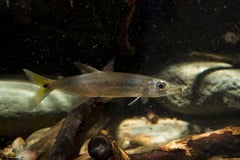
Acestrorhynchus microlepisPike Tetra
Acestrorhynchidae · Jardine, 1841
The pike tetra, Acestrorhynchus microlepis, is a predatory acestrorhynchid from northern Amazon drainages and the Orinoco. It also occurs in coastal rivers of Guyana, Suriname and French Guiana. A member of the A. microlepis group, it has a small blackish spot behind the gill cover and is separable from the very similar A. grandoculis only by counts. It tends to take smaller prey such as tetras, and acestrorhynchids are cannibalistic, so a group must be of comparable size.

Apistogramma commbraeA93
Cichlidae · Regan, 1906
The Corumbá dwarf cichlid, Apistogramma commbrae, is widespread in the Paraguay River watershed of Argentina, Bolivia, Brazil and Paraguay. One of the smallest members of the genus, it is told apart with the rest of the A. commbrae complex by a conspicuous double caudal peduncle spot. Its habitats cool seasonally to as low as 16 °C, and it should be kept cooler over winter.

Apistogramma trifasciataThree-striped Apisto
Cichlidae · Eigenmann & Kennedy, 1903
The three-striped apisto, Apistogramma trifasciata, is a dwarf cichlid from the Guaporé, Paraguay and middle Paraná basins. Found in Brazil, Paraguay and Argentina, it lives in sluggish creeks, tributaries and smaller rivers where leaf litter collects. A narrow third stripe from the pectoral-fin insertion to the anal fin helps separate it from congeners. The DATZ code is A204, with possibly conspecific forms from Argentina and the rio Guaporé coded A205 and A206.

Biotodoma cupidoCupid Cichlid
Cichlidae · Heckel, 1840
The cupid cichlid, Biotodoma cupido, is a geophagine cichlid from much of the Amazon basin, north to the Essequibo in Guyana and south to Bolivia. Also traded as the 'green-streaked eartheater', it varies in colour pattern and shape by locality, and most traded fish come from around Santarém in Pará state. Unless breeding it is surprisingly peaceful. Its relatively compact body and a dark flank blotch above the upper lateral line separate it from B. wavrini.
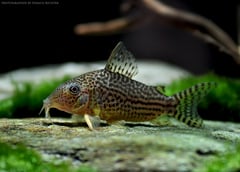
Brochis haraldschultziMosaic Cory
Callichthyidae · (Knaack, 1962)
The mosaic cory, Brochis haraldschultzi, long known as Corydoras haraldschultzi, is an armoured catfish endemic to the rio Guaporé (Río Iténez) in northeastern Bolivia and western Brazil. It resembles Hoplisoma sterbai but has a more extended snout and grows larger, to 85 mm SL. Its head carries dark vermiculations and spots on a light background, where H. sterbai has light markings on dark. The type locality was once modified to the rio Tocantins, well over 1000 km away, but the original Guaporé locality appears to be correct.

Colomesus asellusAmazon Puffer
Tetraodontidae · Müller & Troschel, 1849
The Amazon puffer, Colomesus asellus, is a freshwater puffer found throughout much of the Amazon basin, with records north to Guyana and Venezuela. Also traded as the South American puffer or 'SAP', it is told from congeners by a transverse row of dermal flaps across the chin. It lives mostly in well-oxygenated river habitats, is intolerant of organic waste, and forms loose aggregations, so a group of 6 or more is best, away from the general community.
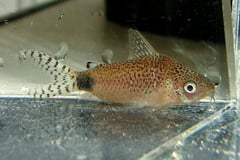
Gastrodermus guaporeGuaporé Cory
Callichthyidae · (Knaack, 1961)
The Guaporé cory, Gastrodermus guapore, long known as Corydoras guapore, is an armoured catfish endemic to the rio Guaporé (Río Iténez) in northeastern Bolivia and western Brazil. Unlike most congeners it forms aggregations in midwater and spends much of its time away from the substrate, with a large eye, a more terminal mouth and a strongly forked caudal fin to match. It partly feeds on pelagic zooplankton, so live Daphnia and Artemia belong in its diet. Similar species such as Hoplisoma simile lack these adaptations.
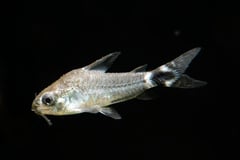
Gastrodermus hastatusTail-spot Pygmy Cory
Callichthyidae · (Eigenmann & Eigenmann, 1888)
The tail-spot pygmy cory, Gastrodermus hastatus, long known as Corydoras hastatus, is a tiny armoured catfish with a wide range across the Amazon and Río Paraguay basins. It is known from Brazil, Bolivia, Paraguay and northeastern Argentina. Unlike most congeners it swims in midwater, forming mixed schools with similarly patterned small characids such as Serrapinnus kriegi. It is frequently confused with G. pygmaeus, but has a dark, roughly diamond-shaped spot on the caudal peduncle where G. pygmaeus has a dark lateral stripe.

Geophagus megasema
Cichlidae · Heckel, 1840
Geophagus megasema is a cichlid from the upper rio Madeira basin, recorded from the Mamoré and Guaporé drainages in Bolivia and Brazil. Very rare in the aquarium hobby, it has been collected, bred and distributed by some private collectors. It has no dark preopercular or infraorbital markings, no bars on the flanks and a relatively large, roundish midlateral marking.
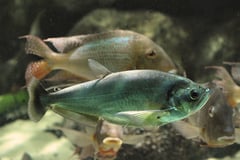
Hydrolycus scomberoidesVampire Tetra
Cynodontidae · Cuvier, 1819
The vampire tetra, Hydrolycus scomberoides, is a predatory dogtooth characin from the central and upper Amazon in Brazil, Bolivia, Peru and Ecuador. Also sold as 'scomb' and 'sabre tooth tetra', it is regularly confused with the much larger payara, H. armatus. At up to 300 mm it still needs a huge tank and specialist care, and newly-imported specimens often refuse anything but live food.

Hyphessobrycon herbertaxelrodiBlack Neon Tetra
Characidae · Géry, 1961
The black neon tetra, Hyphessobrycon herbertaxelrodi, is a characid from the upper rio Paraguai in Mato Grosso and Mato Grosso do Sul, Brazil. A ubiquitous aquarium fish since its discovery, it is produced commercially in several countries, so wild fish are no longer collected. It is widespread north and south of the Pantanal, favouring minor tributaries, headwater rivers, oxbows and seasonal floodplains.

Iguanodectes spilurusGreen Line Lizard Tetra
Iguanodectidae · Günther, 1864
The green line lizard tetra, Iguanodectes spilurus, is a characin found throughout the Amazon, Orinoco, Essequibo and Tocantins river systems. The most widespread Iguanodectes species, it has also been called the 'slender', 'spindle' or 'iguana' tetra, and differs from its congeners in its translucent dorsal and anal fins, lack of a red lateral stripe and prominent dark caudal-fin marking. It is sensitive to poor water conditions.
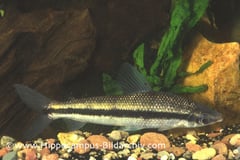
Laemolyta taeniataStriped Headstander
Anostomidae · Kner, 1858
The striped headstander, Laemolyta taeniata, is an anostomid from the central Amazon basin, also recorded from the Orinoco system in Venezuela. The largest-growing member of the genus, to 288 mm SL, it is rarely seen in the aquarium trade. Something of a habitat generalist, it migrates into flooded forest in the wet season and has been seen in large migratory shoals with Leporinus fasciatus and L. agassizii. Water quality is of the utmost importance, and anostomids are prodigious jumpers.
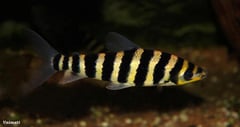
Leporinus fasciatusBanded Leporinus
Anostomidae · Bloch, 1794
The banded leporinus, Leporinus fasciatus, is an anostomid from the Amazon and Orinoco systems and coastal Guyana, Suriname and French Guiana. Young fish are often sold without warning of their size and requirements, and it is fairly ubiquitous in public aquarium displays. It is frequently confused with L. affinis, and its dark body bars multiply with age, from five in young fish to around ten in adults.
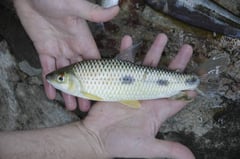
Leporinus fridericiThreespot Leporinus
Anostomidae · Bloch, 1794
The threespot leporinus, Leporinus friderici, is an anostomid from much of the Amazon system, with further records from the Guianas and Trinidad. It grows to 350 to 400 mm and needs an aquarium with base dimensions of at least 240 by 90 cm. Across this enormous range the fish differ in morphology and, especially, colour pattern.

Megalamphodus equesSerpae Tetra
Characidae · (Steindachner, 1882)
The serpae tetra, Megalamphodus eques, is a characid with an enormous range through much of the Amazon drainage and the Río Paraguay. Very common in the trade, it is also sold as the 'jewel', 'red minor', 'blood' or 'callistus' tetra, and ornamental strains include 'long-finned' and 'balloon' forms. It has a reputation for nipping the fins of tankmates, although this is most pronounced when too few are kept or space is limited.

Megalamphodus megalopterusBlack Phantom Tetra
Characidae · (Eigenmann, 1915)
The black phantom tetra, Megalamphodus megalopterus, is a characid from the upper rio Madeira and upper rio Paraguai in Bolivia and Brazil. Most records are from the rio Guaporé (Río Iténez in Bolivia). Popular in the hobby and bred commercially in several countries, it is also available as a 'long-finned' strain. Adult males have black fins with the pelvic, dorsal and anal enlarged, while females are deeper-bodied with reddish pelvic, anal and adipose fins.
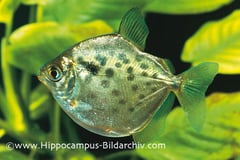
Metynnis maculatusSpotted Metynnis
Serrasalmidae · Kner, 1858
The spotted metynnis, Metynnis maculatus, is a silver dollar probably confined to the upper rio Madeira and upper rio Paraguai in Bolivia and Brazil. It is most often confused with M. argenteus and M. lippincottianus, but it has more midlateral scales and more spines on the ventral keel than either. It schools in nature and needs a very large tank with a group of six or more.

Mikrogeophagus altispinosusBolivian Ram
Cichlidae · Haseman, 1911
The Bolivian ram, Mikrogeophagus altispinosus, is a cichlid endemic to the upper rio Madeira basin in Bolivia and Brazil. Also traded as 'hi-fin ram' and 'Bolivian butterfly', it is larger and less colourful than M. ramirezi and lacks its blue iridescent markings, and it is arguably a better choice for less-experienced aquarists. A soft, sandy substrate is essential, and it needs pristine water quality.
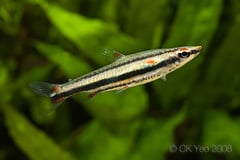
Nannostomus trifasciatusThree-lined Pencilfish
Lebiasinidae · Steindachner, 1876
The three-lined pencilfish, Nannostomus trifasciatus, is a lebiasinid widespread in the western Amazon basin in Brazil, Peru, Colombia and Bolivia. Fairly ubiquitous in the trade, it is less demanding than many congeners and a good choice for a newcomer to pencilfishes. Many fish on sale are farmed, and wild populations vary in colour pattern, one being marketed as 'super red' for its unusually long red stripe.
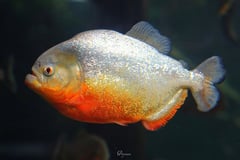
Pygocentrus nattereriRed Bellied Piranha
Serrasalmidae · Kner, 1858
The red bellied piranha, Pygocentrus nattereri, occurs through much of the Amazon basin and south into the Paraná and Uruguay river systems. Famed as a rapacious predator, it is among the most notorious freshwater fishes in the world. According to Herbert Axelrod (1976), the myth began with a feeding frenzy staged for Theodore Roosevelt in Brazil in 1913. Usually only juveniles form aggregations, and the species is relatively easy to breed in the aquarium.

Satanoperca pappaterraPantanal Eartheater
Cichlidae · Heckel, 1840
The Pantanal eartheater, Satanoperca pappaterra, is a cichlid from the rio Guaporé and upper rio Paraguai basins in Brazil, Bolivia and Paraguay. Relatively rare in the ornamental trade and much sought after, it is easily told from all known congeners by a series of prominent black blotches beneath the dorsal-fin and a well-defined dark band along the side of the body. It has been introduced to the upper rio Paraná in southeastern Brazil.
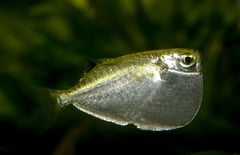
Thoracocharax stellatusSpotfin Hatchetfish
Gasteropelecidae · Kner, 1858
The spotfin hatchetfish, Thoracocharax stellatus, is the most widespread neotropical hatchetfish, recorded from much of South America. It is told from its only congener, T. securis, by a prominent dark spot in the dorsal fin, and is sometimes traded as 'platinum hatchetfish'. It feeds almost entirely on insects, and a tightly fitting cover is needed because it can clear several metres in one jump.

Aequidens tetramerusSaddle Cichlid
Cichlidae · Heckel, 1840
The saddle cichlid, Aequidens tetramerus, is a cichlid found across much of northern South America, from the Amazon and Orinoco basins to the Guianas. The type species of its genus, it occurs in several colour forms, and fish from Ecuador and Peru are sought after for the red or orange colouration on the lower head and belly. As currently recognised it is likely to represent a group of related fishes, some of which may be described as distinct species.
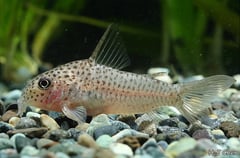
Hoplisoma albolineatumC056
Callichthyidae · (Knaack, 2004)
Hoplisoma albolineatum (C056), long known as Corydoras albolineatus, is an armoured catfish from the Río Iténez, or Guaporé, system in Bolivia and Brazil. It has a wide white longitudinal band and unmarked fins, and may be confused with the deeper-bodied H. xinguense. In the wild it forms aggregations of up to several thousand over sandy substrates and sand banks. It is not common in the hobby but is available occasionally.
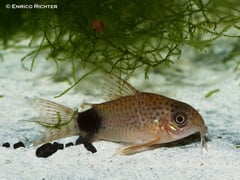
Hoplisoma caudimaculatumTailspot Cory
Callichthyidae · (Rössel, 1961)
The tailspot cory, Hoplisoma caudimaculatum, long known as Corydoras caudimaculatus, is an armoured catfish endemic to the rio Guaporé (Iténez) drainage in western Brazil and Bolivia. A well-defined blackish spot on the caudal peduncle separates it from H. simile, in which the marking is a smudged bluish one. Gastrodermus guapore has a comparable pattern but a distinctly rounded snout, and tends to swim above the substrate.

Laetacara dorsigeraRedbreast Acara
Cichlidae · Heckel, 1840
The redbreast acara, Laetacara dorsigera, is a small cichlid from the Guaporé in Bolivia and Brazil, and the Paraná and Uruguay systems further south. Breeding males and females develop conspicuous red cheeks, opercula and belly, a feature L. curviceps lacks. A dark spot in the middle of the dorsal fin is shared only with L. curviceps and L. flamannellus. Populations vary in colour pattern, and it is a biparental substrate spawner growing to around 37 mm SL.

Iguanodectes variatus
Iguanodectidae · Géry, 1993
Iguanodectes variatus is a characin from Brazil, recorded from the Guaporé, Madeira, Branco, Trombetas and Urubu river systems in the Amazon basin. It belongs to a small genus of elongate fishes in the family Iguanodectidae and grows to around 103 mm SL.