River
Itaya
Only species with a profile on Seriously Fish are counted.
- Species
- 13
- Families
- 7
- Photographed
- 13 of 13
- Difficulty rated
- 13 of 13
Basin
Also in the Amazon basinspecies recorded from both
Shares fishes with rivers elsewherespecies recorded from both
Runs through

Apistogramma cacatuoidesCockatoo Cichlid
Cichlidae · Hoedeman, 1951
The cockatoo cichlid, Apistogramma cacatuoides, is a small cichlid from the upper Amazon basin, from the Ucayali in Peru to the Solimões in Brazil. It lives in slow tributaries, backwaters and creeks where leaf litter collects. Numerous line-bred forms such as 'double red' and 'orange flash' are traded, and captive-raised fish suit a community aquarium, while wild fish are best kept alone or with small dither fishes.

Apistogramma eremnopygeA218
Cichlidae · Ready & Kullander, 2004
Apistogramma eremnopyge (A218) is a dwarf cichlid known only from Loreto region in northeastern Peru, in the Itaya, Nanay and Tapiche drainages. Traded under names including A. sp. 'strawberry', 'red beard' and 'diamante', it has a dark blotch low on the caudal peduncle in both sexes. Pairs can apparently be kept only when other pairs are visible in adjacent tanks, so a group of several males with more females is preferable.

Apistogramma eunotus
Cichlidae · Kullander, 1981
Apistogramma eunotus is a dwarf cichlid from the Río Ucayali in Peru and the Solimões/Amazon in Colombia and Brazil, as far east as the Japurá. Coded A73 under the DATZ system, it has similar-looking, possibly conspecific populations referred to as A74 to A77 depending on locality. It inhabits slow-moving streams, creeks and tributaries, and captive-raised fish are the recommended choice for the community aquarium.

Apistogramma paulmuelleriA52
Cichlidae · Römer, Beninde, Duponchelle, García Dávila, Vela Díaz & Renno, 2013
Apistogramma paulmuelleri (A52) is a dwarf cichlid apparently endemic to Loreto, Peru, described from a forest stream near the Iquitos to Nauta road. It has been traded as A. sp. 'Apache', a name also applied to other, non-conspecific Apistogramma. Since 2009 parts of the type locality stream have been degraded by removal of riparian vegetation.

Astyanax kennedyiKennedy's Tetra
Characidae · Géry, 1964
Kennedy's tetra, Astyanax kennedyi, is a small characid endemic to the upper Amazon basin in Peru, around the city of Iquitos. Like most Astyanax it is rarely offered for sale, and the occasional specimen turns up mixed among shipments of wild fishes from Peru.
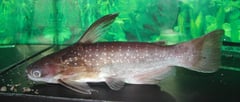
Auchenipterichthys coracoideusMidnight Catfish
Auchenipteridae · Eigenmann & Allen, 1942
The midnight catfish, Auchenipterichthys coracoideus, is an auchenipterid catfish from the Peruvian and Brazilian Amazon and the Essequibo drainage. Also known as the 'Zamora woodcat', it has often been misidentified as A. thoracatus, and the two differ principally in anal-fin ray count. By day it shelters among submerged roots, tree stumps or vegetation in turbid rivers and flooded areas, emerging to feed in open water at night.
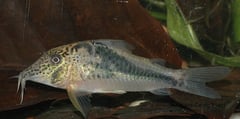
Corydoras fowleriFowler's Cory
Callichthyidae · Böhlke, 1950
Fowler's cory, Corydoras fowleri, is a long-snouted armoured catfish from the Amazon basin in Peru. Also known as the 'huanta cory' and 'milegros cory', it is often confused with C. coriatae and C. semiaquilus, and aquarium fish are regularly misidentified. Most long-snouted cories grow larger and are more aggressive than other Corydoras, and this one is suitable only for larger community aquaria.

Hyphessobrycon peruvianusPeruvian Tetra
Characidae · Ladiges, 1938
The Peruvian tetra, Hyphessobrycon peruvianus, is a characid known only from the upper Amazon basin in Peru. Popular in the trade, it is sometimes confused with H. loretoensis and H. metae and has repeatedly appeared under the latter name in aquarium literature. A more elongate body, a dark band reaching the tips of the median caudal-fin rays and red markings at the base of both caudal lobes set it apart.

Iguanodectes spilurusGreen Line Lizard Tetra
Iguanodectidae · Günther, 1864
The green line lizard tetra, Iguanodectes spilurus, is a characin found throughout the Amazon, Orinoco, Essequibo and Tocantins river systems. The most widespread Iguanodectes species, it has also been called the 'slender', 'spindle' or 'iguana' tetra, and differs from its congeners in its translucent dorsal and anal fins, lack of a red lateral stripe and prominent dark caudal-fin marking. It is sensitive to poor water conditions.
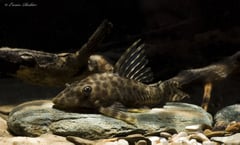
Peckoltichthys bachiL146
Loricariidae · (Boulenger, 1898)
The bola pleco, Peckoltichthys bachi, is a loricariid catfish from the upper Amazon region in Brazil, Colombia, Ecuador and Peru. It has been assigned several L-numbers, including L146 from Colombia and L232 from the Río Putumayo/Içá, and has been exported under other generic names including Hemiancistrus and Sophiancistrus. Its mottled colour pattern separates it from most Peckoltia species, and it lives among submerged grasses and branches in flowing water along the margins of medium to large rivers.
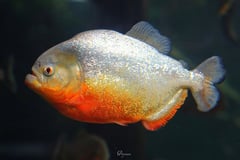
Pygocentrus nattereriRed Bellied Piranha
Serrasalmidae · Kner, 1858
The red bellied piranha, Pygocentrus nattereri, occurs through much of the Amazon basin and south into the Paraná and Uruguay river systems. Famed as a rapacious predator, it is among the most notorious freshwater fishes in the world. According to Herbert Axelrod (1976), the myth began with a feeding frenzy staged for Theodore Roosevelt in Brazil in 1913. Usually only juveniles form aggregations, and the species is relatively easy to breed in the aquarium.

Aequidens tetramerusSaddle Cichlid
Cichlidae · Heckel, 1840
The saddle cichlid, Aequidens tetramerus, is a cichlid found across much of northern South America, from the Amazon and Orinoco basins to the Guianas. The type species of its genus, it occurs in several colour forms, and fish from Ecuador and Peru are sought after for the red or orange colouration on the lower head and belly. As currently recognised it is likely to represent a group of related fishes, some of which may be described as distinct species.
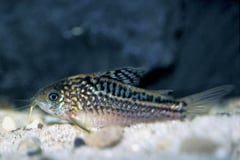
Gastrodermus elegansElegant Cory
Callichthyidae · (Steindachner, 1876)
The elegant cory, Gastrodermus elegans, long known as Corydoras elegans, is an armoured catfish from the western Amazon basin in Peru, Ecuador and Brazil. Unlike most congeners it spends a fair amount of time away from the substrate, often forming groups in midwater. It gives its name to the unofficial 'C. elegans group' of similar species, which includes G. nanus and G. undulatus plus many C- and CW-numbered fishes of uncertain status.