River
Karnali
Only species with a profile on Seriously Fish are counted.
- Species
- 6
- Families
- 4
- Photographed
- 6 of 6
- Difficulty rated
- 6 of 6
Shares fishes withspecies recorded from both
Runs through
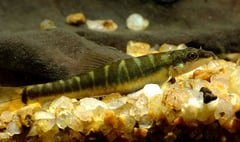
Acoura savonaHalf-banded Loach
Nemacheilidae · (Hamilton, 1822)
The half-banded loach, Acoura savona, is a nemacheilid loach from Ganges tributaries draining the eastern Himalayas in India, Nepal and Bangladesh. The species is seen in the trade fairly often and is sometimes sold as 'bicolor loach' in the United States. Its colour pattern of 9-10 thin, yellowish bars on a dark upper body, with plain whitish lower parts, separates it from similar loaches, and it is among the less aggressive of them.

Barilius shacra
Cyprinidae · (Hamilton, 1822)
Barilius shacra is a cyprinid from the Himalayan foothills of Nepal and northern India, in the Ganges and Brahmaputra systems, and from Bangladesh. Poorly known in the hobby but exported on occasion, it has around 12 vertical bars on each flank and a black band in the upper third of the dorsal fin. It inhabits well-oxygenated, fast-flowing rivers with gravel, cobble and boulder substrates, and is too fast and vigorous a feeder for the general community.

Esomus danricaFlying Barb
Cyprinidae · (Hamilton, 1822)
The flying barb, Esomus danrica, is a cyprinid with an enormous range across Pakistan, Nepal, Bangladesh, most of India, Myanmar and Sri Lanka. It shows a marked preference for shallow, slow-moving and standing waters such as rice paddies with dense vegetation, and is generally absent from major river channels. Reports on its suitability for community aquaria are mixed, with some keepers seeing a pronounced tendency to nip fins.

Channa maruliusBullseye Snakehead
Channidae · (Hamilton, 1822)
The bullseye snakehead, Channa marulius, is a large snakehead recorded from Pakistan across southern Asia to southern China, Laos and Vietnam. Also called the 'giant', 'cobra' or 'Indian' snakehead, it is widely accepted to represent a complex of related species in need of further research. Reports of 120-180 cm remain to be proven, with 500-600 mm a more common adult size, and it is suitable only for public installations or the very largest private aquaria.

Chitala chitalaIndian Featherback
Notopteridae · (Hamilton, 1822)
The Indian featherback, Chitala chitala, is a very large notopterid probably restricted to Pakistan, India, Nepal and Bangladesh. Its name has been widely misapplied in the trade, most often to the Southeast Asian C. ornata, but it is very rarely exported for aquaria and is fished and cultured for food in India. Growing to 1220 mm SL, it has non-ocellated black spots above the anal fin and is the only Chitala normally showing gold or silver bars on the back.

Labeo angra
Cyprinidae · (Hamilton, 1822)
Labeo angra is a benthic cyprinid from Pakistan, Nepal, northern India, Bangladesh and Myanmar, described from the Brahmaputra. It can be identified by a brownish back, yellowish flanks and belly, and a black to bluish stripe from the eye to the caudal-fin base. It undertakes annual spawning migrations within its native river systems.